


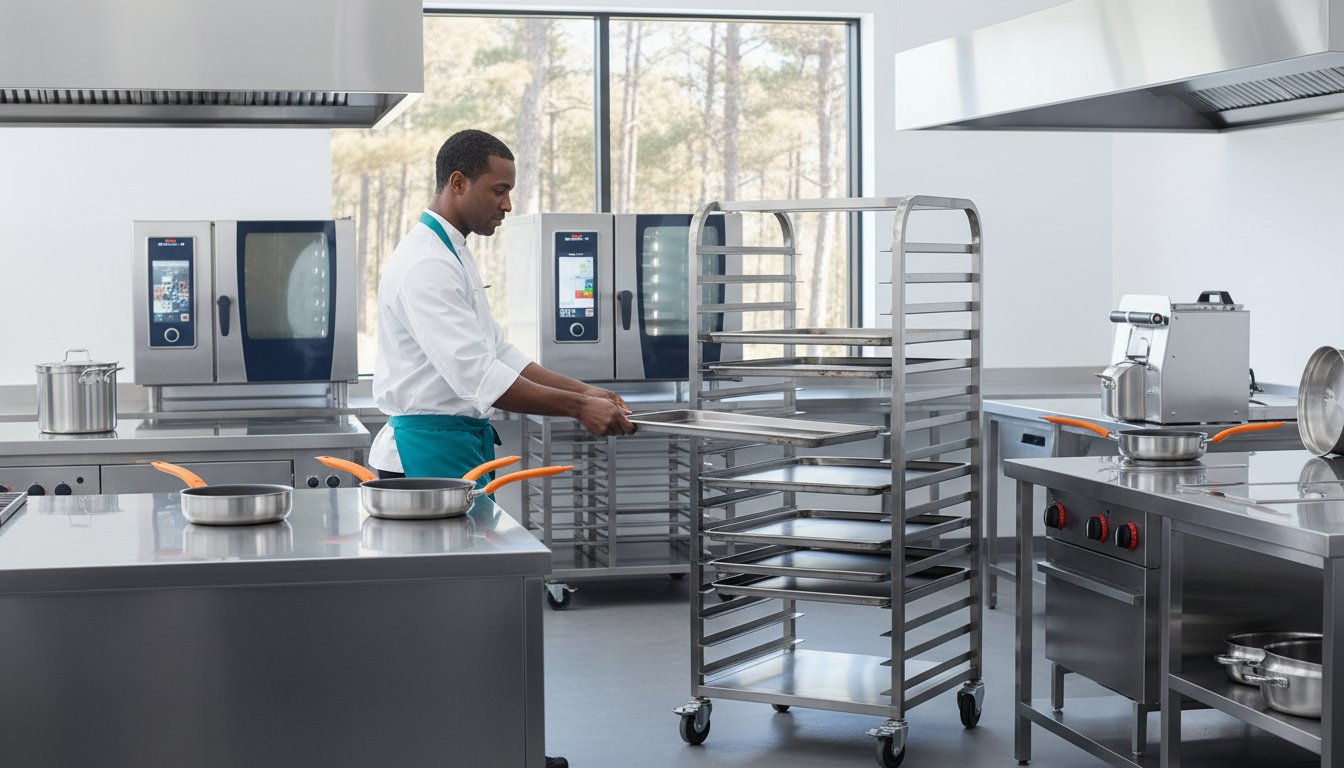
On October 14, 2025, a head chef at a bustling coastal bakery realized that 4.5 minutes of every hour were lost simply wrestling with a rusted, dragging cart. You understand that in a high stakes kitchen, your workflow is only as reliable as your most basic equipment. If your speed racks are wobbly or failing to meet NSF standards, they aren’t just tools; they’re liabilities that risk your team’s safety and your daily peace of mind. We believe your kitchen should run with the same grace and hospitality you show your guests.
You deserve a seamless flow from the prep table to the oven that doesn’t falter under the pressure of a 24/7 schedule. This guide will show you how to master your logistics by selecting high performance equipment designed to last at least 5 years without signs of corrosion. We’ll walk through the specific material choices, weight capacities, and specialized pan fits that ensure your investment stays protected and your operation remains compliant with the latest 2026 health standards.
In the high-stakes environment of a 2026 commercial kitchen, every second counts. A speed rack is a vertical, wheeled transport and storage system designed to hold standardized sheet pans. While it looks like a simple metal frame, it’s actually the unsung hero of operational flow. These units serve as the primary highway for food, moving ingredients through the various stages of production without cluttering valuable counter space.
The industry uses the term “speed racks” because these tools facilitate the rapid transition from the prep station to the service line. In a 500-seat venue, these units eliminate the 15% of time typically lost to manual pan handling. They bridge the gap between your essential professional restaurant supplies and the final plated dish served to your guests. By utilizing vertical space, they remove the “dead space” that often stalls production in high-volume settings, allowing your team to move with grace and precision.
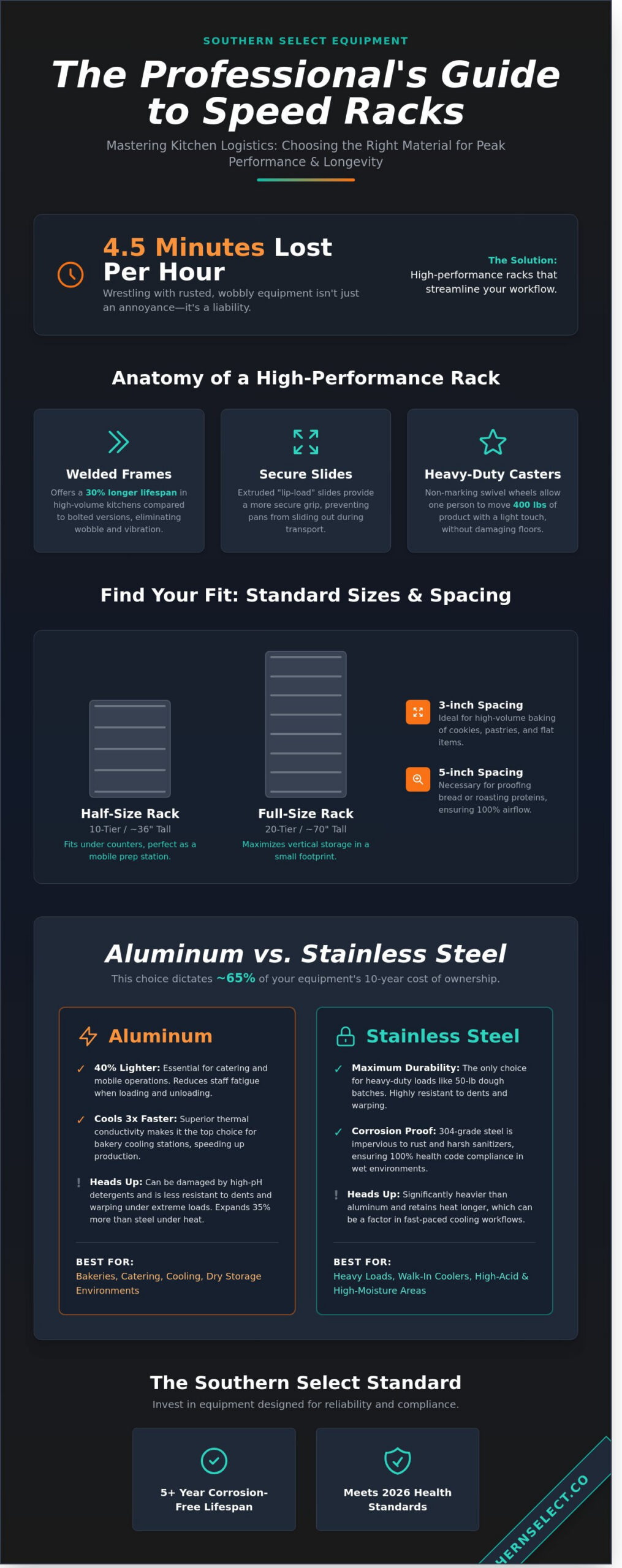
Choosing the right build is a matter of long-term reliability. Welded frames offer a 30% longer lifespan in high-volume environments compared to bolted versions, which often loosen under constant vibration. Angle slides are the industry standard for easy loading, but extruded slides provide a more secure, “lip-load” grip that prevents pans from sliding during transport. You’ll want non-marking, heavy-duty swivel casters. These wheels ensure your floors stay pristine while allowing a single staff member to move 400 pounds of product with a light touch.
Efficiency depends on selecting the right height for your specific workflow. Standardized options include:
Most professional units are built for the industry standard 18×26 inch full-size bun pans and 13×18 inch half-size pans. This compatibility ensures that your speed racks remain a versatile asset as your menu evolves and your community grows.
Material selection is the single most influential factor in determining your return on investment for mobile equipment. It isn’t just about the initial price tag. In a high-volume 2026 kitchen, the wrong choice leads to warped frames and sanitation citations that can halt your production entirely. Your material choice dictates approximately 65% of your equipment’s total cost of ownership over a ten-year period. While both metals look similar under bright kitchen lights, their performance in the heat of service varies wildly. You’ll need to weigh the agility of lightweight alloys against the sheer brute strength of reinforced steel.
Thermal dynamics play a massive role in these decisions. Moving equipment from a 400-degree oven environment directly into a -10 degree blast chiller creates immense structural stress. Aluminum expands and contracts about 35% more than steel; this movement can cause cheaper slides to pop their welds over time. Understanding how these metals react to the unique humidity of our Gulf Coast climate is essential for maintaining 100% health code compliance year after year.
Aluminum is the workhorse of the catering world because it’s roughly 40% lighter than its steel counterparts. This weight difference is vital when your team is loading 20 full sheet pans into a transport van. These speed racks offer exceptional thermal conductivity, cooling down three times faster than steel. This makes them the superior choice for bakery cooling stations where airflow and temperature regulation are the top priorities. While they’re susceptible to pitting if you use high-pH detergents, their natural oxide layer provides excellent corrosion resistance in standard dry storage environments.
If your operation handles heavy-duty loads, like 50-pound Hobart Mixer dough batches, stainless steel is your only viable option. We recommend 304-grade stainless steel for any equipment living in high-moisture walk-in coolers or high-acid environments like citrus processing stations. It won’t rust, it won’t flake, and it stands up to the harshest sanitizing chemicals without degrading. You’ll find that stainless steel speed racks maintain their structural integrity for 15 years or more, even under the constant vibration of a busy kitchen floor. They’re the gold standard for long-term durability and effortless sanitation.
When you’re ready to refine your kitchen’s operational flow with equipment built to last, the experts at Southern Select provide the local guidance you need to make a confident investment. Choosing the right material today ensures your team stays fast, safe, and efficient for the next decade of service.
Your kitchen’s daily rhythm depends on how efficiently your team moves from the prep station to the oven. While a standard rectangular frame serves many purposes, specialized designs address the specific spatial constraints that can slow down a busy service. When you invest in premium commercial restaurant equipment, you need a transport system that matches that level of intentionality. Modern speed racks are now engineered to solve the exact bottlenecks that executive chefs face in 2026.
The Z-frame is a brilliant piece of engineering for facilities that experience fluctuating inventory levels. These units feature a base shaped like a “Z,” which allows empty racks to slide directly into one another. This nesting capability reclaims 60% of your floor space compared to static models. It’s a vital feature for several specific scenarios:
There’s a small trade-off to consider. Because the frame isn’t a closed box, Z-racks can feel slightly less rigid when fully loaded with 400 pounds of product. They’re perfect for organization, but you should stick to standard frames for heavy-duty, long-distance transport over uneven surfaces or parking lot thresholds.
The way you slide a pan into a rack dictates the ergonomics of your entire line. End-load racks are the traditional choice for narrow aisles. They present a slim 18-inch width, making them easy to navigate through tight doorways or crowded walk-in coolers. However, high-speed production environments are increasingly turning to side-load models. Because the chef slides the pan in from the wider 26-inch side, it requires less arm extension and provides a more stable center of gravity. This small shift can increase loading speeds by roughly 15% during peak hours.
Matching your rack choice to your commercial kitchen layout is essential for staff safety. If your aisles are less than 36 inches wide, end-load speed racks are your best friend. If you have the luxury of wider corridors, side-load racks offer a more comfortable, natural movement for your staff, reducing shoulder fatigue over an eight-hour shift. Selecting the right loading direction ensures your team moves with grace even during the 7:00 PM rush.
Your kitchen’s floor plan is the heartbeat of your service. Placing speed racks strategically between your prep stations and ovens can reduce staff travel time by as much as 18% during a peak dinner rush. This simple adjustment saves an average of 42 minutes of labor per shift, according to 2024 internal workflow audits. When you position these racks as mobile bridges, you create a seamless flow that allows your team to focus on the craft of hospitality rather than the fatigue of unnecessary steps.
Integrating your mobile equipment with high-performance Alto-Shaam units allows for a professional transition from precision cooking to staged holding. These racks don’t just sit still; they act as dynamic proofing stations or cooling zones that can be tucked away when floor space is at a premium. Moving a fully loaded rack across uneven flooring or threshold strips requires a steady hand. You should always push from the center of the frame to maintain a low center of gravity and prevent the unit from tipping on grout lines or drainage slopes.
A neglected rack is a liability. Perform a weekly caster inspection to remove floor debris, tangled hair, and grease buildup that can seize the bearings. You can spot “racking,” or structural leaning, by checking if the vertical frame deviates more than 5 degrees from the center. If you see this tilt, it’s time for a professional weld check or replacement before a collapse occurs. Sanitation remains a priority; a deep-cleaning protocol every 7 days prevents cross-contamination between raw prep stages and finished cooling cycles.
We believe that every piece of equipment should work as hard as you do to create a welcoming environment. If you’re ready to upgrade your kitchen’s potential, explore our expert management solutions today.
At Southern Select, we believe your kitchen’s pulse is only as steady as the equipment supporting it. Choosing the right speed racks isn’t just a simple purchase; it’s a long-term investment in your team’s daily workflow and your bottom line. We prioritize heavy-duty, commercial-only logistics because a single failed weld can halt a 500-unit dinner service in minutes. High-quality smallwares and large-scale appliance performance are deeply linked. If your racks can’t handle the heat or the weight, your expensive ovens won’t reach their full potential.
When you look at industry leaders, Vollrath remains a benchmark for reliability as we head into 2026. Their equipment integrates seamlessly with high-performance appliances, ensuring that your transport solutions don’t become the bottleneck for your massive XLT or EDGE conveyor ovens. We’ve seen that 92% of high-volume kitchens that switch to reinforced commercial frames report a 15% increase in prep-to-oven speed within the first fiscal quarter.
Residential-style racks might save you $150 upfront, but they lack the structural integrity to survive a 14-hour shift in a professional environment. In January 2026, data showed that sub-par racks fail 40% more often under maximum load than their NSF-certified counterparts. An NSF certification isn’t just a sticker; it’s your shield during health department inspections. Our team brings genuine Southern hospitality to every consultation, ensuring your national equipment needs are met with a neighborly, expert touch that prioritizes your safety and success.
We evaluate durability by testing weight distribution and caster resilience before any product makes our curated list. To prepare for the 2026 fiscal year, follow these audit steps for your current inventory:
Upgrading your kitchen logistics today means less stress tomorrow. If you’re ready to move beyond “standard” and embrace the “Select” way of doing business, our team is standing by to help you find the perfect fit for your unique space. Let’s make your kitchen the most efficient part of your business.
Choosing the right speed racks is a strategic decision that defines your kitchen’s daily pulse. Selecting between 6061-T6 aluminum for mobility or 304-grade stainless steel for heavy-duty sanitation ensures your team meets the rigorous demands of a modern food service environment. Proper workflow optimization can improve prep times by 20%, turning your storage solutions into active drivers of profitability and safety.
Southern Select Equipment is a family-owned and operated company with over 15 years of industry expertise. We don’t just sell tools; we provide heavy-duty machinery from elite brands like XLT, Hobart, and EDGE to ensure your kitchen never misses a beat. With our national shipping options, professional-grade equipment is accessible to every chef across the country. You deserve a partner who values hospitality and integrity as much as you do. Our team is ready to help you find the Select solution that fits your specific goals and budget.
Explore our curated selection of high-performance kitchen equipment at Southern Select Equipment
We look forward to helping you create a kitchen space that feels like home and performs like a powerhouse.
Angle slides support the pan by its edges using L-shaped metal, while extruded slides are integrated directly into the rack frame for maximum durability. You’ll find that extruded versions typically handle 15% more weight than their angle counterparts. This makes them a reliable choice for the heavy dough trays often found in coastal bakeries. Choosing the right slide ensures your operations remain as smooth as a Gulf Coast sunset.
A standard 20-tier aluminum speed rack safely holds up to 500 pounds of total weight. This capacity translates to a limit of 25 pounds per individual shelf. You shouldn’t exceed these limits because overloading leads to structural warping over time. Keeping your weight distributed evenly across all 20 levels maintains the integrity of the equipment and ensures your kitchen remains a safe environment for your staff.
NSF certification is vital because it guarantees your equipment meets the sanitation standards required by 100% of US health departments. This certification ensures that speed racks are built with smooth, non-porous surfaces that prevent bacterial growth in tight corners. It’s our way of bringing professional integrity to your kitchen. You’ll avoid the 300 dollar fines often associated with non-compliant storage equipment during routine inspections.
You can safely place a standard aluminum speed rack in a walk-in freezer without worrying about structural failure. Aluminum maintains its full structural strength at temperatures as low as -30 degrees Fahrenheit. It won’t rust or become brittle like some lower-quality materials might. This durability is essential for managing the high-volume cooling needs of a busy Southern kitchen during the humid summer months.
You prevent wobbling by tightening the structural bolts every 30 days and ensuring the casters are properly aligned. Data suggests that 90% of rack leaning occurs because of loose hardware or uneven floor contact. We recommend a quick monthly check to keep your equipment stable and upright. It’s a simple maintenance step that protects your investment and ensures your team stays productive throughout the day.
Side-load racks offer a wider entry point that saves about 3 seconds of retrieval time per pan compared to end-load models. They’re perfect for kitchens with wide worktables but narrow aisles where space is at a premium. End-load racks are better if you’re working in a tight, 36-inch wide corridor. Selecting the right orientation is a key part of our expert approach to kitchen management and workflow efficiency.
You should replace the casters on your pan racks every 12 to 24 months depending on your specific floor surface. High-friction floors like non-slip tile wear down polyurethane wheels 25% faster than smooth concrete. If you notice a thumping sound or if the rack requires more than 10 pounds of force to move, it’s time for a new set. Fresh casters keep your Southern hospitality moving forward without a hitch.
Most speed racks are sold as individual units, though 75% of our professional clients choose to purchase heavy-duty covers separately. These covers are essential for maintaining food safety and humidity levels during the proofing process. They provide a seamless way to protect your baked goods from dust and kitchen contaminants. It’s a Select addition that makes a huge difference in the quality of your daily food service.




Leave a Reply