


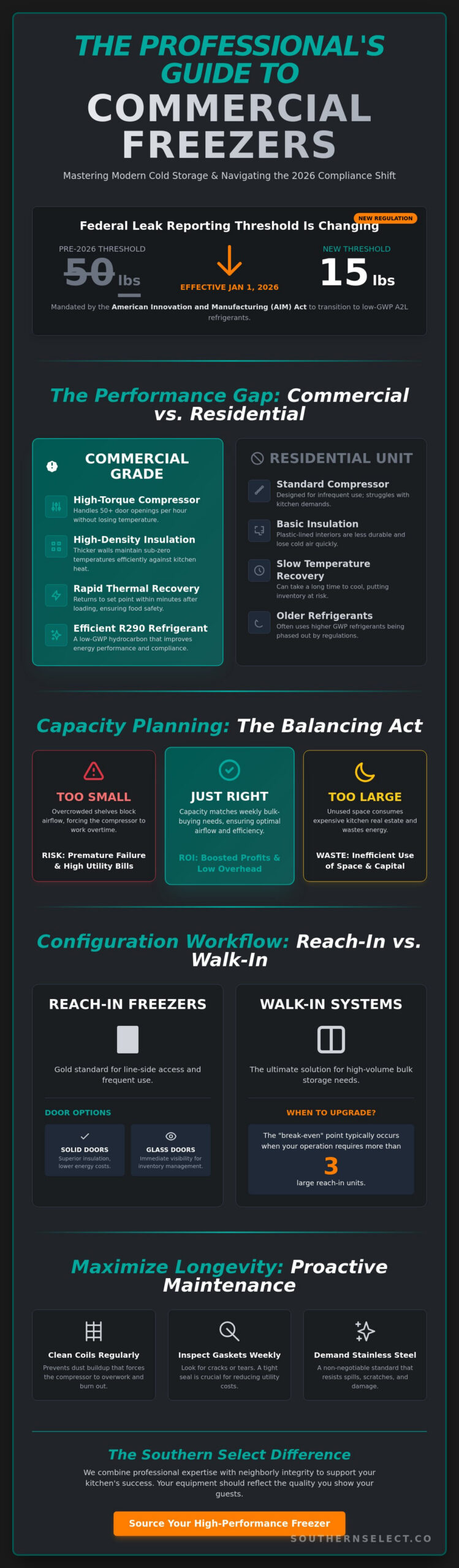
Did you know that as of January 1, 2026, the federal threshold for mandatory leak reporting for refrigeration systems dropped from 50 pounds to just 15 pounds? This regulatory shift means your selection of Commercial Freezers is no longer just a matter of floor space and cooling power. It’s now a critical decision involving the American Innovation and Manufacturing Act and the transition to low-GWP A2L refrigerants. We understand that as a professional, you’re looking for more than just a cold box. You want a reliable partner that keeps your ingredients at peak freshness while keeping your utility bills manageable.
Managing a busy kitchen is a high-stakes job, and you shouldn’t have to worry about compressor failures or storage shortages during your peak hours. You deserve equipment that reflects your commitment to quality and hospitality. This guide will help you master the complexities of modern cold storage and discover how to select the high-performance equipment your professional kitchen deserves. We’ll walk through the latest 2026 compliance standards and the smart features that ensure a seamless workflow for your entire team.
Choosing the right cold storage for your kitchen isn’t just about finding a place to stack boxes. It’s a fundamental shift from simply needing extra space to investing in the long-term performance of your business. In our years of serving the local culinary community, we’ve seen that a high-quality freezer acts as the heartbeat of a successful kitchen. It protects your inventory, ensures your guests’ safety, and keeps your workflow moving without a hitch during the busiest dinner rushes.
We believe in equipment that reflects the hospitality you show your guests. That’s why we focus on Commercial Freezers built with NSF International standards. These certifications ensure that every surface is easy to sanitize and designed for food safety compliance. Beyond the labels, look for heavy-duty stainless steel construction. It’s a non-negotiable standard for any kitchen that values longevity. Stainless steel resists the inevitable spills and scratches of a high-volume environment, making it much more durable than the plastic-lined units you might find in a home setting.
The difference between a residential unit and a professional one comes down to raw power and insulation. Home freezers are designed to be opened a few times a day, while a professional unit might face fifty door openings in a single hour. To handle this, commercial units utilize high-torque compressors that provide significantly more cooling capacity. Understanding Refrigeration principles helps explain why these systems require thicker, high-density insulation to maintain sub-zero temperatures against the heat of a working line. Thermal recovery in a 2026 kitchen is the mechanical ability of a unit to return to its set point within minutes after a heavy loading session or frequent door openings. Without this power, your food safety is at risk every time a cook reaches for an ingredient.
Getting your capacity right is a balancing act between floor space and inventory turnover. If you buy too small, you’ll end up overcrowding your shelves, which blocks airflow and forces the compressor to work overtime. This leads to premature failure and higher utility bills. Conversely, a unit that’s too large is just a waste of expensive kitchen real estate. We recommend calculating your cubic footage based on your weekly bulk-buying needs. Having the right amount of storage allows you to take advantage of seasonal pricing on local ingredients, which directly boosts your ROI. It’s about creating a seamless storage solution that grows with your menu while keeping your overhead low.
Every professional kitchen has its own unique rhythm. Your choice between different configurations of Commercial Freezers will dictate how smoothly your team moves during the peak of a dinner rush. It’s not just about how much food you can fit inside; it’s about how quickly your staff can access what they need without disrupting the flow of service. Selecting the right setup is a commitment to the long-term efficiency of your operation.
Reach-in units are the gold standard for line-side access. By placing your most frequently used ingredients right where your chefs need them, you eliminate unnecessary steps and keep the service window moving at a steady clip. These units come in single, double, and triple-door configurations, allowing you to scale your storage as your business grows. When choosing your model, consider the trade-off between solid and glass doors. Solid doors provide superior insulation and lower energy costs, while glass doors offer immediate visibility, which can be a lifesaver for inventory management during a hectic shift. If you are looking to coordinate your entire cold storage suite, you might also find our guide on Commercial Refrigerators helpful for maintaining a consistent look and feel in your kitchen.
There comes a point in every growing business where reach-in units are no longer the most cost-effective solution. This “break-even” point usually occurs when your bulk storage needs require more than three large reach-in units. Walk-in freezers offer massive capacity and allow for better organization of pallet-sized deliveries. Adhering to USDA refrigeration and food safety guidelines becomes much easier in a walk-in, as you have the space to properly rotate stock and ensure adequate airflow around every item. You’ll also need to decide between a self-contained system, which is easier to install, or a remote refrigeration system that vents heat outside of your building to keep your kitchen cooler.
For those managing tighter footprints, undercounter and worktop units offer a brilliant way to maximize utility. These specialized Commercial Freezers provide a sturdy surface for prep work while keeping frozen essentials just inches away from the chef’s hands. We also see many local cafes benefiting from dual-temp units. These versatile machines house both a freezer and a refrigerator in a single footprint, which is perfect for small-scale operations that prioritize flexibility. If you’re feeling overwhelmed by the options, our team at Southern Select is always here to act as your trusted local guide to help you find the perfect fit for your space.
Selecting the right technical specs for your Commercial Freezers often feels like a hurdle, but it’s really about ensuring your kitchen’s heart beats steadily for years to come. Once you’ve settled on a reach-in or walk-in configuration, it’s time to look under the hood at the components that define your daily operating costs and equipment lifespan. We believe that professional equipment should be a source of reassurance, not a cause for technical headaches.
The placement of your compressor is a decision that should be based entirely on your specific kitchen environment. Bottom-mount compressors are a favorite in high-heat Southern kitchens because they pull cooler air from the floor, where temperatures are naturally lower. They also offer easier maintenance access for your team and provide a bit of extra storage height for your staff. On the other hand, top-mount compressors are ideal for bakeries or pizza shops where flour and grease tend to settle on the floor. Because they are located at the top, they don’t suck in as much debris, which keeps the coils cleaner for longer. Choosing the wrong compressor location for your specific kitchen environment is the most frequent cause of premature mechanical failure and shortened equipment lifespan.
As we move through 2026, the industry is shifting toward eco-friendly cooling solutions that align with the latest Department of Energy conservation standards. One of the most significant changes is the adoption of R290 refrigerant. This highly refined propane has a Global Warming Potential (GWP) of just 3, making it a sustainable choice that also offers high energy efficiency. You’ll also want to look for variable speed compressors. Unlike traditional models that are either “all on” or “all off,” variable speed units adjust their power based on the actual cooling demand. This reduces the mechanical wear and tear caused by constant “cycling” and keeps your internal temperatures incredibly stable.
Energy consumption can account for 60-70% of a freezer’s total lifecycle cost. To protect your bottom line, prioritize Energy Star certified Commercial Freezers that utilize LED lighting and high-efficiency fan motors. These features might seem small, but they add up to substantial utility savings over the life of the unit. When combined with precise electronic temperature controls, you gain the peace of mind that your most delicate inventory is being kept in a perfect, high-performance environment that treats your ingredients with the same care you do.
Owning high-performance Commercial Freezers is a significant step toward kitchen excellence, but the work doesn’t end at the installation. To protect your investment and ensure your utility bills remain low, you must treat your equipment with the same care you show your guests. Neglecting basic maintenance is the quickest way to face a mid-service crisis. We want to help you avoid those high-stakes repairs by sharing the neighborly advice we’ve gathered over years of supporting professional kitchens. When you prioritize equipment health, you’re prioritizing the integrity of every dish you serve.
The most critical task is cleaning your condenser coils. These coils are responsible for releasing the heat pulled from inside the cabinet. When they’re covered in dust and grease, the compressor has to work twice as hard, leading to a premature burnout that can be incredibly costly. Similarly, a worn-out door gasket acts like a leak in your budget. A simple seal check can save hundreds in energy costs by ensuring the cold air stays exactly where it belongs. For a deeper look at keeping your entire operation running smoothly, explore our comprehensive commercial kitchen maintenance guide.
Proper loading is another often-overlooked factor. It’s tempting to pack shelves to the brim during peak hours, but overstocking blocks essential airflow. Without proper circulation, your unit will develop warm spots, putting your food safety compliance at risk. Keep items at least two inches away from the walls and fans to ensure a seamless cooling environment.
Consistency is the secret to equipment longevity. Every month, your team should perform a thorough coil vacuuming to remove debris that a simple brush might miss. Check your drain lines for any signs of standing water or ice buildup; these are early warnings of potential water damage. Finally, calibrate your internal thermometers. Even the most advanced Commercial Freezers can drift over time, and a one or two-degree difference can be the gap between perfect preservation and a food safety violation. If you find your current units are struggling to keep up, it may be time to browse our Southern Select equipment selection for a more reliable upgrade.
As of 2026, federal regulations have tightened, requiring mandatory leak repairs for any system with more than 15 pounds of refrigerant that exceeds a 20% leak rate. Identifying the signs of a refrigerant leak, such as oily residue around the lines or a sudden drop in cooling power, is now a legal necessity. If you notice the unit is running constantly but the temperature is rising, check the evaporator fan before assuming the thermostat is broken. Sometimes, a simple fan replacement can save a unit that seems destined for the scrap heap. However, if your repair costs are climbing toward 50% of the price of a new machine, it’s often more fiscally responsible to invest in a new high-performance unit that offers better energy efficiency and modern compliance.
Building a professional kitchen is a journey that requires more than just a list of appliances; it requires a partner who understands the unique rhythm of your business. At Southern Select, our philosophy is rooted in the same hospitality you show your guests every day. We treat every kitchen like it belongs to our own neighbor, offering the kind of reassurance and reliability that only comes from deep industry roots. When you choose your Commercial Freezers from our curated inventory, you aren’t just making a transaction. You’re entering a long-term partnership with a guide who cares about your success as much as you do.
We’ve built our reputation on “Select” sourcing. This means we purposefully ignore the “budget-friendly” units that fail when the heat rises and instead focus exclusively on professional-grade machinery. Our inventory is chosen for its ability to handle high-volume efficiency without flinching. We understand that a freezer doesn’t exist in a vacuum; it’s part of a larger ecosystem that includes your prep stations and your cook line. Whether you’re looking for Hobart Mixers to streamline your dough production or high-performance ovens to finish your signature dishes, our expertise across all categories informs every refrigeration recommendation we make.
Our sales process is consultative because we believe in getting the details right the first time. We help you size your freezer capacity based on your oven output and prep volume to ensure your workflow remains seamless. As a family-owned entity with a focus on integrity, we offer a steady and confident alternative to the frantic pace of national retailers. We’re here to help you navigate the 2026 compliance landscape with ease, ensuring your kitchen remains a place of calm competence even during your busiest shifts. Our commitment is to the long-term health of the hospitality industry, one reliable unit at a time.
If you’re ready to invest in equipment that matches your commitment to quality, we invite you to explore our current selection. We provide national shipping and professional support to ensure your new unit arrives ready to perform. Our team is standing by to provide the insider knowledge you need to make a choice you’ll be proud of for years to come. Don’t settle for standard market offerings when you can have a curated experience designed for excellence.
Explore Southern Select Commercial Freezers
Navigating the shift toward 2026 compliance standards and high-efficiency refrigerants is a significant step in protecting your culinary investment. By mastering the balance between thermal recovery power and smart maintenance habits, you ensure your kitchen remains a place of calm competence. We’ve seen how the right configuration and compressor placement can transform a chaotic line into a seamless workflow, allowing your team to focus on what they do best: providing exceptional hospitality.
Selecting the right Commercial Freezers is a decision that impacts your inventory quality and your utility bills for years to come. At Southern Select, we bring family-owned integrity and a national reach to every partnership, offering an expertly curated inventory that meets the demands of high-volume kitchens. We are proud specialists in top-tier brands like XLT and Hobart, and we’re ready to act as your trusted guide in finding the equipment your professional kitchen deserves.
Browse Our Professional Commercial Freezer Inventory
Your passion for excellence is the foundation of your business, and we are here to provide the reliable tools you need to see that vision through. Let’s build a more efficient, compliant, and successful future for your kitchen together.
The ideal operating temperature for a commercial freezer is between 0°F and -10°F. Maintaining this specific range ensures that your inventory remains frozen solid and prevents the growth of harmful bacteria. Keeping your unit at these levels balances food safety with energy efficiency, as temperatures lower than -10°F can cause unnecessary strain on your compressor.
You should clean your condenser coils at least once every 30 to 90 days depending on your specific kitchen environment. Kitchens with high levels of flour or grease, such as bakeries and pizza shops, often require monthly cleanings to prevent debris from choking the system. Regular cleaning keeps the air flowing freely and prevents the compressor from overheating or burning out prematurely.
Choose a solid door for maximum energy efficiency in the back-of-house or a glass door if you need immediate product visibility. Solid doors offer thicker insulation and are much easier to keep clean in a high-volume prep area. Glass doors are a better fit for front-of-house displays where staff or guests need to identify contents quickly without opening the door and losing cold air.
A self-contained system has the compressor and condenser built directly into the unit, while a remote system places those mechanical components outside your building. Self-contained Commercial Freezers are easier to install and can be moved if your kitchen layout changes. Remote systems are excellent for reducing the heat and noise levels inside your workspace, making the kitchen more comfortable for your team.
Water leaking on your floor is typically caused by a clogged drain line or a damaged door gasket. If the drain is blocked by food debris or ice, the water produced during the defrost cycle has nowhere to go and will pool at the bottom. Additionally, a faulty gasket allows warm air to enter, creating excess frost that eventually melts and leaks out of the cabinet.
High-quality Commercial Freezers typically last between 10 and 15 years when they receive consistent preventative maintenance. Factors such as the ambient temperature of your kitchen and the frequency of door openings will play a role in this lifespan. Investing in professional-grade equipment and staying on top of coil cleanings ensures you get the most reliable performance for your investment.
Most professional units require a dedicated circuit and a specific NEMA plug configuration that matches their voltage and amperage requirements. While smaller units might use a standard 115V outlet, larger three-door models or walk-ins often require a 208-230V connection. It is vital to check the manufacturer’s spec sheet before installation to ensure your kitchen’s electrical system can safely support the equipment.
Buying used equipment is often risky because you don’t have a verified maintenance history or a manufacturer’s warranty to protect you from hidden failures. With the 2026 transition to new A2L refrigerant standards, older units may also become more expensive to repair as parts and compliant refrigerants become harder to source. Choosing new equipment provides the reassurance of modern efficiency and long-term reliability for your business.




Leave a Reply