


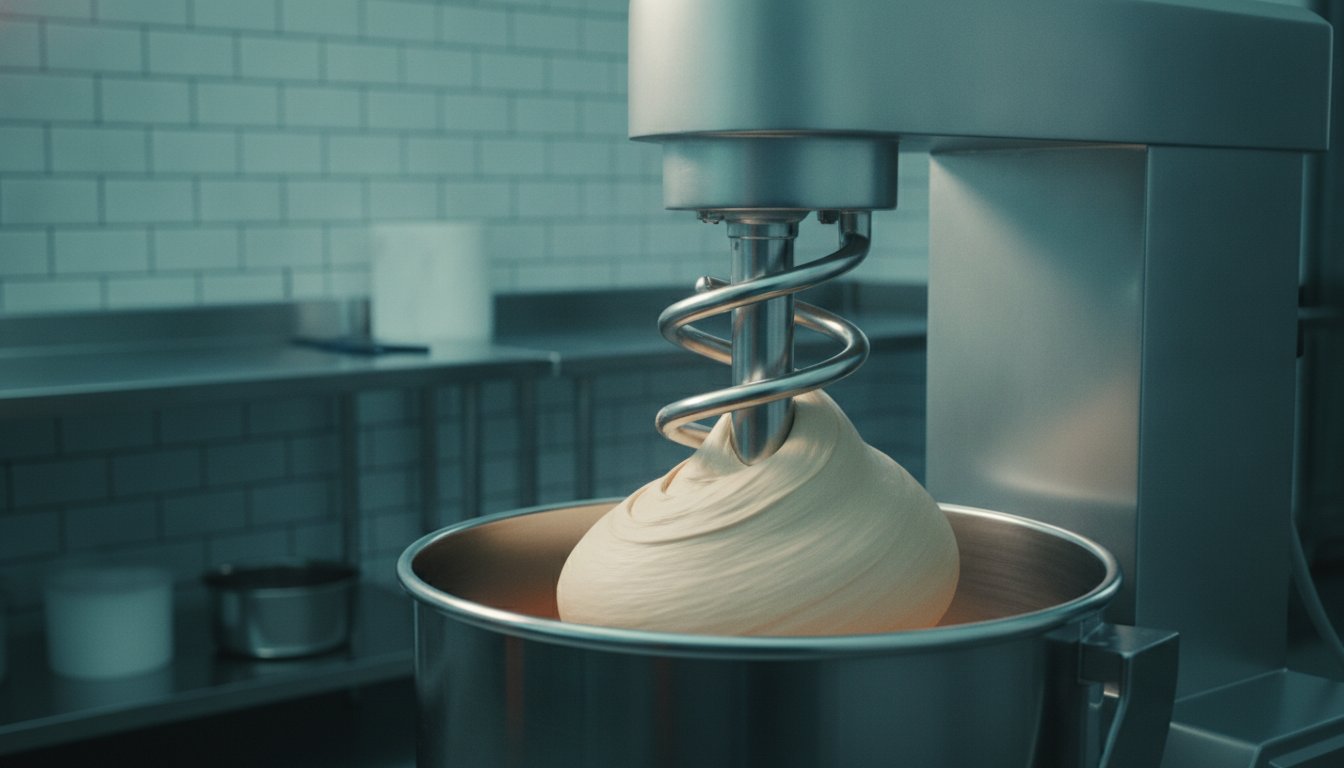
Your commercial dough mixer is more than just a piece of stainless steel in the corner; it’s the heartbeat of your production line where torque and durability decide if you can actually scale your menu. You’ve likely felt the sting of a motor smoking during a Friday night rush or the disappointment of a batch that just won’t reach that perfect gluten window. It’s a high-stakes environment, and you deserve equipment that feels like a reliable partner rather than a constant repair bill. We believe that true hospitality starts with having tools you can trust to perform every single day.
This guide will help you master the technical nuances of modern mixing technology to ensure your kitchen achieves perfect consistency and long-term operational efficiency. We’ll explore the critical differences between planetary and spiral units, the impact of the new NSF/ANSI 4-2025 sanitation standards, and how to identify high-volume equipment that retains its resale value. Whether you’re considering a legendary Hobart or preparing for the 2026 “electric-ready” energy codes, you’ll find the expert insights needed to keep your production seamless and your Gulf Coast community well-fed. Choosing the right machinery is a Select step toward ensuring your kitchen remains a reliable pillar of local hospitality for years to come.
Every successful kitchen begins with a vision of growth, but scaling that vision requires more than just a great recipe. It requires a mechanical partner that can keep up with the pace of your ambition. While a residential stand mixer is a wonderful tool for a home hobbyist, a true commercial dough mixer is an industrial engine designed for the relentless demands of a professional production line. In the high-stakes world of food service, the gap between “good enough” and “professional grade” is often measured in motor life and dough consistency. When you’re serving a community that values the warmth of Southern hospitality, providing a consistent, high-quality product isn’t just a business goal; it’s a promise to your neighbors.
As we move into 2026, the technology behind these machines is evolving to meet stricter standards. New regulations, such as the NSF/ANSI 4-2025 sanitation standards, are placing a higher premium on equipment that is easy to clean and built with food-safe materials. Choosing a high-quality mixer today means you’re not just buying a tool for this season, but investing in a long-term asset that will remain compliant and efficient as industry standards shift toward smarter, more sustainable kitchen operations.
Motor burnout is the primary reason new kitchens face unexpected downtime. Heavy, dense doughs used for pizza, bagels, or artisan breads put immense strain on a mixer’s internal gears. If your equipment isn’t rated for the specific torque required by your menu, the friction will eventually lead to a catastrophic failure. The cost of a breakdown isn’t just the repair bill; it’s the lost revenue from a halted production line and the potential damage to your reputation when you can’t deliver to your customers. Reliable equipment ensures your kitchen remains a steady, dependable presence in your local market.
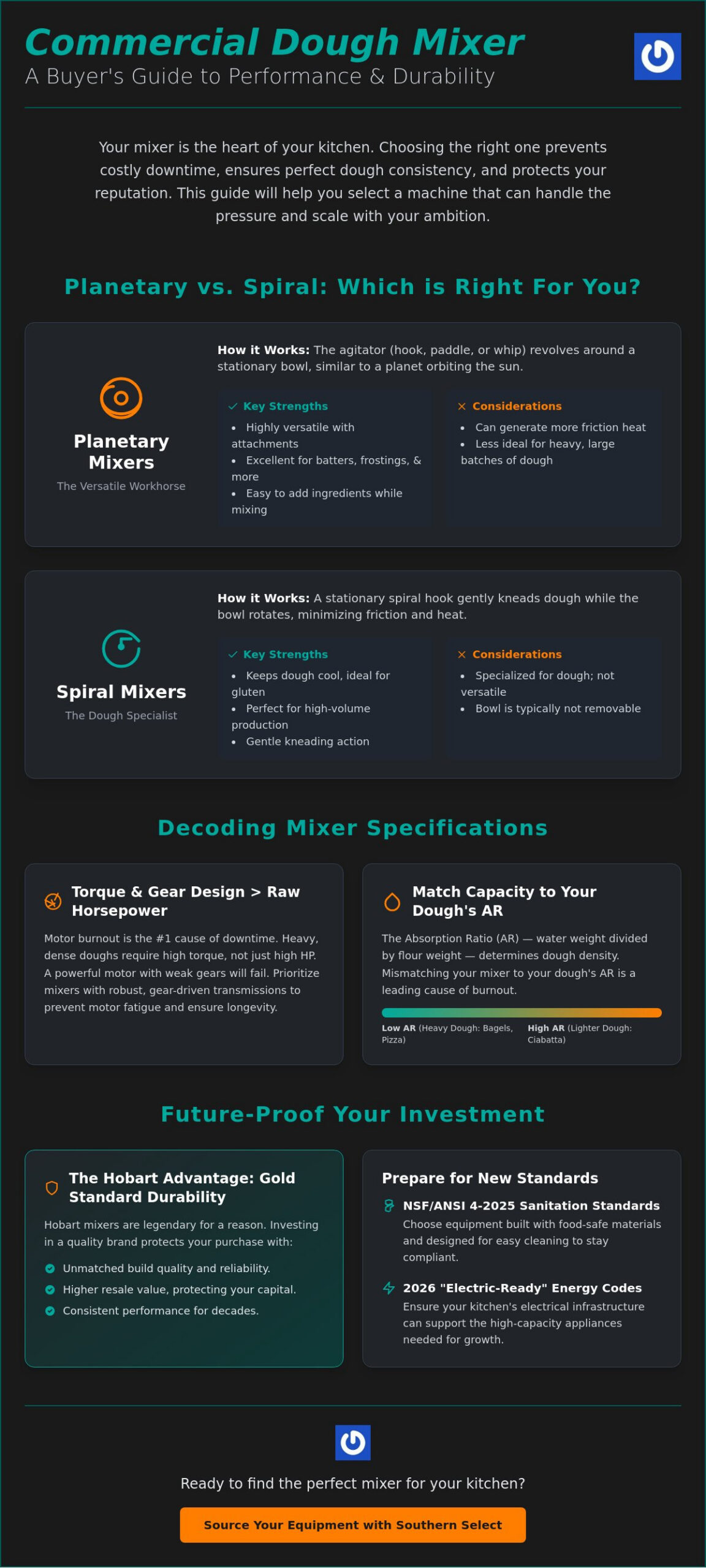
Before you select a commercial dough mixer, you must understand your dough’s Absorption Ratio (AR). This is the weight of the water divided by the weight of the flour. Lower AR percentages indicate “heavy” doughs that require more power to knead. You’ll also need to decide between Planetary vs. Spiral Mixers based on your primary output. While planetary mixers offer versatility for various attachments, spiral mixers are the champions of high-volume dough production because they generate less friction heat. Additionally, keep the 2026 Energy Code in mind; new projects are increasingly required to be “electric-ready,” so ensuring your electrical infrastructure can support high-capacity appliances is a vital first step in your planning process.
Selecting the right commercial dough mixer often comes down to the specific motion required for your recipes. It isn’t just about size; it’s about how the machine interacts with your ingredients. Planetary mixers operate much like their namesake, where an agitator revolves around a stationary bowl. Conversely, spiral mixers feature a rotating bowl that moves past a stationary spiral hook. This distinction might seem technical, but it fundamentally changes how your dough develops gluten and manages temperature during a long shift. Choosing the wrong movement can lead to inconsistent batches and frustrated staff, which is the opposite of the seamless experience we strive to provide in our kitchens.
In a high-volume environment, heat is often the enemy of a perfect rise. Spiral mixers are designed to keep dough cooler by minimizing friction. Because the bowl itself moves, the dough isn’t constantly being pummeled against the sides, which prevents the internal temperature from climbing too quickly. This efficiency is why high-volume pizzerias can produce large batches of dough without the risk of “pre-proofing” in the bowl. When you’re managing a busy kitchen, safety is just as vital as speed. Ensuring your team operates according to OSHA’s Machine Guarding Standard protects your staff while maintaining the steady flow of your production line. A safe kitchen is a hospitable kitchen, and protecting your team is a core value of any professional operation.
If your menu requires a diverse range of products, from whipped creams and batters to the occasional batch of cookie dough, a planetary mixer is likely your best ally. Its primary advantage is the #12 attachment hub. This allows you to transform your mixer into a vegetable slicer or a meat grinder, making it a true multi-tasker. For medium-sized operations that need versatility, a 20-quart or 60-quart planetary model provides the flexibility to handle various kitchen tasks without needing multiple specialized machines. It’s a reliable choice for those who want to offer a broad spectrum of dishes with that signature neighborly touch.
Serious pizzerias and artisan bakeries almost exclusively lean toward the spiral motion. These machines are built for high-torque kneading, allowing for superior gluten development without overworking the dough. One of the most significant benefits is the lack of “dead zones.” In a spiral mixer, the rotating bowl ensures that even small batches are mixed thoroughly, as the ingredients are constantly brought to the hook. This precision helps you maintain the high standards of quality your customers expect. If you’re looking for the right fit for your specific volume, you can explore our curated restaurant equipment to find a solution that matches your kitchen’s unique rhythm.
Sizing your equipment correctly is the difference between a kitchen that hums with efficiency and one that grinds to a halt. Many operators feel overwhelmed by the technical specifications, often confusing a bowl’s volume with its actual mixing capacity. While a manufacturer might label a commercial dough mixer by its quart size, that number only tells you the volume of the bowl, not the weight of the ingredients it can safely knead. In a high-volume environment, you must think in terms of pounds of finished product to avoid the mechanical fatigue that leads to premature motor failure. We want to ensure you feel confident in your investment, knowing your machinery can handle the weight of your community’s favorite recipes.
There is a common misconception that higher horsepower (HP) always translates to a better machine. This is the “Horsepower Myth.” In reality, raw wattage matters far less than the internal gear design and torque delivery. A lower-HP machine with a sophisticated gear-driven system often outperforms a high-wattage belt-driven unit when tackling dense, heavy doughs. When you’re evaluating equipment for a 2026 kitchen, you also need to account for the new “electric-ready” mandates. Most 20-quart to 80-quart units require specific NEMA plug configurations, so checking your electrical infrastructure before delivery is a vital step in ensuring a seamless installation.
Your dough’s density dictates how much your mixer can actually carry. The Absorption Ratio is the primary metric for mixer load management, calculated by dividing water weight by flour weight. If you’re working with a low AR, specifically under 50% for items like bagels or thin-crust pizza, you must de-rate your mixer’s capacity. For example, a machine rated for 60 pounds of standard bread dough might only safely handle 40 pounds of a low-moisture pizza recipe. Overlooking this calculation is the fastest way to smoke a motor and void your warranty.
Deciding between a countertop and a floor model depends on both your current volume and your physical space. While countertop units are excellent for small batches or specialty items, high-volume production almost always requires the stability of a floor-mounted commercial dough mixer. As you scale, consider the ergonomics of your staff. Manual bowl lifts are standard, but power lift systems can significantly reduce physical strain during long shifts, embodying the spirit of care we value in our professional communities. If your budget allows, buying one size up from your current needs is often the best long-term investment; it provides the headroom for growth and prevents the machine from constantly running at its absolute limit.
When you invest in a commercial dough mixer, the sticker price is only the beginning of the story. A truly “Select” experience means looking at the equipment as a long-term asset that supports your staff and satisfies your customers for decades. While budget-friendly imports might look tempting on a balance sheet today, they often lack the heavy-duty construction needed for high-volume production. Investing in a premium brand isn’t just about prestige; it’s about reliability and the peace of mind that comes from knowing your production line won’t fail during your busiest Saturday morning. High-end equipment retains its resale value far better than entry-level units, making it a smarter financial move for the stability of your business.
To keep your machinery running with professional integrity, preventative maintenance is non-negotiable. Regular oil changes for the transmission, inspecting the bowl seals for leaks, and ensuring the planetary gears are properly lubricated will extend the life of your machine by years. These simple steps prevent the friction heat we discussed earlier from damaging internal components. When you treat your equipment with care, it returns the favor by providing the seamless service your community expects from a local staple.
Hobart has long been the gold standard in professional kitchens, primarily due to their robust gear-driven designs. Unlike belt-driven alternatives that can slip or snap under high torque, Hobart’s all-gear transmissions provide the consistent power required for dense doughs. Another massive advantage is parts availability. Because these machines are so prevalent, finding a technician or a replacement seal is a simple, neighborly process rather than a logistical nightmare. You can learn more about these industry workhorses in our guide to Hobart Mixers. Choosing a brand with this kind of history ensures you aren’t just buying a machine, but joining a legacy of quality.
As we approach 2026, safety features are more than just a suggestion; they’re a requirement for a modern, hospitable workplace. Interlocked bowl guards are essential for compliance, ensuring the motor stops the moment the cage is opened. No-volt release switches prevent the commercial dough mixer from accidentally restarting after a power flicker, while thermal overload protection guards the motor from burning out during an accidentally heavy batch. These features protect your most valuable asset: your people. If you’re ready to secure a machine that balances safety with power, browse our expert-vetted restaurant equipment to find your next kitchen partner.
Navigating the technical specifications of a commercial dough mixer can feel like a daunting task, but you don’t have to do it alone. At Southern Select, we view every equipment purchase as the beginning of a long-term partnership. We aren’t just selling machinery; we’re helping you build the foundation of your business with professional integrity and a neighborly touch. Our goal is to ensure that the equipment you choose today will support your growth well into 2026 and beyond, providing the reliability you need to serve your community with confidence.
Our curated inventory features industry leaders like XLT, EDGE, and Hobart. These brands are chosen because they represent the pinnacle of high-volume success and durability. Whether you’re looking for the high-torque precision of a Hobart mixer or the integrated efficiency of our conveyor and pizza oven lines, we provide the expert guidance needed to make the right choice. We understand that your kitchen is a high-stakes environment, and we’re committed to making your acquisition process as smooth and reassuring as possible.
Matching your specific menu to the right mechanical specifications is where our team truly shines. We don’t believe in one-size-fits-all solutions. Instead, we offer expert consulting that considers your dough’s absorption ratio, your daily volume, and your future scaling goals. Your mixer doesn’t exist in a vacuum; it needs to work in harmony with your entire line of commercial restaurant equipment. By taking a holistic view of your operation, we help you avoid the common pitfalls of underpowered motors or mismatched capacities. This level of personalized service is the hallmark of Southern hospitality, ensuring you feel like you’re in capable, friendly hands from the first consultation to the final installation.
Your next commercial dough mixer is more than an expense; it’s a long-term profit center that dictates the quality and consistency of your signature dishes. By prioritizing durability and gear-driven power, you ensure that your kitchen remains a steady, reliable pillar of the local food scene. We invite you to move beyond the stress of equipment failures and embrace a future of seamless production. When you’re ready to invest in excellence, we’re here to provide the insider’s knowledge and stable partnership you deserve. Browse our current selection of professional mixers today and let’s start building a kitchen that reflects the high standards of your craft.
Choosing the right equipment is about more than just checking boxes; it’s about setting a foundation for your staff and your customers to thrive. By matching your signature recipes to the correct mechanical motion and respecting the technical limits of your absorption ratio, you ensure your commercial dough mixer remains a reliable asset for years to come. Quality machinery from trusted names like Hobart and XLT provides the durability needed to withstand the high stakes of a busy production line while maintaining significant value over time. You’ve worked hard to build your menu, and your equipment should work just as hard to protect it.
As a family-owned business with national reach and deep roots in professional hospitality, Southern Select is here to offer the expert technical guidance your high-volume kitchen deserves. We take pride in our integrity and our status as an authorized dealer for the industry’s most reliable brands. Our team is ready to help you navigate the nuances of the 2026 market so you can focus on what matters most: serving your community with excellence. We look forward to helping you create a kitchen that is as efficient and welcoming as the food you serve.
Explore Our Curated Selection of High-Performance Mixers
Gear-driven mixers use internal metal gears to provide direct, high-torque power to the agitator. This design is superior for heavy doughs because it won’t slip under pressure. Belt-driven models use rubber belts to transfer power, which are quieter and often cheaper to repair but can slip or snap during a heavy shift. For high-volume success, a gear-driven commercial dough mixer is usually the most reliable investment for your kitchen.
You can use a 20-quart mixer for pizza dough, but you must limit your batch size to avoid straining the motor. Pizza dough typically has a low absorption ratio, meaning it is dense and heavy. A 20-quart bowl might only safely handle 10 to 12 pounds of dough depending on the moisture content. Always consult your manufacturer’s capacity chart to ensure you aren’t pushing the machine beyond its intended limits.
Most commercial floor mixers require a 208V or 240V electrical connection, often using a three-phase power supply for maximum efficiency. Smaller countertop units might run on standard 120V power, but high-capacity 60-quart or 80-quart models need dedicated circuits and specific NEMA plug configurations. It’s vital to have a licensed electrician verify your kitchen’s infrastructure before your equipment arrives to ensure a seamless and safe installation process.
You should generally change the transmission oil in your mixer once a year or after approximately 2,000 hours of operation. Regular oil changes prevent metal-on-metal friction from damaging the gears. If you notice the oil looking dark or smelling burnt during a routine inspection, it is time for a refresh. Consistent maintenance is a hallmark of professional integrity and protects the long-term resale value of your equipment.
The absorption ratio (AR) is vital because it tells you exactly how much weight your motor can handle without overheating. A lower AR means the dough is stiffer and harder to knead, which puts more stress on the gears. If you ignore the AR when choosing a commercial dough mixer, you risk buying a machine that is technically large enough but mechanically underpowered for your specific recipes.
Bowl guards are indeed mandatory for commercial mixers in 2026 to meet current OSHA safety standards and NSF/ANSI 4-2025 requirements. These interlocked cages prevent accidental injuries by stopping the motor immediately if the guard is opened. Modern designs are now more user-friendly, featuring easy-to-clean materials that help you maintain a hospitable and safe environment for your staff without slowing down your production speed.
The most useful attachments for a planetary mixer are those that fit the #12 attachment hub, such as meat grinders and vegetable slicers. These tools allow your mixer to function as a versatile multi-tasker in a busy kitchen. You can quickly shred cheese for pizzas or grind meat for signature sauces without needing additional standalone appliances. This versatility makes the planetary model a favorite for multi-product bakeries and restaurants.
You will know your motor is being overloaded if you hear a high-pitched squealing sound or notice the agitator slowing down significantly during the mix. Most modern machines also feature thermal overload protection, which will automatically shut the unit off to prevent permanent damage. If your mixer trips frequently, it is a clear signal that your batch size is too large or your dough is too dense for the machine’s capacity.




Leave a Reply