


Imagine it is 7:00 PM on a Friday night and your kitchen is at absolute capacity. Your staff is hustling, but the pizzas coming out of your current setup are inconsistent, with some charred and others doughy. You know that maintaining a perfect crust during a high-volume rush shouldn’t feel like a gamble. It is deeply frustrating to watch your profit margins shrink because of rising energy bills or the urgent need to find a new conveyor pizza oven that actually fits your limited floor space. We believe that professional equipment should offer reassurance, not a headache.
At Southern Select, we understand that your restaurant is a place where quality and hospitality meet. This guide will help you select the ideal oven to maximize your kitchen’s throughput and long-term profitability. We will explore the latest 2026 innovations, including the new XLT J-Version and Lincoln’s FastBake technology, to ensure you achieve push-button consistency and lower labor costs. From Energy Star 3.0 efficiency to the reliability of brands like EDGE, we are here to act as your trusted local guide in building a seamless, high-performance kitchen that serves your community for years to come.
Growing a successful pizzeria is a journey that often begins with a single deck oven and a passion for the craft. As your community grows and your tables fill up, you might find that your manual equipment is struggling to keep pace with your ambition. Moving toward a professional conveyor pizza oven represents a significant milestone in your business. It is the moment you transition from a manual, artisan-dependent process to a sophisticated, scalable production engine. This evolution doesn’t mean you are sacrificing the soul of your pizza; rather, you are ensuring that every neighbor who walks through your door receives the same high-quality experience, regardless of how busy the kitchen gets.
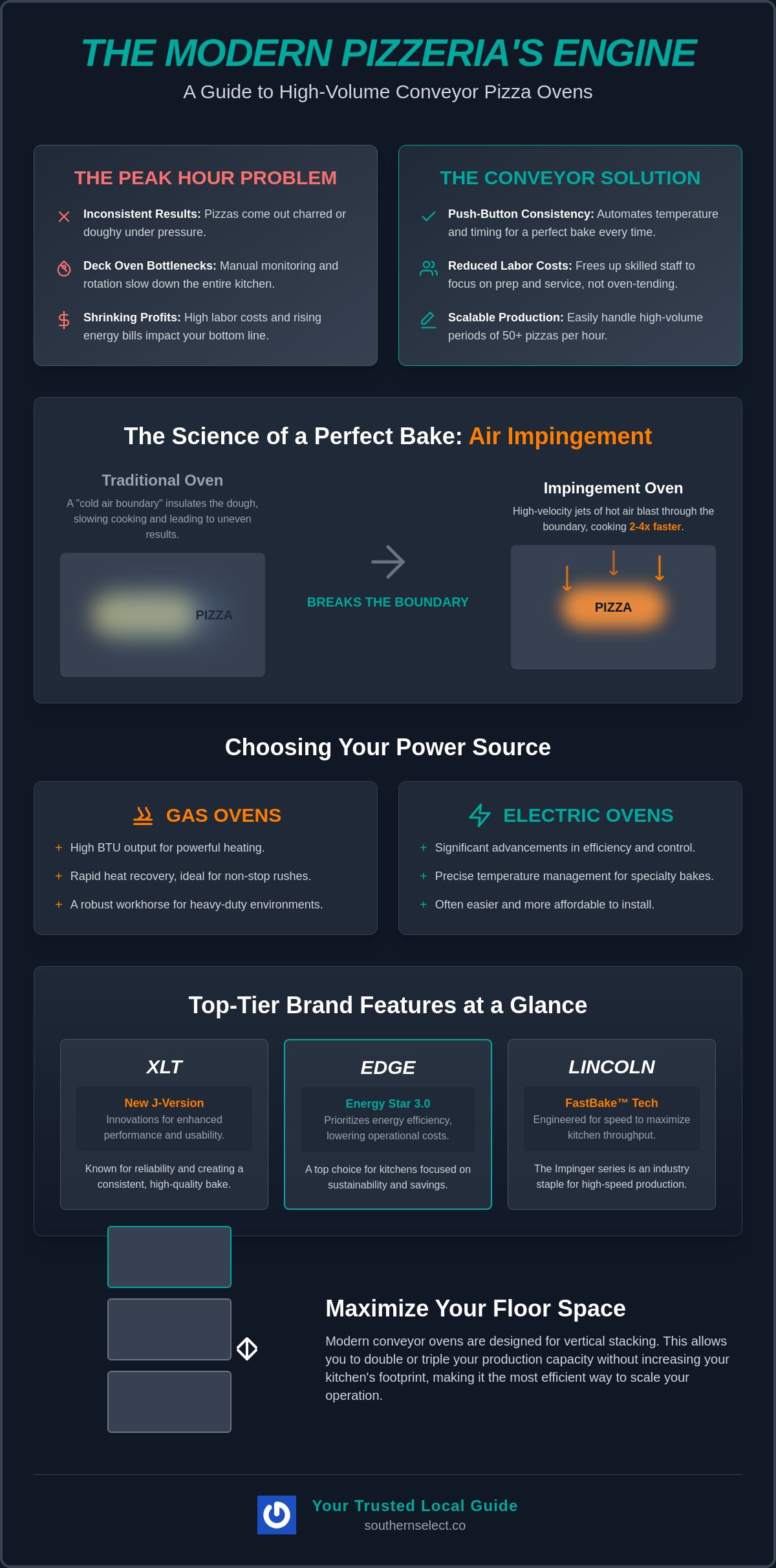
In a high-efficiency kitchen, the oven functions much like a specialized conveyor processing line, where timing and temperature are locked in with surgical precision. While deck ovens require a skilled operator to constantly monitor, rotate, and “deck” pizzas to manage hot spots, conveyor technology automates these variables. This allows your team to focus on prep and hospitality rather than managing a temperamental fire. By acting as the heart of your kitchen, these systems provide a steady rhythm that keeps the entire operation moving forward without the frantic energy of a back-logged ticket rail.
Deciding to upgrade is usually driven by your ticket times. If your peak-hour wait times are stretching past twenty minutes because your oven capacity is full, you are likely losing repeat business. A conveyor system eliminates the “bottleneck at the hearth” by providing a continuous flow of perfectly baked product. This automation also drastically reduces labor costs. You no longer need a highly paid master baker on every shift to manage the bake. Instead, you can rely on push-button consistency that ensures a great crust even when you are training new staff members.
High-volume production is typically defined by kitchens pushing fifty or more pizzas per hour during peak periods. For successful franchises and growing local favorites, consistency is the primary driver of brand loyalty. Customers expect the same crunch and melt every time they order. If you are looking to expand your footprint, checking out a comprehensive commercial restaurant equipment guide can help you understand how to balance your oven choice with other vital components like refrigeration and prep space. Choosing the right scale now prevents the need for a costly, disruptive upgrade just a year or two down the road.
To get the most out of your conveyor pizza oven, it helps to understand the specialized engineering that makes these machines so reliable. Most modern commercial units utilize air impingement technology to achieve their results. Air impingement is a method using high-velocity jets of hot air to cook food 2-4 times faster than traditional ovens. This process isn’t just about raw speed; it’s about the precision of heat transfer. When raw dough enters a heated chamber, a thin layer of stagnant, cooler air naturally surrounds it. This “cold air boundary” acts as an insulator, often slowing down the bake and leading to soggy crusts in lesser equipment.
Impingement fingers solve this problem by blasting through that boundary with targeted columns of pressurized heat. When comparing impingement vs. convection ovens, the primary difference is the velocity and direction of the air. While standard convection relies on gentle circulation, impingement technology ensures that heat hits the product directly and consistently. By fine-tuning your belt speed and temperature, you create a repeatable “set and forget” environment that guarantees the same quality at 1:00 PM as you get at 8:00 PM.
Choosing between gas and electric power usually depends on your building’s infrastructure and local utility costs. Gas-fired models are famous for their high BTU output and rapid heat recovery times, making them a staple for heavy-duty environments. They provide a robust heat that stands up well to constant use. Modern electric models have advanced significantly, offering incredible precision and a cleaner heat profile. They are often easier to install in urban locations with strict venting requirements. As energy efficiency standards evolve, many operators find that high-efficiency electric units offer the reliability they need with a lower environmental footprint.
The interior of a high-end oven is a masterpiece of airflow management. Removable fingers allow you to customize the airflow patterns, directing more heat to the bottom for a crispy crust or to the top for perfectly melted cheese. Durability is another cornerstone of professional design. Heavy-gauge stainless steel dominates the industry because it handles the constant thermal expansion of a 500-degree kitchen without warping. If you are looking for a partner to help you navigate these technical choices, you can browse our curated equipment selection to see how these features translate to real-world performance.
Choosing a conveyor pizza oven is a significant investment in your brand’s future. At Southern Select, we don’t just sell equipment; we curate a selection of brands that embody the reliability and hospitality we value. We focus on XLT and EDGE because they consistently deliver the performance national operators and local favorites demand. While each manufacturer offers unique advantages, they all share a commitment to durability that ensures your kitchen remains the heart of your community. We believe in providing tools that make your job easier, allowing you to focus on the people you serve.
XLT Ovens built their reputation on the motto “simple, smart, and durable.” Their engineering focuses on minimizing downtime through tool-less cleaning and maintenance features. The 2026 J-Version model has taken this further with a front-removable conveyor system and an error-proof finger arrangement that prevents mistakes during reassembly. This level of thoughtfulness is why XLT is the preferred choice for major national pizza chains. Beyond ease of use, their patented exhaust systems offer remarkably quiet operation, which significantly improves the working environment for your team.
If your priorities are precision control and lower utility bills, EDGE Ovens are an exceptional choice. Their “G2” technology is designed to maximize combustion efficiency, ensuring you get the most out of every BTU. The Science of Impingement plays a major role here, as EDGE units are engineered to reduce ambient heat loss. This keeps your kitchen cooler and reduces the strain on your HVAC system. Their precision belt controls also make them incredibly versatile, allowing you to perfect a varied menu that includes toasted subs and appetizers alongside your signature pies.
Lincoln Impinger is the legacy brand that originally pioneered impingement technology. Their 1100 and 1400 series remain industry staples because of their proven versatility. While they are world-class pizza machines, they excel at cooking proteins and complex appetizers that require specific heat profiles. When equipping a high-volume commercial kitchen, having an oven that can handle diverse menu items without sacrificing speed is a massive advantage. Whether you are a traditional pizzeria or a multi-concept venue, these brands offer the reassurance that your equipment will perform under pressure, day after day.
Selecting the right conveyor pizza oven requires a careful look at your kitchen’s physical footprint and your long-term production goals. It’s not just about finding a machine that cooks well; it’s about ensuring the unit integrates seamlessly into your workflow. As your trusted local guide, we want to help you avoid the common mistake of buying an oven that is either too small for your Saturday night rush or too large for your ventilation hood. Planning for your kitchen’s future means choosing equipment that can grow alongside your community’s appetite.
The width of your conveyor belt is the primary factor in determining your kitchen’s maximum capacity. Entry-level models often feature an 18-inch belt, which is excellent for tight spaces or low-volume cafes. However, most high-volume pizzerias find their sweet spot with a 32-inch or 40-inch belt. A 32-inch belt can typically produce 70-100 large pizzas per hour depending on bake time. Beyond width, you must consider the chamber length. A longer chamber allows the belt to move faster while still ensuring a thorough bake, which is essential for maintaining speed when the ticket rail is full. Matching these dimensions to your specific pizza size ensures you aren’t leaving empty space on the belt or causing a bottleneck during peak hours.
If you have limited floor space but high demand, vertical growth is your best strategy. Most professional conveyor units are designed to be stacked in double or triple configurations. This allows you to double or triple your output without taking up an extra inch of floor space. One of the greatest advantages of stacking is the ability to use independent controls for each deck. You might set the top oven for your signature thin-crust pizzas while using the bottom deck at a lower speed for toasted subs or heavy deep-dish pies. When planning a triple-stack, you’ll need to ensure your flooring can handle the concentrated mechanical weight and that your kitchen’s airflow can manage the increased heat load from multiple units operating simultaneously.
Your choice between gas and electric models will also dictate your venting requirements. Gas ovens almost always require a Type I hood to manage grease and products of combustion, while some modern electric models may qualify for Type II hoods or even ventless operation in specific jurisdictions. Always consult local codes, such as the 2025 California Mechanical Code (CMC) if applicable, to ensure your installation is compliant. Beyond the hood, don’t forget to account for clearance. You’ll need enough room on both the loading and unloading sides for your staff to work safely without bumping into other equipment. If you’re ready to find the perfect fit for your space, you can view our restaurant equipment options to see the dimensions and specs of our curated lineup.
Choosing a piece of equipment is about more than just checking specifications on a website. It’s about finding a partner who understands that your kitchen is the heartbeat of your business. A high-quality conveyor pizza oven represents a significant capital investment, and we believe you deserve the reassurance that your choice will pay dividends for years. Unlike generic wholesalers who focus only on the transaction, Southern Select prioritizes a neighborly approach. We’ve seen how the right equipment can transform a struggling kitchen into a high-throughput engine of success, and we are dedicated to helping you reach that goal with integrity and expertise.
While the initial price tag of a premium oven might be higher than entry-level alternatives, the total cost of ownership tells a different story. High-end brands like XLT and EDGE are engineered to save you money every day through superior thermal retention and reduced mechanical downtime. When you invest in professional-grade machinery, you are buying reliability that prevents the nightmare of a broken oven during your busiest shift. Our team acts as your trusted local guide, ensuring you select a model that balances your current budget with your future growth aspirations.
A great bake starts long before the pizza hits the belt. If your dough isn’t consistent, even the most advanced air impingement technology will struggle to deliver a perfect crust every time. This is why we emphasize the synergy between your oven and your prep station. Using industry-leading Hobart Mixers ensures that your hydration and gluten development are identical every single day. When you pair a perfectly mixed dough with the precision of a modern conveyor system, you create a seamless workflow that removes the guesswork from your operation. This level of consistency is exactly what builds a loyal customer base in a competitive market.
We use the word “Select” for a reason. Our inventory isn’t a random collection of brands; it’s a curated list of the most reliable names in the industry. We only carry equipment that we would trust in our own kitchens, focusing on durability and professional service. Our commitment to Southern hospitality means we are here to provide more than just a box on a pallet. We offer the expert management and local insight that national operators and independent pizzerias alike need to thrive. If you’re ready to upgrade your infrastructure and experience the peace of mind that comes with professional equipment, we are ready to help you take that next step toward a more profitable future.
Your journey toward a more efficient kitchen begins with a single, well-reasoned decision. By understanding the science of air impingement and the logistical benefits of vertical stacking, you’ve equipped yourself with the knowledge to support your team. A high-performance conveyor pizza oven is more than just a purchase; it’s a commitment to the consistency that defines your brand. Reliability matters. Whether you are scaling a local favorite or managing a national franchise, the right equipment ensures every guest receives the high-quality experience they expect.
At Southern Select, we bring decades of experience in high-volume hospitality to every partnership. As an authorized dealer for XLT and EDGE, we offer expert guidance on national equipment logistics to ensure your transition is seamless. We are here to act as your trusted local guide, providing the reassurance you need to thrive in a competitive market. We invite you to browse our curated selection of professional conveyor ovens and discover how the right tools can transform your daily operations. We look forward to helping you build a kitchen that serves your vision for years to come.
A conveyor oven uses a motorized belt to move pizzas through a heated chamber, while a deck oven requires a chef to manually place and rotate pizzas on a hot stone surface. The conveyor system provides push-button consistency and high-volume throughput without the need for constant monitoring. This automation makes it easier to train new staff and ensures every pizza is baked identically, even during your busiest shifts.
A 32-inch conveyor pizza oven typically produces between 70 and 100 large pizzas every hour, depending on your specific dough thickness and bake time. This capacity is a significant step up from smaller 18-inch models and is designed to handle the heavy demand of a Friday night rush. If you need even more production, these units can be stacked to double or triple your output in the same floor space.
Venting requirements for electric models depend on your local building codes and the specific ingredients you are cooking. While some electric ovens are marketed as ventless, many jurisdictions still require a Type II hood to manage ambient heat and moisture. It’s always best to consult with a local professional or check the 2025 California Mechanical Code standards to ensure your kitchen remains safe and compliant.
You can bake a wide variety of items including toasted sandwiches, wings, appetizers, and even certain desserts. The adjustable belt speed and temperature settings allow you to fine-tune the environment for different recipes. This versatility makes the conveyor pizza oven a multi-functional asset that can support an entire menu beyond just your signature pies, maximizing your return on investment.
XLT ovens are engineered for simple, tool-less maintenance that your team can perform daily. The 2026 J-Version models feature front-removable conveyors and an error-proof finger arrangement system to make cleaning straightforward. Regularly emptying the crumb trays and wiping down the stainless steel surfaces will prevent grease buildup and keep your equipment running reliably. We recommend a professional inspection once a year to check the mechanical components.
Most commercial units require about 20 to 30 minutes to reach their full operating temperature and achieve thermal stability. It’s a good practice to start the preheat process well before your first ticket arrives so the internal components are thoroughly saturated with heat. Once the oven reaches your set point, the air impingement system maintains that temperature consistently, even when the belt is fully loaded with cold product.
Gas models are often favored for their high BTU output and rapid heat recovery, making them very efficient for high-volume operations. However, electric ovens have become much more competitive under the Energy Star 3.0 standards, which require 76% cooking energy efficiency. Your choice should depend on your local utility costs and whether your building already has the necessary gas lines or high-voltage electrical service in place.
Air impingement technology uses high-velocity jets of hot air to blast away the “cold air boundary” that naturally insulates cold dough. This process allows the oven to cook food 2 to 4 times faster than a traditional convection oven while ensuring a perfectly crispy crust. By directing heat exactly where it’s needed, impingement technology provides the reassurance of a uniform bake every time the belt completes its cycle.




Leave a Reply