


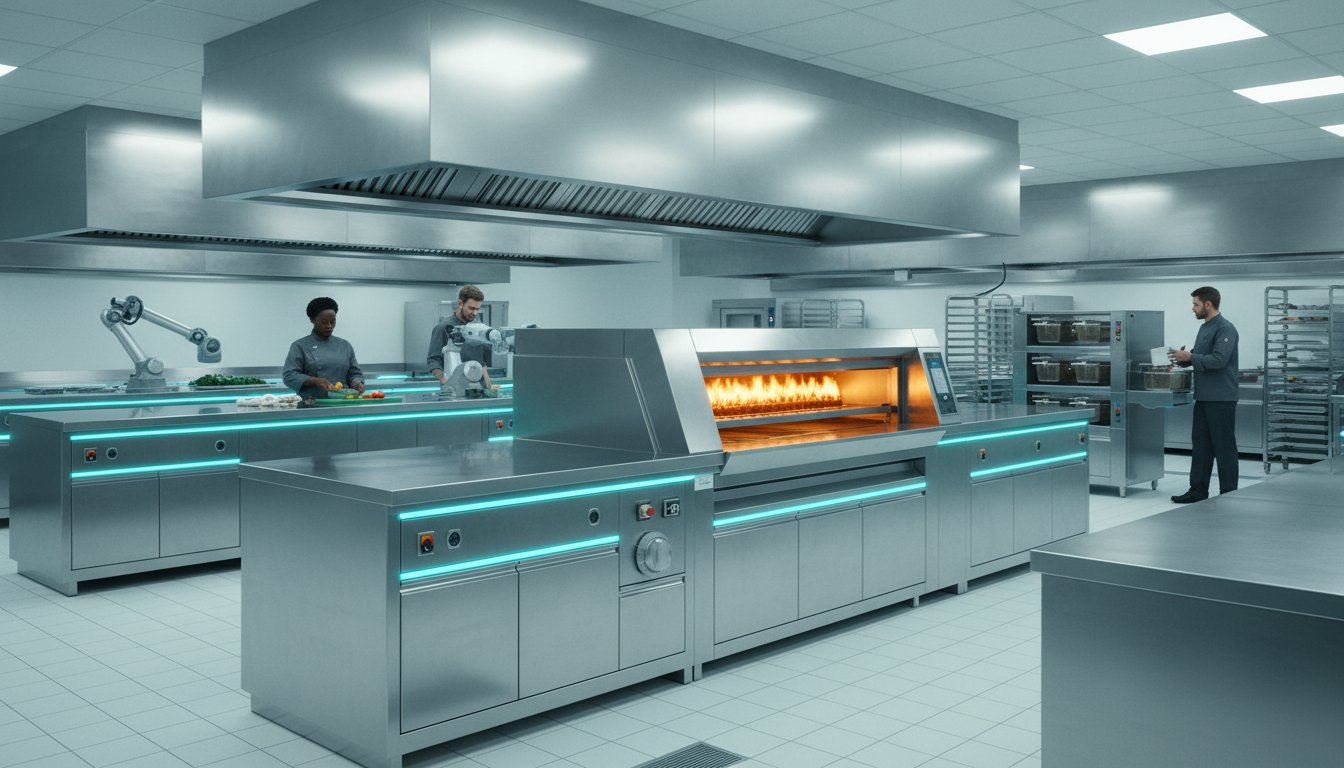
Did you know that 72% of hospitality professionals reported significant burnout in 2024 due to outdated workflows and high-pressure environments? You likely feel that tension every Friday night when orders pile up and the air in your restaurant kitchen grows heavy with heat and stress. It’s a challenge we understand deeply; we believe your workspace should support your team’s craft rather than hindering it with constant equipment failures or compliance anxiety.
This guide promises to show you how to transform a standard back-of-house setup into a high-performance engine of hospitality and profit. We’ve curated the essential 2026 standards for ergonomic design, predictive maintenance, and smart technology to ensure your operations remain seamless. You’ll learn how a few “Select” strategic upgrades can eliminate bottlenecks and restore the joy of service to your staff. We’re diving into the specific layout changes and equipment innovations that will define the most efficient kitchens on the Gulf Coast over the next two years.
Your restaurant kitchen is the engine room of your hospitality vision. It is the place where your culinary creativity meets the rigorous demands of a fast paced business. While a home kitchen focuses on aesthetics and personal comfort, a professional environment is built for endurance and high speed output. In the hospitality industry, we call this the heart of the house because every guest experience depends on the pulse of the kitchen. Unlike home setups, commercial kitchens are engineered for relentless performance and strict regulatory compliance. They must withstand 16 hour workdays and temperatures that would cause residential appliances to fail within weeks.
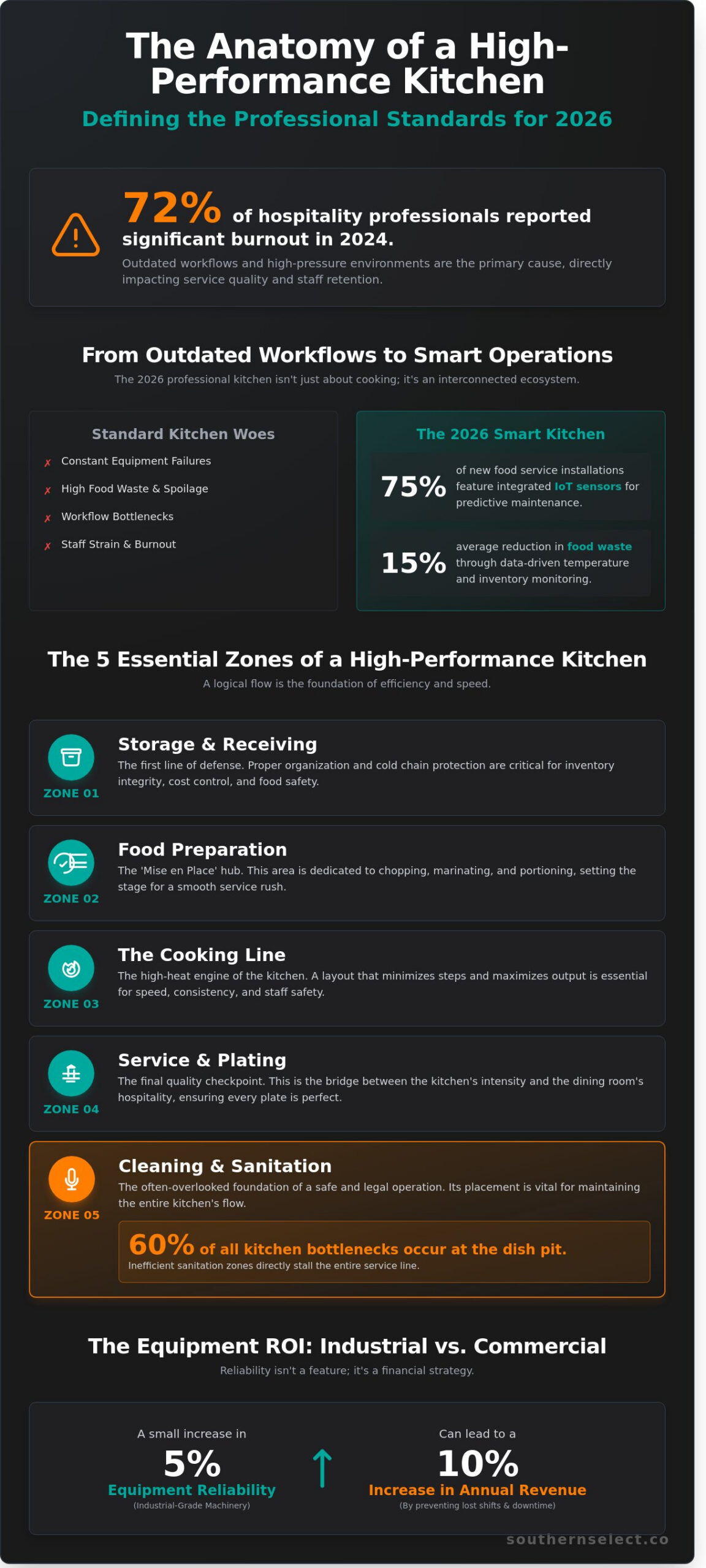
As we move into 2026, the definition of a professional space has evolved to include the Smart Kitchen. Industry data from 2024 suggests that 75% of new food service installations now feature integrated IoT sensors. These systems monitor everything from walk-in refrigerator temperatures to the precise oil quality in your deep fryers. This data driven approach allows you to reduce food waste by 15% on average, ensuring your Gulf Coast establishment remains profitable and sustainable. You aren’t just buying stoves and prep tables anymore; you are investing in an interconnected ecosystem that talks to your management software.
A successful layout focuses on maximizing throughput without sacrificing the food quality that defines your brand. When your team can move naturally through their stations, they maintain a higher level of consistency during a heavy dinner rush. Ergonomic planning is vital here, as it reduces physical strain and keeps your staff safe from burns or repetitive motion injuries. Kitchen throughput is the total volume of orders a kitchen can accurately produce and serve within a specific timeframe, serving as the primary metric for restaurant profitability. By streamlining the path from the prep station to the pass, you ensure every plate leaves the restaurant kitchen at its peak flavor profile. Renowned establishments like Copper Chimney exemplify this, using efficient kitchen workflows to deliver consistent Halal-certified North Indian and Indian-Chinese fusion flavors even during peak hours.
It is a common mistake to assume that any piece of equipment labeled commercial is sufficient for your needs. If you are running a high volume pizzeria producing 300 pies a night, a standard commercial oven will likely struggle to maintain its recovery time. This leads to longer wait times and unhappy guests. Industrial grade machinery is designed for these high output environments where equipment downtime is not an option. A 5% increase in equipment reliability can lead to a 10% increase in total annual revenue by preventing lost shifts.
At Southern Select Equipment, we understand that true Southern hospitality starts with reliability. We curate equipment based on long term durability rather than just the initial price tag. Our expert team looks for machinery that offers seamless maintenance and heavy duty construction. We want you to feel the reassurance that comes with professional grade tools, allowing you to focus on your community and your craft while we handle the technical foundations of your success.
A high-performance restaurant kitchen operates like a well-oiled machine where every square inch serves a purpose. We believe that a successful floor plan isn’t just about fitting equipment into a room; it’s about honoring the rhythm of service and the people who bring it to life. To achieve this, your layout must be divided into five distinct zones that facilitate a seamless transition from raw ingredients to a finished masterpiece.
The cooking line is where your vision becomes a reality. To maintain a steady pace, many modern operators are turning to conveyor ovens to automate consistency across high-volume orders. Your layout should strictly follow a one-way flow. This prevents staff collisions and reduces the risk of workplace accidents. Integrating high-heat equipment with ventilation systems that meet the 2024 NFPA 96 standards is essential for keeping your team comfortable and your air quality clean. If you’re looking to refine your current setup, our team can help you find a select management strategy that fits your unique space.
Integrity in a restaurant kitchen starts with how you treat your ingredients. Investing in high-quality Commercial Refrigerators is a necessity for food safety compliance and long-term profitability. You should design your storage area to support a strict First In, First Out (FIFO) system. This ensures that older stock is used before newer shipments, reducing waste by an average of 12% according to recent food waste studies. When choosing between walk-in and reach-in units, consider your daily volume. Walk-ins are ideal for bulk storage and coastal climates where humidity fluctuates, while reach-ins provide the immediate access needed during a busy dinner service.
Building a high-efficiency restaurant kitchen requires a shift in perspective. You aren’t just buying appliances; you’re selecting the silent partners that will support your staff during a frantic Friday night rush. On the Gulf Coast, where hospitality is our local currency, your equipment must be as reliable as the tide. Investing in premium machinery ensures your team spends less time troubleshooting and more time perfecting the guest experience. High-volume operations depend on consistency, and that consistency starts with the mechanical bones of your line.
Reliability in the prep station often begins and ends with a single name. Hobart Mixers remain the gold standard for dough and prep work heading into 2026 because they prioritize mechanical integrity over flashy digital gimmicks. These machines utilize gear-driven planetary drives that provide relentless torque for heavy pizza or bread doughs. Unlike budget-friendly belt-driven alternatives that slip or snap under pressure, a Hobart maintains steady RPMs regardless of the bowl’s resistance. It is a common industry reality that a well-maintained, 20-year-old Hobart often outperforms a brand-new economy mixer. This longevity protects your capital and ensures your recipes remain identical from batch to batch, year after year.
For the pizza and sandwich segments, the transition to conveyor technology has redefined throughput. Brands like XLT and EDGE have revolutionized the restaurant kitchen by introducing “set it and forget it” automation. This reduces your reliance on highly skilled labor at the oven station, which is vital when staffing remains a challenge. While Lincoln Impinger technology pioneered the use of pressurized hot air in the 1980s to speed up cook times, modern XLT and EDGE units have refined this with superior heat curtain technology and energy-efficient burners. These ovens allow a single operator to manage high-volume production without the risk of burnt crusts or cold centers.
Beyond the cooking line, your refrigeration serves as a silent profit center. A 1-degree fluctuation in a walk-in cooler can lead to thousands of dollars in annual food waste. Stable temperatures extend the shelf life of expensive proteins and delicate coastal produce, directly impacting your bottom line. When selecting these workhorses, prioritize brands with established national service networks. Even the best equipment requires maintenance. Knowing an expert technician is available for a 2:00 AM emergency repair provides the reassurance you need to run a seamless operation. Expertly chosen equipment doesn’t just cook food; it builds the foundation for long-term business stability.
A well-planned restaurant kitchen is more than a collection of appliances; it’s a choreographed dance floor where every second counts. To build a space that feels seamless, you must first map your menu directly to your equipment needs. Many owners over-equip, purchasing specialized gear that sits idle 80% of the time. Instead, focus on versatility and calculate your peak-hour volume to determine station sizes. If your Gulf Coast bistro expects 100 covers between 6:00 PM and 8:00 PM, your prep area needs enough linear footage for three chefs to work without bumping elbows.
Effective design relies on five strategic steps to ensure your operation runs with professional integrity:
This configuration is the gold standard for fast-casual spots and high-volume pizza shops. By positioning prep stations immediately adjacent to the cooking line, you enable just-in-time assembly. This reduces the physical steps a staff member must take by roughly 30%, which is the secret to preventing kitchen fatigue during a double shift. When you’re designing a commercial kitchen, remember that every extra step taken is a second lost in ticket time.
Your team is your most valuable asset, and the physical environment directly impacts their morale. Proper counter heights, typically 36 inches, and slip-resistant, cushioned flooring are just as vital as your ovens. Heat management is another critical factor; a 2023 industry report found that kitchens maintaining temperatures below 85 degrees see a 12% increase in staff retention. Providing a comfortable, expertly designed restaurant kitchen shows your crew that you value their health as much as their output. It’s about creating a home for their craft, not just a place to work.
Building a high-performance restaurant kitchen requires more than just a floor plan and a budget. It demands a shift away from the “catalog mentality” that treats equipment like disposable commodities. Many new owners spend weeks perfecting their menu only to stall when they realize a generic oven can’t keep up with their peak hour demand. At Southern Select, we act as your trusted local guide, ensuring you don’t just buy gear, but invest in the heartbeat of your business.
We balance the high-stakes demands of the food service industry with the warmth of a neighborly partnership. Our goal is to provide reassurance through reliability, making sure you feel supported by experts who understand the local market. By focusing on long-term ROI rather than initial price tags, we help you avoid the pitfalls that lead to 20% of new restaurants struggling with equipment failure in their first two years.
We don’t believe in offering every brand under the sun. Instead, we curate a selection of industry leaders like XLT, EDGE, and Hobart because they’ve proven their worth in high-volume environments. Buying no-name equipment from massive online retailers might save you 15% on the initial invoice, but the hidden costs are steep. These units often lack a domestic service network, meaning a simple broken belt could leave your restaurant kitchen dark for weeks while you wait for international shipping.
Our curated approach is specifically designed for growth. Whether you’re opening your first shop or scaling from one location to ten, we provide the consistency you need. Having standardized, high-quality equipment across multiple sites simplifies staff training and streamlines your maintenance protocols, allowing you to focus on the hospitality your guests expect.
Our commitment to Southern hospitality means we stay in your corner long after the initial sale is finalized. We understand that in the commercial world, a broken walk-in cooler is an emergency that affects your bottom line and your reputation. We help you stay ahead of these issues by establishing preventative maintenance schedules. Regular check-ups can extend the lifespan of your heavy machinery by 30% or more, ensuring your investment remains profitable for the long haul.
You aren’t just another transaction to us; you’re a member of our coastal community. We provide the professional authority of a seasoned consultant with the approachability of a friend. When you choose your equipment through our team, you’re choosing a partner who values integrity and seamless service as much as you do.
The landscape of 2026 demands a restaurant kitchen that functions with surgical precision and unwavering durability. Success hinges on integrating the five essential zones with heavy-duty workhorses from XLT, EDGE, and Hobart. These technologies don’t just save time; they ensure your staff can maintain peak performance during the most demanding high-volume shifts. By prioritizing a workflow-first layout, you eliminate the bottlenecks that traditionally stall growth.
Southern Select brings deep expertise to every project, blending technical mastery with the genuine warmth of a family-owned business. We specialize in the high-volume commercial environments that define the regional culinary scene. Our team understands that a kitchen build is an investment in your legacy. We treat every client with the signature Southern hospitality you’d expect from a trusted neighbor, ensuring your equipment and design are perfectly tailored to your goals. You deserve a partner who values integrity as much as efficiency.
Partner with Southern Select for Your Next Kitchen Build
Your vision for a more efficient, high-performing space is within reach, and we’re ready to help you build it.
The commercial range is the most vital piece of equipment in a restaurant kitchen because it serves as the primary cooking hub for almost every menu item. You’ll find that 90% of professional menus rely on the range for sautéing, boiling, and searing. Ensuring your unit meets NFPA 96 standards is essential for both safety and insurance compliance. It’s the engine that keeps your Southern hospitality flowing from the back of the house to your guests’ tables.
You should allocate approximately 40% of your total floor space to your restaurant kitchen layout. For a typical 3,000 square foot establishment, this equates to 1,200 square feet dedicated to food preparation, storage, and dishwashing. A helpful rule of thumb is to allow 5 square feet of kitchen space for every seat in your dining room. This balance ensures your team has enough room to move with the grace and efficiency our coastal community expects.
Buying new equipment is the superior choice for 2026 due to the strict Energy Star 5.0 efficiency standards and the availability of Section 179 tax deductions. While used gear might save you 30% upfront, the 2026 energy codes make older models more expensive to operate over time. New units come with manufacturer warranties that protect your investment during those critical first 24 months of business. We always recommend starting with a clean slate to ensure your long term success.
High-volume pizza ovens require a Type I ventilation hood designed to handle grease-laden vapors and intense heat. According to the 2024 International Mechanical Code, these hoods must extend 6 inches beyond the equipment on all sides to capture thermal plumes effectively. You’ll also need a dedicated make-up air system to replace the 2,000 cubic feet of air per minute that large ovens typically exhaust. Proper ventilation keeps your kitchen comfortable and your air quality pristine for your staff.
Choose a conveyor oven if you need to produce 80 pizzas per hour with consistent results; select a deck oven if you prefer an artisanal, charred crust. Conveyor ovens use forced air to cook 25% faster than traditional methods, making them ideal for high-traffic delivery spots. Deck ovens offer that authentic stone-baked quality that local foodies love, though they require a skilled operator to manage the 10 minute bake cycle. Your choice depends on whether you prioritize speed or tradition.
A well-maintained Hobart mixer typically lasts 20 to 30 years in a commercial environment. Industry data shows that 15% of high-volume bakeries still use Hobart models manufactured in the 1990s because of their heavy-duty gear-driven transmissions. To reach this lifespan, you must follow a quarterly lubrication schedule and avoid overloading the bowl beyond the 80% capacity mark. These machines are the reliable workhorses of the Gulf Coast’s best bakeries.
An optimized kitchen layout can reduce your labor costs by 15% by minimizing the physical steps your staff must take during a shift. By applying the “Work Triangle” principle, you can ensure that prep, cooking, and plating stations are within 10 feet of each other. This efficiency allows a smaller crew to handle higher volumes during peak weekend hours. It’s about creating a seamless flow that lets your team focus on the art of hospitality rather than wasted movement.
You cannot use residential appliances in a commercial setting because they lack the necessary NSF certification required by local health departments. Residential units don’t meet the UL 197 standards for fire safety and sanitation in high-volume environments. Most commercial insurance policies won’t cover damages or fires caused by a non-commercial range or refrigerator. Investing in professional-grade gear ensures your business remains compliant with the 2024 FDA Food Code and protects your professional reputation.




Leave a Reply