
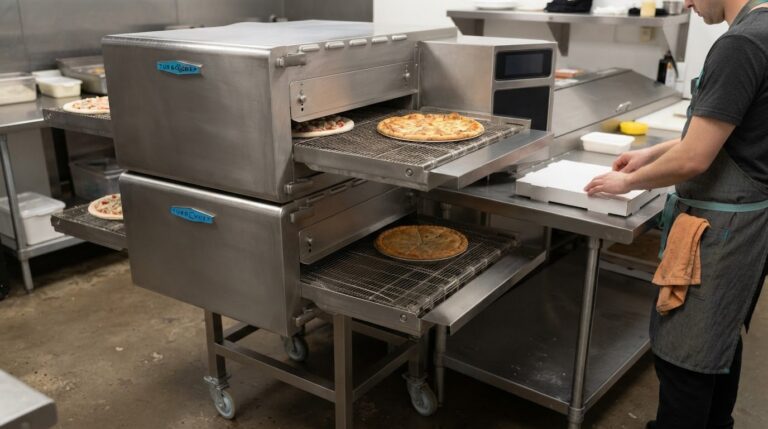
The fastest route to lower kitchen labor may be a smoother cooking workflow, not simply fewer hands on the floor. An automated pizza cooking line can help reduce kitchen labor costs by handling repeatable cooking tasks more consistently, while staff focus on preparation, order flow, and customer needs. In automated quick-service kitchens, labor costs can fall to 22-28% of revenue.
That possibility matters when labor is a major operating expense and busy periods put pressure on staffing and service. Automation can change how work is divided, but people are still needed to oversee the kitchen and keep orders moving.
This article explains how automated pizza preparation and cooking affect daily workflows, which tasks equipment can support, and how to weigh staffing needs against labor costs. You’ll get a practical view of where automation may help and what to consider before changing how your kitchen operates.
Key Takeaways
- Identify where labor pressure comes from before investing: repetitive tasks, uneven order volume, and workflow bottlenecks call for different solutions.
- See how automation can shift staff time toward preparation, order coordination, and customer service rather than eliminating the need for kitchen staff.
- Understand which pizza-making stages equipment can support and how a more consistent workflow can help during busy periods.
- Assess staffing changes alongside throughput, scheduling, and the tasks people still need to manage in an automated kitchen.
- Explore how commercial ovens and mixers can fit into a production line shaped around your kitchen’s needs.
What Does Restaurant Labor Actually Cost Before Automation?
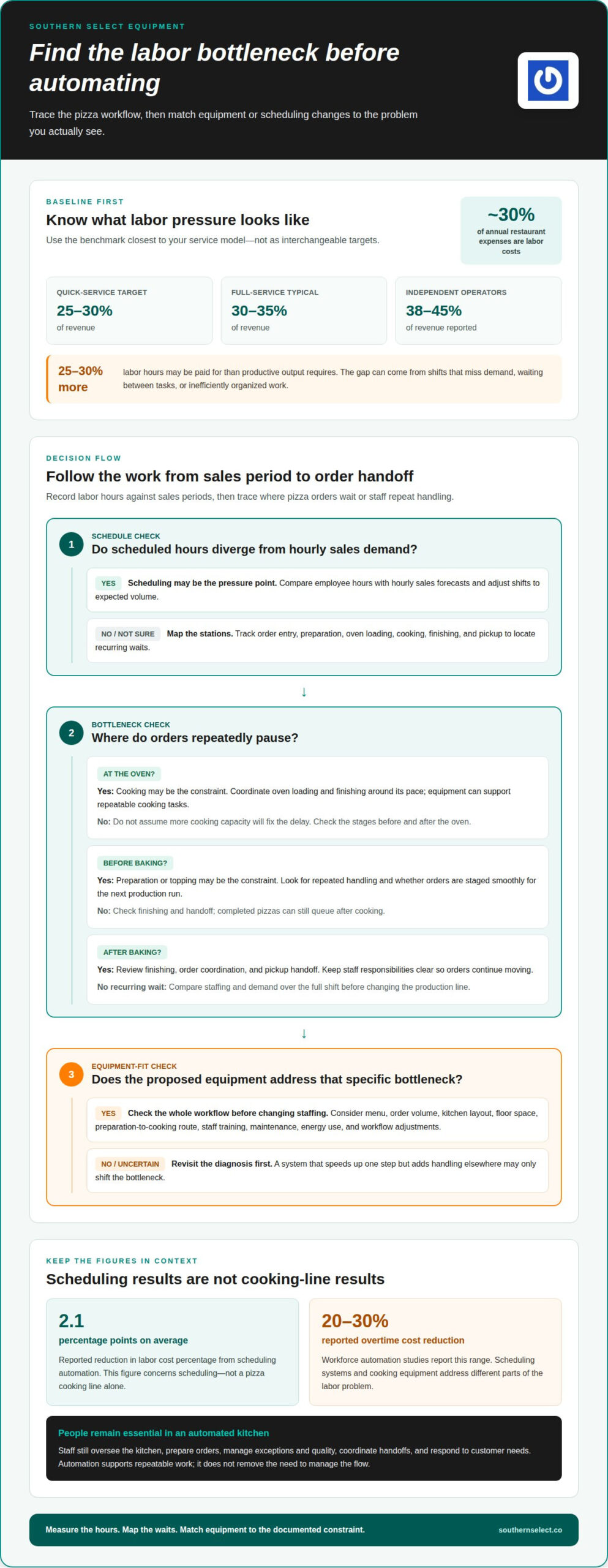
Before considering an automated pizza line, set a baseline using labor as a share of sales and operating expenses. Quick-service restaurants typically target labor costs of 25-30% of revenue, while full-service restaurants typically spend 30-35%. Independent restaurant operators are reported to spend 38-45% of revenue on labor. The figures describe different restaurant settings, so use the one closest to your service model rather than treating them as interchangeable.
Revenue share is only one view. Restaurant labor costs account for around 30 percent of annual expenses, making scheduling and task allocation important to the overall operating picture. A restaurant may also pay for 25-30% more labor hours than its productive output requires. That gap can arise when shifts do not match demand, staff wait between tasks, or several people handle work that could be organized more efficiently.
Pizza kitchens have distinct workflow demands. During a rush, orders can pile up across dough preparation, topping, oven loading, finishing, and handoff. If one station slows, the rest of the line may wait while scheduled staff hours continue. Automation is most relevant when repetitive tasks or a persistent bottleneck consume labor time. A robotic system is not automatically the answer: its value depends on whether it suits your menu, order volume, and kitchen layout.
Adoption involves the equipment investment and the changes that come with it. Consider floor space, the route from preparation to cooking, staff training, and how equipment will fit existing routines. A system that speeds up one step but adds handling elsewhere may simply shift the bottleneck. Plan for the whole pizza workflow, from preparation through oven output and order completion.
Maintenance, training, and operating costs depend on the equipment, its upkeep, how often it runs, and the time staff need to learn it. Include routine care, energy use, and workflow adjustments in your purchase decision, since each affects the equipment’s overall value.
A practical baseline begins with three steps:
- Measure labor hours against sales periods to see where schedules and demand diverge.
- Map each pizza station and note where orders wait or staff repeat the same handling.
- Compare the proposed equipment’s role with those specific bottlenecks before changing staffing plans.
This gives operators a clearer basis for deciding whether automation addresses a real labor constraint. A line designed around a documented bottleneck has a stronger operational case than one chosen for robotics alone.
Kitchen labor and workflow automation
Kitchen automation changes how work moves between stations, not just how quickly equipment cooks. In a pizza restaurant, staff coordinate dough preparation, topping, oven loading, finishing, and order handoff. When each task begins only after the previous one ends, orders can queue even if another station has spare capacity. A more efficient workflow coordinates these tasks, allowing staff to prepare the next order while equipment handles a repeatable cooking step.
Scheduling is part of that system. Restaurant operators can analyze employee hours alongside hourly sales forecasts, then adjust shifts to match expected volume. For example, a schedule built around a lunch rush may leave too many people on duty during a slower period, while a sudden dinner surge can leave a finishing station short-handed. Scheduling automation is reported to reduce labor cost percentage by an average of 2.1 percentage points. That result concerns scheduling, not the effect of a pizza cooking line alone.
Workflow tracking can help managers see where labor time goes. Compare the timing of order entry, preparation, oven loading, and pickup to identify recurring waits. If orders repeatedly pause before baking, adding cooking capacity may not solve the problem: preparation or handoff could be the constraint. If the oven is the bottleneck, coordinating loading and finishing around its pace may help staff avoid idle stretches and rushed handoffs.
Overtime is another consideration. Workforce automation studies report overtime cost reductions of 20-30%, but scheduling systems and cooking equipment address different parts of the problem. A schedule can help align staff hours with predicted demand. Cooking equipment can support repeatable production tasks. Operators still need to manage exceptions, quality, food preparation, and customer requests.
For a pizza kitchen, an efficient workflow might assign clear responsibilities across these steps:
- Preparation staff portion ingredients and stage orders for the next production run.
- The oven operator manages loading and monitors cooking progress.
- Finishing staff check completed pizzas, add required finishing touches, and coordinate handoff.
- A shift lead watches order flow and moves support to the station where orders are waiting.
This arrangement connects equipment use with staff responsibilities instead of treating automation as a standalone fix. It also makes training more specific: each person learns the handoff points and what to do when an order changes or a station falls behind. As volume shifts through the day, managers can use hourly sales forecasts to adjust staffing rather than assigning every employee the same tasks throughout a shift.
For a restaurant considering an automated pizza cooking line to reduce kitchen labor costs, the key is to match equipment to a documented workflow need. Trace an order from entry to pickup, mark each wait or repeated handoff, and identify which tasks equipment could support. This gives operators a clearer basis for weighing equipment changes against scheduling improvements.
Automated pizza preparation and cooking
Pizza automation can coordinate preparation and baking, but the right setup depends on each kitchen’s menu and order flow. Understanding the differences between oven types, production-line equipment, and quality controls helps clarify what automation can accomplish.
Automated, Conveyor, and Deck Ovens
An automated pizza oven uses equipment to support or control cooking, while conveyor and deck refer to oven formats. A conveyor moves pizzas through a heated chamber; a deck oven cooks them on a stationary surface. Automation may be part of a conveyor setup, so these terms are not always competing categories.
The practical choice depends on how orders arrive and how staff handle loading, timing, and removal. Menu requirements matter too, including the crust and finish customers expect. Compare the entire cooking workflow, not just the oven label.
Automated Production Line Equipment
An automated production line connects equipment and workstations to move a pizza from preparation toward cooking and handoff. Depending on the operation, it may include ingredient preparation, assembly, oven loading, baking, and order finishing. Each stage needs to connect smoothly with the next.
Restaurants, ghost kitchens, and high-volume operations need different setups because their menus, space, and order patterns vary. A delivery-focused ghost kitchen may prioritize predictable order flow, while a restaurant may also need staff to handle counter service. Choose equipment to address the task creating the bottleneck instead of assuming a fully automated line suits every operation.
Quality, Consistency, and Cooking Times
Pizza automation can make cooking steps more repeatable by keeping the process consistent across orders. The result still depends on preparation, ingredients, oven operation, and staff oversight. The Pizzaiola example gives a baking time of 7-9 minutes, but that figure describes its stated process, not every pizza or oven.
In the United States, food-safety, fire, and ventilation requirements depend on the location, equipment, and kitchen setup. Account for applicable local requirements when planning the line, including how cooking equipment fits the building’s ventilation and fire-safety arrangements. These factors affect equipment placement and workflow.
To improve consistency, define the recipe and each station’s handoff before changing the cooking process. Staff can stage ingredients consistently, load orders according to the kitchen’s procedure, and monitor pizzas as they leave the oven. A machine can repeat a cooking process, but people remain important for checking presentation, handling special orders, and responding when an order falls outside the usual flow.
These distinctions help match cooking technology to the operation: conveyor equipment moves pizzas through a cooking process, while a deck oven uses a stationary cooking surface. The right arrangement depends on menu needs, expected volume, available space, and how preparation connects with baking and pickup. This whole-process view matters more than the word “automated” alone.
Automation and headcount reduction
Automation can reduce the labor hours needed for repeatable tasks, but it does not automatically eliminate a position. In a pizza kitchen, cooking equipment may change how staff manage oven loading, timing, and order movement. The staffing effect depends on how employees use the time that becomes available. Some kitchens may need fewer labor hours during a shift; others may keep headcount steady and serve more orders.
Reported labor costs in automated quick-service kitchens can fall to 22-28% of revenue. That range offers context, not a forecast for every pizza restaurant. Sales volume, opening hours, menu complexity, and the tasks automated all shape the outcome. A restaurant should look at the entire shift, from opening preparation to the final order handoff, rather than treating oven speed as a direct measure of staffing needs.
Retention also affects how operators plan headcount. U.S. quick-service restaurants are reported to have annual workforce turnover rates of 130-150%. Automation-related scheduling satisfaction improvements are reported to reduce voluntary turnover by 15-20%. These figures point to a broader opportunity: a more manageable workflow may support staff stability, as well as labor planning.
Plan roles around the work that remains. Staff still prepare ingredients, handle custom orders, monitor equipment, maintain food quality, and assist guests. For example, if cooking requires less hands-on attention during a busy period, an operator could assign that employee to order finishing or pickup. Changing headcount makes more sense when those remaining duties are covered across the full shift.
- Map tasks: Separate repetitive cooking work from preparation, quality checks, and guest service.
- Review coverage: Match roles to expected demand during opening, rush periods, and closing.
- Track outcomes: Compare labor hours, orders completed, and handoff delays after workflow changes.
- Support the team: Train employees on equipment procedures and their responsibilities when orders change.
Success means meeting demand without leaving essential work unattended. If automation reduces one task but adds monitoring or cleaning duties, account for those hours before adjusting the schedule. Plan for the whole team, including who handles exceptions and customer requests when order volume rises.
Use these measures to decide whether staffing should change: labor hours by shift, orders completed, overtime, and employee turnover. Review them together. A lower labor share alone does not show whether service, workload, and kitchen quality remain on track.
What equipment is included in an automated pizza production line?
An automated pizza production line connects equipment and work areas to move orders from preparation through baking and handoff. The configuration varies: one restaurant may automate oven movement, while another connects several preparation stages. The key question is which equipment supports the kitchen’s menu and workflow, not whether every possible stage is automated.
At the preparation end, a line may use equipment to mix dough, divide portions, shape bases, and apply toppings. These stages can be separate or partly manual. For example, staff might prepare and top each pizza, then use an automated system to move it through cooking. This targets a defined part of production without requiring the entire kitchen to operate as one machine.
The oven is the central cooking stage, but the surrounding equipment determines how smoothly orders reach it and leave it. A conveyor-style oven moves pizzas through a cooking chamber, while a deck oven provides a stationary cooking surface. Preparation tables, staging areas, and a clear route to finishing connect the oven with the rest of the line. Placement matters: a poorly arranged handoff can create a new queue.
After baking, finishing and order handoff complete the production flow. Staff may add final ingredients, portion or package orders, and route them for dining room service, pickup, or delivery. A restaurant that handles delivery orders, for example, needs a practical way to keep completed pizzas organized by order. Automation at the oven does not replace these tasks, so the line should account for them.
A useful way to map a line is to follow one order through its stations:
- Prepare: Mix, portion, and shape dough according to the kitchen’s process.
- Assemble: Add sauce, cheese, and toppings, with staff or equipment handling each step.
- Cook: Move the pizza into the selected oven and manage its cooking process.
- Finish: Check the order, package it when needed, and route it to the correct handoff point.
This map helps distinguish essential equipment from optional automation. If orders wait before assembly, adding cooking capacity may not address the delay. If completed pizzas accumulate after baking, the finishing or pickup area may need attention instead. Consider menu variety, available space, order routing, and staff responsibilities together when planning the line.
To explore equipment that can support a commercial pizza workflow, review suitable restaurant equipment options alongside your preparation and cooking needs.
The best system depends on the kitchen’s menu, workflow, available space, order routing, and staff responsibilities. A conveyor-style oven moves pizzas through a cooking chamber, while a deck oven provides a stationary cooking surface. Preparation, staging, finishing, and handoff equipment should all fit the operation.
Southern Select Equipment
Southern Select Equipment can help you consider commercial pizza equipment in the context of your kitchen’s workflow. If you’re planning changes to preparation or cooking, its XLT Pizza Ovens, EDGE Pizza Ovens, Conveyor Ovens, and Hobart Mixers are options to consider as part of your equipment mix. The right fit depends on which tasks you want equipment to support and how orders move through your kitchen, from preparation to baking and handoff.
Whether you’re updating an existing setup or planning a new production flow, Southern Select Equipment can help you explore relevant restaurant equipment. Contact Southern Select Equipment to discuss your pizza kitchen equipment needs.
Plan the Next Step for Your Kitchen
If your goal is to use an automated pizza cooking line to reduce kitchen labor costs, start with the workflow you want to improve. Identify where staff time is most needed, then decide which equipment can support that process. A considered equipment choice starts with your menu, available space, and the way orders move from preparation to service.
Southern Select Equipment offers XLT Pizza Ovens, EDGE Pizza Ovens, and Hobart Mixers. These options can inform your equipment planning as you shape a production setup around your operation’s needs. The next step is to connect the equipment decision to the work your team handles each day.
Contact Southern Select Equipment to discuss your commercial pizza equipment needs. With a clear view of your workflow, you can move ahead with greater confidence and build a kitchen setup suited to your goals.
Frequently Asked Questions
As Wages Climb and Margins Shrink, is Pizza’s Automated Future Finally Here?
Yes, pizza automation is a practical option for restaurants designing production around repeatable tasks and steady demand. It is not a universal replacement for kitchen staff. The strongest case comes from matching equipment to a real operating need, such as consistent cooking during a busy service period. Consider whether your menu, kitchen layout, and order mix suit the way an automated process operates.
How Does Kitchen Automation Reduce Labor Expenses in Practice?
Kitchen automation can reduce the time employees spend on repeatable tasks, including moving products through a cooking process. That may let a team handle the same workflow with fewer labor hours, or use available time for service and order completion. For a delivery-focused restaurant, pickup cabinets can allow customers to collect orders without an additional employee facilitating pickup. The impact comes from how the workflow is organized around the equipment.
How Should a Prospective Franchisee or Restaurant Investor Evaluate Automation ROI?
Evaluate ROI by comparing expected labor-hour changes and operating expenses with the equipment investment and installation costs. Build sales forecasts around realistic order volume, then test how the equipment performs during both peak and slower periods. Include training, maintenance, energy use, and any layout changes in the model. Reviewing the investment over a 3-5-year horizon can help show whether projected gains persist beyond an opening-period rush.
What Are the Buildout and Equipment Costs for an Automated Restaurant Kitchen?
Buildout and equipment costs depend on the scope of automation, the kitchen’s existing condition, and the work needed to integrate equipment. A project focused on cooking differs from one that also changes preparation and order handoff. Budget separately for equipment, installation, integration, staff training, and any required space or utility changes. This breakdown helps investors understand which parts of a proposed buildout drive the overall investment.
How much does an automated pizza cooking line cost in the United States?
There is no single standard U.S. price for a complete pizza cooking line because the equipment mix and project scope vary. A setup centered on an oven differs from a line connecting multiple preparation and finishing stages. Costs also depend on installation and integration needs. To compare options fairly, define which stages to automate and review the full equipment scope, rather than comparing oven prices as if they represented equivalent systems.
How much labor can automated pizza equipment save?
Labor savings depend on which tasks the equipment handles and how much staff time those tasks currently require. Start with a typical-shift baseline: record hours spent on preparation, cooking, and order handling. Then compare those hours after changing the workflow, while tracking overtime and completed orders. This shows whether the equipment reduced labor input or helped the same team serve more orders.
What is the return on investment for an automated pizza line?
ROI measures the financial benefit of changes to labor needs and production against the investment and ongoing operating expenses. A useful payback calculation divides the initial investment by expected annual net savings. Include installation, maintenance, training, and energy use in the total. The result is most meaningful when based on actual sales patterns and realistic staffing plans, not the assumption that every available production hour will be busy.
What kitchen space, utilities, and installation requirements do pizza automation systems have?
Requirements vary by equipment and kitchen layout. Plan for the equipment footprint, staff access, product movement, and the route from preparation through cooking and handoff. Utilities and ventilation also depend on the selected equipment and building setup. Consider how the new line connects with existing stations so equipment placement does not block staff movement or interrupt order flow during service.