
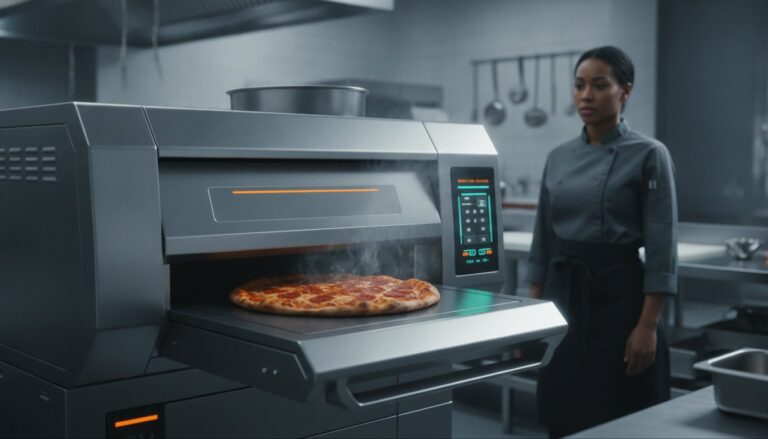
Your kitchen equipment is either a silent partner driving your success or a liability waiting to disrupt your busiest shift. In a high-volume environment, outfitting a new space can account for up to 25% of your total startup capital, making every choice a high-stakes decision for your bottom line. We understand that frequent downtime and inconsistent results from low-tier machinery do more than just cause stress; they actively erode your reputation. Whether you are looking for the precise, automated temperature control of commercial conveyor pizza ovens or the legendary durability of a Hobart mixer, the goal is a seamless operation that runs 24/7 without failure.
You deserve a partner who values hospitality and integrity as much as you do. We’ve curated this 2026 guide to help you master the complexities of professional sourcing by breaking down high-performance machinery and durable brand selection. You will learn how to lower long-term maintenance costs and stay ahead of the latest 2026 FDA Food Code updates regarding food safety management systems. We are exploring the specific brands and energy-efficient trends that provide the best return on investment, ensuring your kitchen remains the reliable heart of your community for years to come.
Key Takeaways
- Learn why residential appliances are a liability in professional settings and how high-duty machinery protects your warranty and your bottom line.
- Discover how commercial conveyor pizza ovens from brands like XLT and EDGE provide the consistent heat management required for high-volume success.
- Understand the critical difference between holding temperature and pull-down capacity to ensure your ingredients stay safe during the heat of a busy shift.
- Master the Select framework for evaluating brand history and parts availability to choose between new equipment and vetted used units with confidence.
- Build a resilient kitchen that operates without failure by choosing a partner who brings Southern hospitality and expert management to your equipment needs.
The Landscape of Commercial Food Equipment in 2026: Beyond Basic Utility
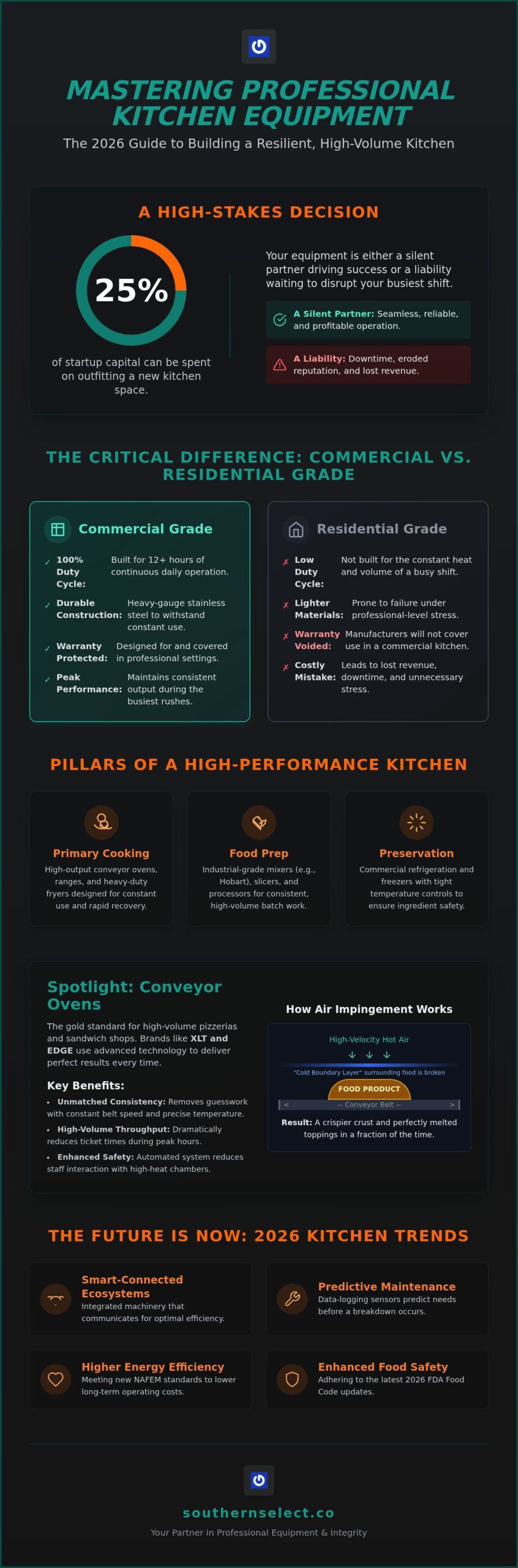
Commercial food equipment isn’t just a larger version of what you might use in a home kitchen. It’s a completely different class of machinery built for the relentless pace of a professional environment. True commercial-grade equipment is defined by a 100% duty cycle rating and heavy-gauge stainless steel construction designed to withstand the rigors of 12 or more hours of continuous daily operation. In commercial kitchens, where every second affects your bottom line, these specifications are the foundation of your success.
Choosing residential-grade appliances for a business setting is a gamble that rarely pays off. These units aren’t built to handle the constant heat or the sheer volume of a busy shift. They’ll likely fail when you need them most, leaving you with a line of hungry customers and no way to serve them. To make matters worse, most manufacturers will void your warranty the moment they see a residential unit in a professional setting. It’s a costly mistake that leads to lost revenue and unnecessary stress for your team.
As we move through 2026, the industry is shifting toward smart-connected kitchen ecosystems and higher energy efficiency. New NAFEM standards for energy consumption are now the benchmark for high-performance kitchens. Modern commercial conveyor pizza ovens and refrigeration units now feature data-logging sensors that predict maintenance needs before a breakdown occurs. This technology helps you stay ahead of repairs, ensuring your operation remains seamless and reliable.
The High-Volume Throughput Challenge
Success in food service depends on your ability to handle peak-hour demand without breaking a sweat. If your equipment has a slow recovery time, your ticket times will inevitably climb. A single bottleneck in a commercial conveyor pizza oven can stall your entire production line, creating a ripple effect that touches every part of your service. The hidden costs of equipment failure during a Friday night rush go far beyond the repair bill; they include lost repeat customers and a damaged reputation. Reliability isn’t just a feature. It’s your greatest asset.
Key Categories of Professional Kitchen Machinery
Building a high-performance kitchen requires a curated selection of tools that work in harmony. We focus on three main pillars of equipment that define a successful operation:
- Primary cooking: This includes high-output conveyor ovens, ranges, and heavy-duty fryers designed for constant use and easy cleaning.
- Food prep: Industrial-grade Hobart mixers, slicers, and processors provide the consistency needed for large batches and daily prep work.
- Preservation: Commercial refrigerators and freezing solutions ensure ingredient safety by maintaining tight temperature controls even during the busiest service hours.
By investing in the right categories of machinery, you are building a foundation that supports your staff and delights your guests. We are here to help you select the exact pieces that fit your unique volume and menu requirements.
For those also looking to upgrade their presentation and service tools, you can find out more about premium catering supplies designed for busy environments.
Maximizing Output with Specialized Conveyor Ovens and Industrial Mixers
Consistency is the heartbeat of any successful high-volume kitchen. When your dining room is full and the delivery tickets are stacking up, you can’t afford the variability that comes with manual cooking processes. This is why commercial conveyor pizza ovens have become the gold standard for modern pizzerias and sandwich shops. These machines remove the guesswork by using a constant belt speed and precise temperature control, ensuring the first pizza of the day looks and tastes exactly like the hundredth. Because Kitchen equipment poses special hazards during peak hours, the automated nature of a conveyor system also enhances safety by reducing the need for staff to constantly reach into high-heat chambers.
The technical superiority of brands like XLT and EDGE lies in their advanced air impingement technology. By blasting high-velocity hot air directly onto the food, these ovens break through the cold boundary layer that surrounds cold dough. This results in a crispier crust and perfectly melted toppings in a fraction of the time required by traditional deck ovens. Lincoln Impinger technology takes this a step further, focusing on heat management that delivers incredible speed without sacrificing the internal cook quality of thicker crusts or dense sandwiches. If you’re looking to upgrade your throughput, exploring our curated inventory of professional ovens is a great place to start.
Conveyor Ovens: XLT vs. EDGE
When you’re trying to maximize every square inch of your kitchen, stackability becomes a primary concern. Both XLT and EDGE offer designs that allow you to stack up to three oven chambers vertically, effectively tripling your output without expanding your footprint. Maintenance is another area where these brands shine. They feature removable conveyor assemblies and front-loading sandwich doors that make daily cleaning cycles straightforward and manageable for your team. For 2026, both manufacturers have introduced high-volume models with improved energy efficiency ratings, helping you keep utility bills under control even as your production scales.
The Hobart Standard for Dough Production
Your oven can only do so much if your dough isn’t prepared correctly. Hobart mixers remain the industry benchmark because of their legendary planetary design, which ensures every part of the bowl is reached during the mixing process. We often find that a vetted, used Hobart mixer will outperform brand-new entry-level competitors in terms of torque and long-term durability. It’s a testament to the integrity of their engineering. Selecting the right capacity is vital for your workflow. A 20-quart model might suffice for a small boutique shop, but high-volume operations usually require the 60-quart or 80-quart powerhouses to keep pace with demand. For a deeper look at these workhorses, read our guide on Investing in Excellence: The Definitive Guide to Hobart Mixers for 2026. By matching the right mixer capacity to your specific volume, you create a seamless transition from prep table to oven.
Commercial Refrigeration: The Critical Line of Defense
While your commercial conveyor pizza ovens are busy turning out golden crusts, your refrigeration system is working just as hard to protect your inventory. In a high-volume kitchen, the ambient temperature can soar, making your cooling units the critical line of defense against food spoilage. It’s not just about maintaining a holding temperature. You need to consider pull-down capacity, which is the unit’s ability to recover quickly after a staff member leaves the door open during a rush. Choosing ENERGY STAR certified equipment ensures your compressors are efficient enough to handle these demands without sending your utility bills through the roof.
For a comprehensive look at the latest technology, our Commercial Refrigerators: The Ultimate 2026 Professional Buying Guide dives deeper into specific models. In 2026, we’re seeing a major shift toward digital temperature monitoring and smart sensors that alert you to fluctuations before they become a crisis. This level of management gives you the peace of mind to focus on your guests, knowing your ingredients are safe and your equipment is running with the integrity you expect from a professional operation.
Reach-In vs. Walk-In Solutions
Deciding when to transition from reach-in units to a dedicated walk-in cooler usually depends on your daily volume and storage needs. Reach-in freezers and refrigerators are excellent for line-side prep, keeping ingredients within arm’s reach of your commercial conveyor pizza ovens. However, if you’re processing hundreds of orders daily, the constant door openings on small units can lead to compressor burnout. To prevent this, keep your condenser coils clean and ensure there’s proper airflow around the unit. A walk-in cooler offers a more stable environment for bulk storage, allowing your reach-ins to function as efficient staging areas for active service.
Specialized Freezing for Food Safety
Maintaining the cold chain from delivery to final service is a matter of professional hospitality. Standard commercial freezers are designed to keep already-frozen items at the correct temperature, but they aren’t meant for rapid cooling. If you need to bring hot prep items down to safe temperatures quickly, a blast chiller is the right tool for the job. These units prevent the growth of bacteria by moving food through the danger zone as fast as possible. When evaluating new units, pay close attention to insulation thickness and the durability of door seals. A high-quality seal keeps the cold in and the heat out, providing long-term energy savings and ensuring your kitchen remains a model of food safety and efficiency.
Sourcing Strategy: Evaluating Durability and Brand Reputation
Choosing the right gear is a commitment to your staff and your community. We use the Select framework to evaluate every piece of machinery, looking beyond the initial price tag to the brand’s history of parts availability. When you invest in commercial conveyor pizza ovens, you aren’t just buying a box that gets hot. You’re buying a promise of uptime. Brands with a deep heritage, like Lincoln or XLT, ensure that a small sensor failure five years from now won’t force you to scrap the entire unit. For more on building a scalable foundation, see our Commercial Restaurant Equipment Guide: Scaling Your Kitchen for Success in 2026.
Watch out for the warning signs of disposable equipment. If you see plastic gears or non-serviceable motors, keep looking. These components are designed for light use, not the 12-hour shifts common in high-volume kitchens. We often recommend investing in a brand-new unit for your primary cooking line to maximize your warranty coverage. However, a vetted, used Hobart mixer or XLT oven can offer incredible value without sacrificing integrity. For those expanding into large-scale production or wholesale, choosing high-performance machinery from Choice Bagging Equipment can provide the same industrial-grade reliability for your packaging needs. It’s about finding that perfect balance between your current budget and your long-term aspirations.
The ROI of Premium Brands
Calculating the Total Cost of Ownership (TCO) over a five to ten-year period reveals the true cost of “cheap” alternatives. High-end brands hold their worth in the secondary market, providing a safety net for your capital if you ever decide to upgrade. Sourcing parts for industry-standard brands like Hobart and Lincoln is straightforward. This accessibility minimizes the risk of extended downtime, which is the most expensive part of any equipment failure. When you choose quality, you’re investing in a seamless experience for both your kitchen team and your guests.
Vetting Used Equipment for Quality
If you’re considering the used market, focus on critical inspection points to ensure you’re getting a reliable machine. For commercial conveyor pizza ovens, you must check the belt tension and the condition of the heating elements or burners. While random auctions might offer lower entry prices, they lack the reassurance of a reputable distributor. A partner who understands 2026 health and safety codes ensures your equipment remains compliant and safe for your team. If you’re ready to find a reliable addition to your line, view our current inventory of premium used equipment and let us help you make a choice you can trust.
The Southern Select Advantage: Professional Equipment with Integrity
Southern Select Equipment bridges the gap between high-stakes industrial machinery and attentive, personalized service. We understand that your kitchen is more than a workspace; it’s the heart of your community and the foundation of your livelihood. Our curated inventory focuses exclusively on industry leaders like XLT, EDGE, and Hobart because we believe your primary assets should be as reliable as your best employee. By specializing in commercial conveyor pizza ovens and heavy-duty mixers, we provide the expert knowledge required to keep your production line moving without interruption. We don’t just sell boxes; we provide the stability you need to scale your vision with confidence.
While our reach is national, our approach remains deeply personal. We’ve helped kitchens across the country transition from struggling startups to high-volume powerhouses by implementing expert sourcing strategies. Whether you’re outfitting a single specialized eatery or managing a regional chain, our goal is to ensure your equipment is a seamless extension of your talent. We take the stress out of the procurement process by offering a Select quality of inventory that has been vetted for long-term performance and durability.
A Partner in Your Kitchen’s Success
We view every interaction as more than just a transaction. It’s an opportunity to share our expertise and ensure you choose the right model for your specific volume. This commitment to exceptional client service means we’re here to guide you through the technical specifications and operational demands of your kitchen. Professional operators trust our Select vetting process because they know we prioritize integrity over a quick sale. We understand the unique pressures of the fast-paced food service industry, and we bring that insider knowledge to every national shipment we manage.
Ready to Equip Your High-Volume Kitchen?
If you’re ready to upgrade your throughput and eliminate the headache of frequent downtime, we’re here to help. You can easily browse our current inventory of new and used professional equipment to find the perfect fit for your line. We also specialize in custom kitchen equipment packages tailored to your unique menu and space constraints. Don’t leave your success to chance by settling for low-tier machinery that can’t handle the heat. Contact our expert team today for a professional consultation, and let’s build a kitchen that runs as smoothly as your signature service. We look forward to becoming your trusted guide in the pursuit of high-volume excellence.
Building a Legacy of Kitchen Excellence
Success in the food service industry is measured by the reliability of your line and the consistency of your product. By prioritizing high-duty machinery and understanding the technical advantages of air impingement, you’ve taken the first step toward a kitchen that thrives under pressure. Your equipment is an investment in your team’s efficiency and your guests’ experience. Whether you’re integrating new commercial conveyor pizza ovens into your workflow or sourcing a legendary Hobart mixer, the focus should always remain on durability and long-term parts availability.
At Southern Select, we’re more than just a vendor; we’re a family-owned partner dedicated to your growth. We specialize in industry-leading brands like XLT, EDGE, and Hobart, ensuring every piece of equipment meets our rigorous vetting standards before it reaches your door. With our national shipping and neighborly approach to consultation, we bring the integrity of Southern hospitality to kitchens across the country. Browse our curated selection of high-volume commercial food equipment to find the silent partners your business deserves. We look forward to helping you build a kitchen that stands the test of time.
Frequently Asked Questions
What is the most durable brand of commercial pizza oven?
XLT and EDGE are widely considered the most durable brands because of their heavy-duty stainless steel construction and reliable designs. They’re built for high-volume environments where downtime isn’t an option for your business. These brands focus on minimizing moving parts, which naturally reduces the risk of mechanical failure during your busiest shifts. You can trust these machines to remain the steady heart of your kitchen for years.
Is it better to buy a new or used Hobart mixer in 2026?
Buying a vetted, used Hobart mixer is often a smarter investment in 2026 than purchasing a brand-new entry-level model from a lesser-known brand. These machines are engineered with high-torque gear systems that last for decades with proper care. We ensure every used unit we select meets our high standards for integrity, providing you with a powerhouse that handles heavy dough without the premium price of a new unit.
What are the power requirements for an XLT conveyor oven?
XLT conveyor ovens typically require a dedicated electrical circuit, with specific voltage and amperage depending on the model size and whether it’s gas or electric. For example, many gas models need a standard 120V outlet for the belt motor and controls, while all-electric versions require 208V or 240V three-phase power. It’s vital to consult the specific manufacturer data sheet to ensure your kitchen’s infrastructure can support the load.
How often should commercial refrigeration units be serviced?
You should have your commercial refrigeration units professionally serviced at least twice a year to ensure peak performance and food safety. This maintenance should include cleaning the condenser coils, checking refrigerant levels, and inspecting door gaskets for any leaks. Regular care prevents the compressor from working too hard, which lowers your energy costs and extends the life of your equipment. It’s a simple step that protects your inventory.
Can I use residential pizza ovens in a commercial kitchen?
No, you cannot use residential pizza ovens in a professional environment because they lack the duty cycle and safety certifications required by health codes. These units aren’t built to run for 12 hours a day and will likely fail under professional demand. Using them also voids most insurance policies and manufacturer warranties, making commercial conveyor pizza ovens the only reliable choice for your business success.
What is the difference between an impinger oven and a standard conveyor?
An impinger oven uses high-velocity jets of hot air to cook food faster and more evenly than a standard conveyor oven, which relies on radiant heat. This air impingement technology breaks through the cold air layer surrounding the food, resulting in superior crust texture and consistent browning. While both use belts, the impinger’s active airflow management provides the speed needed for high-volume operations. It’s the gold standard for consistency.
How much space is required for a commercial conveyor oven installation?
A commercial conveyor pizza oven installation requires enough space for the unit itself plus mandatory clearances for ventilation and airflow, usually at least six inches from walls. You also need to account for the landing zone where finished products exit the belt and enough room for staff to perform daily cleaning. Proper planning ensures your kitchen remains safe and efficient without creating bottlenecks during peak service hours.
Why are Hobart mixers so much more expensive than other brands?
Hobart mixers carry a higher price point because of their superior engineering, planetary mixing action, and the high-quality materials used in their construction. Unlike cheaper alternatives that use plastic parts, Hobart utilizes heavy-duty alloy gears and robust motors designed for industrial use. This level of integrity ensures the mixer holds its value and continues to perform reliably for years, providing a much lower total cost of ownership.