


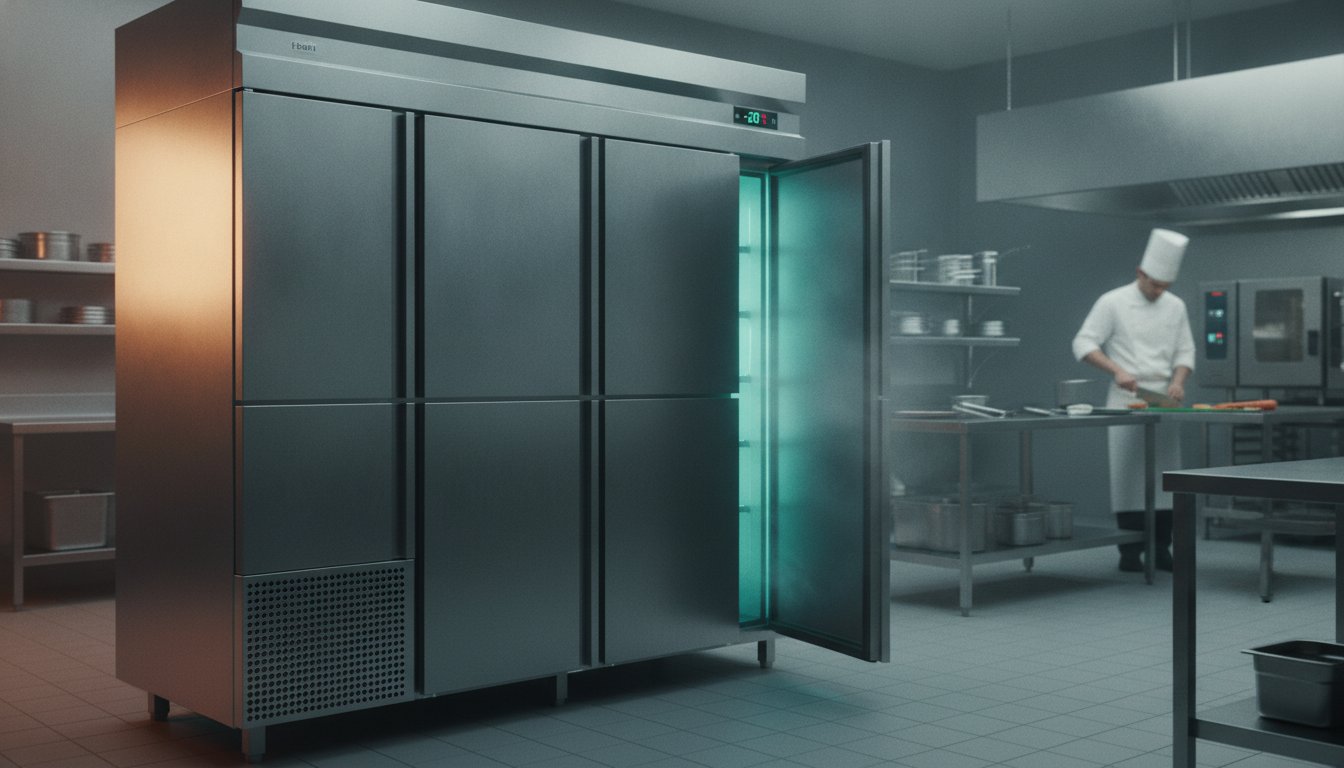
Energy consumption can account for a staggering 70% of your equipment’s total lifecycle cost, yet many kitchens are still losing money to outdated, inefficient units. You work hard to serve your community with excellence, and the last thing you need is a sudden equipment failure or a skyrocketing utility bill eating into your hard-earned margins. We understand that your kitchen is the heart of your hospitality, and keeping it running smoothly requires more than just a standard appliance. It requires a partner who understands the high stakes of food safety and operational reliability.
We’ve crafted this guide to help you master the complexities of professional cold storage, from selecting the right commercial freezers to navigating the 2026 low-GWP refrigerant mandates under the AIM Act. You’ll learn how to balance energy efficiency with your specific kitchen footprint while ensuring your investment stands the test of time. This professional guide provides a clear roadmap to selecting, sizing, and maintaining high-performance equipment that honors your commitment to quality. Let’s explore how to create a seamless, durable cold storage solution that supports your long-term success and keeps your kitchen performing at its best.
Your kitchen is a high-pressure environment where every second and every degree matters. Unlike the appliances you use at home, commercial freezers are engineered as heavy-duty workhorses designed for rapid temperature recovery. In a professional setting, a freezer door might open fifty times an hour during a busy lunch rush. A standard unit would buckle under that stress, but professional equipment uses advanced refrigeration technology to pull temperatures back down almost instantly. This performance is vital for maintaining the cold chain, which is the absolute backbone of food safety compliance. When your equipment keeps a steady, deep freeze, you aren’t just following the law; you’re protecting your guests and your hard-earned reputation.
At Southern Select Equipment, we believe your tools should work as hard as you do. We don’t just provide machinery; we offer the reliable foundations that allow your culinary creativity to flourish without interruption. Our philosophy is rooted in the idea that professional tools should be a source of confidence, not a cause for concern. We select equipment that mirrors the resilience and hospitality you show your own customers every day. By focusing on units that offer superior shelf-life for your inventory and drastic waste reduction, we help you run a kitchen that is as efficient as it is welcoming.
It’s often tempting for new businesses to start with a residential unit to save on initial costs, but the physics of a professional kitchen quickly prove otherwise. Residential freezers are built for a few openings a day, whereas commercial freezers feature significantly more powerful compressors designed to handle a constant influx of warm air. The insulation in a professional unit is much denser, and the gaskets are built from durable materials that won’t brittle or crack under heavy use. Most importantly, using a home unit in a business setting typically voids the manufacturer’s warranty. This leaves you completely unprotected when the unit inevitably fails under the strain of a commercial workload.
Consider the total value of the inventory sitting in your freezer right now. A single equipment failure over a holiday weekend can result in thousands of dollars in lost proteins and specialty ingredients. Beyond the immediate financial sting, consistent temperatures are essential for preserving the delicate flavor and texture of your food. Fluctuating temperatures cause large ice crystals to form, which ruins the “mouthfeel” of premium ingredients. Investing in professional reliability provides a sense of peace of mind that’s truly priceless. You can lock your doors at night knowing your investment is safe, letting you focus on the people and the plates that make your business a community staple.
Selecting the right refrigeration setup is a lot like planning a welcoming home kitchen, just with much higher stakes and a faster pace. You need a system that supports your unique rhythm rather than creating bottlenecks. Your choice of commercial freezers must work in harmony with your existing commercial restaurant equipment. This ensures that your team moves with grace and efficiency, even during the most demanding shifts. Whether you’re running a high-volume coastal seafood shack or a refined downtown bistro, the architecture of your cold storage determines how well your kitchen can perform under pressure.
Reach-in models are the most common sight in professional environments, and for good reason. They offer immediate access to frequently used ingredients right where the action happens. You can choose from single, double, or triple-section models depending on your volume and inventory variety. Modern reach-ins feature precise digital temperature controls and adjustable shelving that allows you to customize your storage as your menu evolves. These units are designed to maintain safe food storage temperatures even when the doors are constantly swinging open during a busy service. Our team at Southern Select Equipment often suggests these as the foundational piece for any growing culinary operation.
Sometimes your storage needs to do double duty. Glass door merchandisers are perfect for front-of-house areas where visibility drives impulse sales. They allow customers to see your premium offerings without releasing cold air. In the back-of-house, chef bases are a brilliant solution for space management. These low-profile commercial freezers are built with reinforced tops, allowing you to place heavy equipment like griddles or ovens directly on top. For prep stations or beverage areas where every inch counts, under-counter units provide a seamless way to keep chilled items within arm’s reach without sacrificing valuable counter space.
When you’re dealing with seasonal harvests or bulk protein orders, a chest freezer is often the most reliable partner you can have. These horizontal units are designed for long-term storage with minimal door openings. Their design makes them incredibly efficient at holding a steady temperature. In the rare event of a power outage, chest freezers typically offer superior temperature stability compared to upright models because the cold air doesn’t “fall out” when the lid is opened. While they require a larger floor footprint, their ability to protect large volumes of expensive inventory makes them an essential component of a well-rounded cold storage strategy. If you are ready to upgrade your storage capacity, you can explore our current inventory of professional solutions.
Understanding the inner workings of your commercial freezers is about more than just reading a spec sheet. It’s about ensuring your kitchen remains a place of stability and calm. When the team at Southern Select Equipment evaluates brands for our curated inventory, we deconstruct the anatomy of the cooling system to see how it handles the daily rigors of a professional environment. High-quality insulation density is a primary factor we consider. It doesn’t just keep the cold in; it significantly dampens operational noise. A quieter kitchen is a more hospitable workplace for your team, allowing for better communication and a more focused atmosphere during the rush.
Environmental standards have reached a pivotal turning point as of January 1, 2026. Under the federal mandates of the AIM Act, new refrigeration systems are prohibited from using high-Global Warming Potential (GWP) refrigerants like R-404A. Modern commercial freezers now utilize low-GWP alternatives, such as R290 (propane) or A2L refrigerants. These aren’t just regulatory hurdles; they are advancements that offer better thermal properties and future-proof your investment. We take the lead in vetting these manufacturers for durability, ensuring that the transition to greener technology doesn’t come at the expense of your equipment’s lifespan.
Choosing where the “heart” of your freezer sits is a strategic decision based on your kitchen’s layout. Top-mount compressors are excellent for cooler environments because they stay away from floor-level grease and dust. However, if your cold storage is positioned near high-heat equipment like XLT Pizza Ovens, a bottom-mount configuration is usually the wiser choice. Bottom-mount units pull in cooler air from the floor and provide a “no-stoop” storage environment that your staff will appreciate during long shifts.
Energy consumption is a major factor in your bottom line, as it can account for up to 70% of a freezer’s total lifecycle cost. Investing in high-efficiency motors and LED lighting isn’t just a trend; it’s a way to ensure long-term ROI. Modern units equipped with smart technology can reduce energy consumption by up to 30%, which adds up to significant savings over time. We look for models with robust Energy Star ratings and advanced gaskets that create a seamless seal. Self-closing doors are another essential feature that prevents energy leakage and ensures your ingredients stay at the perfect temperature, even when things get hectic.
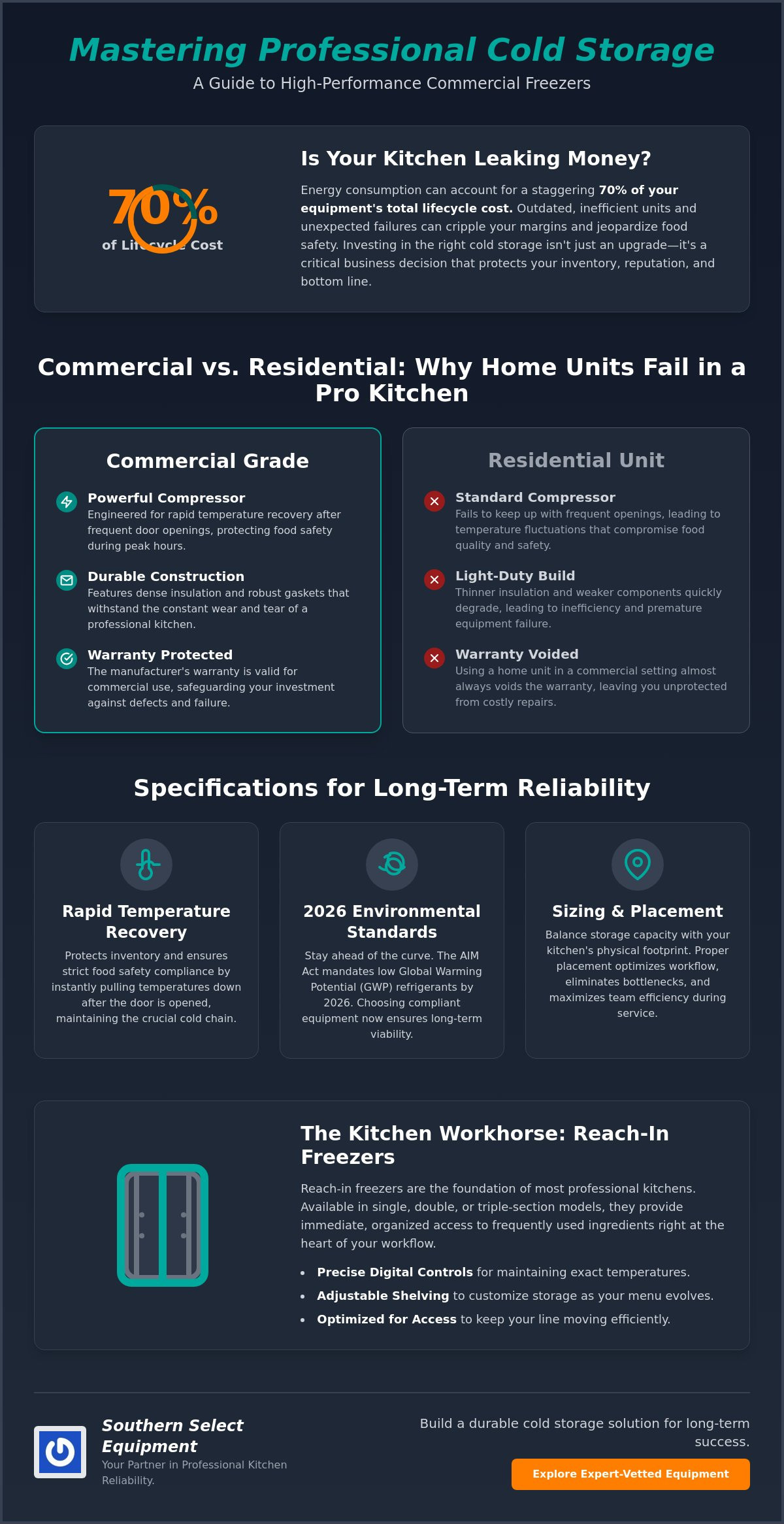
A high-performance kitchen is a choreographed dance, and the placement of your commercial freezers dictates the rhythm of your entire team. Measuring your available space is the first step in ensuring that your equipment serves your workflow rather than obstructing it. We always advise our partners to measure twice and buy once, considering not just the footprint of the unit, but the path it takes to get through your front door. A freezer that’s too large for your hallway or too deep for your line creates a permanent bottleneck that slows down service and frustrates your staff.
Think about how your cold storage integrates with your other essential tools. For example, if your bakery relies on high-volume dough production using Hobart Mixers, your freezer should be positioned within a seamless reach of the prep station. This proximity reduces unnecessary steps and keeps your ingredients at the ideal temperature throughout the production cycle. Planning for future growth is equally vital. While you don’t want to pay for unused cubic footage, choosing a unit that allows for a 15% to 20% increase in inventory turnover can save you from a costly upgrade just a year down the road.
Every refrigeration unit needs room to breathe. Without proper clearance, heat cannot dissipate from the compressor, leading to premature burnout and higher energy bills. You should account for at least two to four inches of space around the sides and back, depending on the manufacturer’s guidelines. Don’t forget to map out the door swing radius. In narrow kitchen aisles, a door that swings into a primary walkway can lead to collisions. Ensure your chosen location has access to the correct electrical phase and voltage requirements to avoid taxing your building’s infrastructure. If you’re unsure which model fits your specific layout, you can view our curated selection of restaurant equipment to find the perfect match.
Estimating your cubic footage needs requires a deep look at your weekly inventory turnover. A general rule of thumb is to allow for about 1.5 cubic feet of storage for every meal served daily, though this varies by concept. The danger of over-stuffing your commercial freezers is real. When you block the internal fans, you create warm spots that compromise food safety and force the motor to work overtime. A well-organized unit should have enough space for air to circulate freely between every container. Consider a layout that separates raw proteins from prepared frozen goods to maintain the highest hygiene standards while keeping your most-used items at eye level for quick access.
In a marketplace crowded with endless, unvetted catalogs, the value of a trusted partner is more significant than ever. You deserve more than a cold transaction; you deserve a partner who understands that your kitchen is the heart of your business and a pillar of your community. We bring the spirit of Southern hospitality to every equipment consultation. This isn’t just about selling commercial freezers; it’s about ensuring your legacy is built on a foundation of reliability and integrity. Whether you’re navigating the coastal humidity of the Gulf or running a high-volume city kitchen, our curated approach ensures your equipment works as hard as you do.
Our team understands the unique pressures of the professional service industry. We’ve seen firsthand how the right equipment can transform a chaotic shift into a seamless experience. By focusing on a hand-picked selection of high-performance tools, we remove the guesswork from your buying process. For those who extend this commitment to high performance into their fitness facilities, you can discover EvoGear for professional-grade bodybuilding equipment. This neighborly approach to business is why professional operators across the country trust us to guide their most important investments. We take the time to understand the people and the places behind the properties, ensuring that every piece of equipment we provide contributes to a thriving, sustainable business.
Our commitment to sourcing brands that stand the test of time is unwavering. We don’t just look at shiny new features; we look at the long-term durability of every component. Much of our insight comes from our deep expertise in restaurant liquidations, where we see exactly which units fail and which ones are still running strong after years of service. This insider knowledge allows us to filter out the noise and present you with only the most resilient options. There is a vital synergy between our commercial freezers and our Commercial Refrigerators. When your entire cooling line is built on the same standard of excellence, your kitchen achieves a level of operational harmony that’s hard to beat.
While we possess the national distribution power to deliver professional-grade solutions across the United States, we’ve never lost our family-owned roots. This accountability is what sets us apart from massive, faceless retailers. When you work with us, you’re working with people who are personally invested in your success. We treat your kitchen like it’s our own, offering the kind of expert-led guidance that only a trusted guide can provide. If you’re looking for similar expertise in other niche areas, you can learn more about Sun Tanning Store for professional wellness equipment. If you’re ready to experience a more neighborly way of outfitting your facility, we invite you to partner with Southern Select for your next kitchen upgrade. Let’s build something lasting together.
Success in the modern culinary landscape requires a delicate balance of technical precision and operational reliability. You’ve seen how staying ahead of 2026 refrigerant mandates and prioritizing efficient workflow placement can transform your cold storage from a simple utility into a cornerstone of profitability. Choosing the right commercial freezers is about more than just maintaining temperatures; it’s about investing in the peace of mind that allows you to focus on your craft and your guests.
Southern Select brings over a decade of deep industry expertise and a commitment to family-owned integrity to every partnership. We’ve meticulously vetted our inventory to feature high-performance brands like Hobart and XLT, ensuring that our national delivery capabilities never compromise our neighborly approach to service. We invite you to browse our curated selection of high-performance commercial freezers and discover a seamless path to kitchen excellence. Your vision for a thriving, efficient kitchen is within reach, and we’re honored to help you lead the way with equipment that works as hard as you do.
The ideal temperature for your freezer is between -10°F and 0°F. This specific range ensures that your inventory remains frozen solid while maintaining the texture and quality of your ingredients. Consistently staying within this window is essential for meeting food safety standards and preventing the growth of harmful bacteria. You should monitor your internal thermometer daily to ensure your unit is performing exactly as expected for your peace of mind.
You should clean your condenser coils at least every 30 to 90 days to keep your equipment running efficiently. In high-volume kitchens with more grease or dust, monthly cleaning is a better practice. Clogged coils force your compressor to work harder, which leads to higher energy bills and a shorter lifespan for your unit. A simple vacuum or brush can save you from a major repair bill down the road.
Yes, most commercial freezers require a dedicated electrical circuit to prevent tripping breakers. While smaller units might use a standard 115V outlet, larger models often require 208V or 230V connections and specific NEMA plug configurations. It’s vital to check your unit’s spec sheet and consult with a licensed electrician before installation. Ensuring your electrical infrastructure is up to code protects both your investment and your facility’s safety over the long term.
A well-maintained, professional-grade reach-in freezer typically lasts between 10 and 15 years. The exact lifespan depends heavily on your cleaning routine and the environment of your kitchen. Investing in high-quality brands and performing regular maintenance, like gasket checks and coil cleanings, can push your equipment toward the longer end of that range. We focus on sourcing durable units that provide a reliable foundation for your business for over a decade.
It is generally not recommended to use a standard freezer in an unheated area. Most units are designed to operate in environments where the temperature stays above 65°F. If the ambient air gets too cold, the refrigeration cycle can fail because the compressor won’t trigger properly. If you must store items in a cold warehouse, you’ll need a unit specifically equipped with a low-ambient kit to ensure consistent performance.
Frost buildup in a frost-free model is usually caused by warm, moist air entering the cabinet. This often happens if your door gaskets are worn or if the door is left open too frequently during busy shifts. When humid air hits the evaporator coils, it freezes instantly. You should inspect your seals for any gaps or cracks; a seamless seal is the best defense against unwanted ice and unnecessary strain on your motor.
If your temperature rises unexpectedly, your first step should be to keep the doors closed to preserve the remaining cold air. Check that the unit is still receiving power and that the condenser coils aren’t blocked by dust or debris. Often, a simple cleaning or a reset of the digital controller can resolve the issue. If the temperature continues to climb after these checks, it’s time to call a professional technician to prevent inventory loss.
Professional commercial freezers are engineered with powerful compressors and dense insulation specifically to handle the heat of a busy line. While residential units would fail in a 90°F kitchen, commercial models use rapid recovery technology to maintain safe internal temperatures. Choosing between a top-mount or bottom-mount compressor, as we discussed earlier, also plays a major role in how effectively your unit manages the high-ambient heat of your specific kitchen layout.




Leave a Reply