
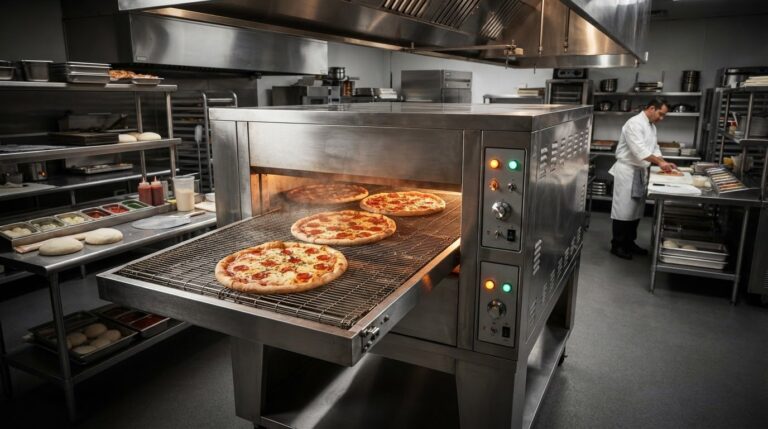
In a high-volume kitchen, a commercial impinger oven’s belt speed can matter as much as its heat. Commercial conveyor pizza ovens typically operate at 450 to 500 degrees Fahrenheit, and pizza generally cooks in 4 to 7 minutes. The right settings depend on the bake you want and the pace your kitchen needs to maintain.
Consistent output matters when orders are coming in fast, but speed alone doesn’t make a commercial impinger oven the right fit. The oven also needs to suit your menu, kitchen layout, and daily volume.
This guide explains how belt speed and temperature affect cooking results, what to assess in an oven’s construction and applications, and how electric and gas power options shape your choice. Use these criteria to compare equipment and identify features that support steady service.
Key Takeaways
- Match belt speed and heat settings to the bake you want, then assess how easily your team can repeat those results during busy service.
- Compare oven capacity and controls with your kitchen’s order volume to find a setup that supports a consistent pace.
- Consider how construction and access affect routine cleaning and fit within your kitchen workflow.
- Review which menu items suit conveyor cooking so the oven supports more than one service need.
- Weigh electric and gas options against your kitchen’s available power and operating requirements.
Belt speed and temperature controls
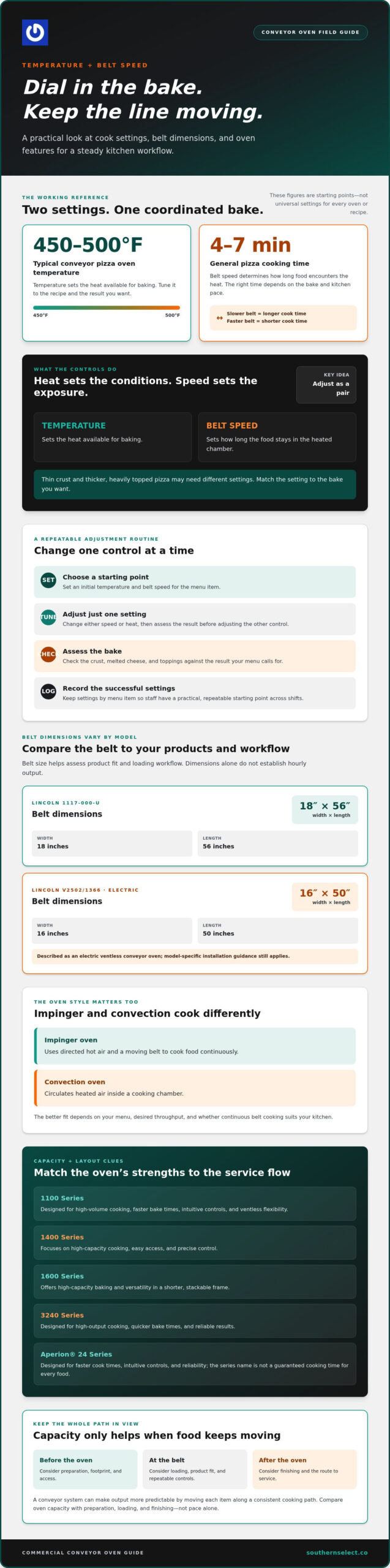
A conveyor oven moves food through a heated chamber, with belt speed and heat settings working together. Slowing the belt increases cooking time; speeding it up reduces that time. Operators can adjust conveyor speed and heat to suit different pizza styles. A thin crust and a thicker, heavily topped pizza may need different settings to bake as desired. Change one setting at a time, then assess the result before adjusting another control.
Temperature sets the heat available for baking, while belt speed determines how long food encounters it. Commercial conveyor pizza ovens typically operate between 450 and 500 degrees Fahrenheit. That range is a useful reference, not a universal setting for every recipe or oven. Record the temperature and belt speed that produce the preferred crust, melted cheese, and toppings. A repeatable setting gives staff a practical starting point across shifts.
Commercial impinger oven vs. convection oven: which is better? An impinger oven uses directed hot air and a moving belt to cook food continuously. A convection oven circulates heated air inside a cooking chamber. The better fit depends on your menu, desired throughput, and whether continuous belt cooking suits your kitchen.
What ventilation, clearance, and installation requirements apply? They depend on the oven’s design, fuel, and installation instructions, along with applicable local requirements. For example, the Lincoln V2502/1366 is described as an electric ventless conveyor oven, but that designation does not replace model-specific installation guidance.
What safety certifications and local codes apply in the United States? Requirements depend on the equipment and the jurisdiction where it will operate. Include the oven’s certification information and applicable local codes in your installation plans. Don’t assume one rule applies to every kitchen.
What are typical specifications and capacities? Belt dimensions, heat controls, power source, and cooking configuration vary by model. For example, the Lincoln 1117-000-U has an 18-inch-wide by 56-inch-long belt, while the electric Lincoln V2502/1366 has a 16-inch-wide by 50-inch-long belt. Belt size helps you assess product fit and loading workflow, but dimensions alone don’t establish hourly output.
High-speed cooking depends on coordinating the product, settings, and service flow. Lincoln’s Aperion® 24 Series is designed for faster cook times, intuitive controls, and reliability. Its name identifies a series, not a guaranteed cooking time for every food. Match the item’s size and thickness to the belt path, then tune speed and heat to achieve the result your menu calls for.
- Set a starting temperature and belt speed for each product, then adjust one control at a time.
- Record successful settings by menu item so staff can reproduce the bake.
- Compare belt dimensions and cooking configuration with the products and workflow your kitchen needs to handle.
Benefits for high-volume kitchens
A conveyor system can make output more predictable in a busy kitchen by moving each item along a consistent cooking path. That repeatability helps teams coordinate preparation, loading, and finishing during a rush. Commercial conveyor ovens provide steady temperatures and predictable bake times, helping staff follow a clear routine: prepare the item, load it, monitor its progress, and finish it consistently.
Capacity matters alongside pace. Lincoln’s 1100 Series is designed for high-volume cooking, faster bake times, intuitive controls, and ventless flexibility. Those features can help a kitchen plan around a demanding service window, while simple controls make routine operation easier to learn. The 1400 Series focuses on high-capacity cooking, easy access, and precise control. For operators, that combination can support a steady workflow where staff need to load and retrieve food efficiently.
Layout also shapes the value of an oven. Lincoln’s 1600 Series offers high-capacity baking and versatility in a shorter, stackable frame. A shorter frame can suit a kitchen where floor space is limited, while stackability offers another way to plan equipment placement. Compare the oven’s footprint with nearby preparation and pass-through areas. Then map the path staff use to move food from prep to oven and from oven to service.
High output is useful only when the kitchen can keep food moving. Lincoln’s 3240 Series is designed for high-output cooking, quicker bake times, and reliable results. Before selecting equipment, trace a typical order from ticket to handoff. Identify where items wait, who loads the belt, and how finished food reaches the next station. This exercise reveals whether the oven’s capacity supports the whole workflow or simply shifts a queue elsewhere.
- Match capacity to service flow. Compare the oven’s intended output with preparation, loading, and finishing tasks.
- Plan for staff learning. Intuitive controls and repeatable routines can make training more straightforward.
- Use the kitchen layout. Consider access, footprint, and stackable configurations when assessing available space.
For a practical comparison, connect the oven’s capacity to your menu and kitchen layout before deciding. Reviewing conveyor oven options can help frame that equipment decision around your service needs.
Cleaning and construction features
Cleaning access affects how easily staff can maintain a conveyor oven between services. Before choosing a model, inspect the belt path, cooking chamber, exterior surfaces, and removable components. Check for places where crumbs or cheese could collect, including belt edges and chamber corners. Clear access to these areas can make routine cleaning more manageable.
Inspect the oven’s construction as a working system, including its exterior, joints, access panels, and belt assembly. Smooth surfaces may be easier to wipe than tight corners, while crowded access areas can complicate routine care. Compare the actual model layout with the cleaning tasks your kitchen needs to perform.
Build a repeatable cleaning routine around the equipment’s operating and care instructions. A practical sequence helps staff cover the areas that need attention:
- Review the model’s instructions before assigning cleaning tasks.
- Identify accessible surfaces and components that the instructions include.
- Remove loose food debris from the belt path and nearby work area.
- Clean permitted surfaces using the method specified for that model.
- Return components to their proper positions before resuming operation.
Tie the cleaning routine to the specific oven rather than making assumptions. For example, don’t treat a belt or panel as removable unless the model’s instructions say it is. Construction details affect which areas staff can reach, how components are handled, and how cleaning fits between orders.
Construction also affects daily workflow. If staff must reach around adjacent equipment to access a panel, routine cleaning may interrupt other kitchen tasks. If crumbs collect near the belt entrance, include that area in the cleaning procedure. Consider the oven’s planned position and the space staff need to move and work safely.
Before selecting a commercial impinger oven, compare models using the same practical questions. Can staff reach areas that need routine attention? Are the belt path and chamber edges easy to inspect? Does the cleaning procedure suit your staffing and service rhythm? Does the oven’s construction work with its planned placement? These checks reveal whether the design will be practical day to day.
- Inspect access: Review the belt path, chamber, and service areas on the actual model.
- Follow instructions: Base cleaning steps on the equipment’s specified care procedures.
- Test the workflow: Consider how staff will reach and clean the oven in its planned location.
Cooking applications
Pizza is the clearest application for a conveyor impinger oven. Pizza typically takes 4 to 7 minutes to cook in a conveyor oven. That range gives kitchen teams a useful planning reference, not a promise for every recipe. Crust thickness, topping load, starting temperature, and desired finish all affect the result. A lightly topped pie and a loaded pie may need different belt and heat settings. Test each recipe and record the setting that delivers the crust and topping quality your menu requires.
Assess applications using the items you actually plan to serve. List pizzas by crust style, size, and toppings. Then consider other possibilities, such as flatbreads or toasted sandwiches, based on shape, thickness, and toppings. Don’t assume every item suits the same belt path or cooking profile. Check whether each product can travel consistently and come out as your service requires.
For each item, create a trial card noting the product, preparation method, desired finish, and result. Change one cooking variable per test to identify what affected the outcome. If a flatbread browns unevenly, for example, review its placement and preparation before changing several settings at once. Keeping clear records helps staff repeat successful results and managers decide which items suit the oven.
A varied menu can make an oven more useful, but it also requires workflow planning. If pizza and another item need different cooking conditions, schedule them to avoid frequent setting changes during a rush. Keep preparation consistent and group items with similar requirements when service allows. Rather than forcing every product through one process, identify applications that suit the oven’s operating pattern and your team.
- Start with core products: Document each pizza style and its desired bake.
- Assess additional items: Compare shape, thickness, toppings, and belt suitability.
- Record trials: Adjust one variable at a time and note the result.
- Plan service flow: Group items with similar cooking needs where practical.
A menu-by-menu assessment helps reveal whether a commercial impinger oven supports your intended service, rather than just your busiest pizza order. Use the 4 to 7 minute pizza reference as a starting point, then evaluate each recipe on its own terms. If an item needs a different finish or handling method, include that requirement in your equipment decision. This keeps the application choice grounded in the food you actually prepare and serve.
Electric and gas power options
Start by checking the utilities available in your kitchen against the oven’s rated requirements. Electric models list voltage, while gas models may specify fuel type and BTU input. Compare these details with the planned equipment connection. A fuel rating describes the oven’s input, not a guarantee of cooking speed or output.
For example, the Lincoln V2502/1366 electric ventless conveyor oven is rated for 240V. The Lincoln 2502/1353 countertop impinger conveyor oven is listed as a 240-volt, single-phase model. Those specifications help you assess whether an electric commercial impinger oven fits the kitchen’s intended setup. The model name alone doesn’t tell you whether the site connection matches.
Gas configurations also vary by model. The Lincoln 1117-000-U Impinger II liquid propane conveyor oven has a 40,000 BTU rating. The Lincoln LINC02 Impinger I liquid propane conveyor oven has a 120,000 BTU rating. These figures show why “gas-powered” is not a complete specification. Compare the exact fuel type and rating for each model under consideration.
Use a simple comparison before narrowing your choice:
- Identify the power source: Note whether each model is electric or liquid propane.
- Record the rating: Capture voltage and phase for electric models, or BTU input for gas models.
- Compare with the site: Match the listed requirements to the kitchen’s planned utility connection.
- Assess the workflow: Consider where the oven will sit and how its power source fits the kitchen plan.
Keep model specifications together rather than comparing one oven’s voltage with another oven’s BTU rating. For instance, the 240V rating of the V2502/1366 and the 40,000 BTU rating of the 1117-000-U describe different power inputs. They don’t provide a direct measure of which model cooks faster. Use the intended menu, capacity, and oven configuration alongside power requirements.
Power requirements also help narrow the configurations to consider. For a liquid propane model, distinguish its fuel requirement from an electric model’s voltage and phase. Use the stated electrical rating as a selection criterion, not as a substitute for reviewing all installation details. A commercial impinger oven needs to suit both your cooking plan and the utilities at its location.
To compare model-specific configurations, review Lincoln Impinger oven options alongside your kitchen’s power requirements.
Another comparison point is a suggested commercial conveyor pizza oven described as 14 inches wide and rated at 3600 watts and 240 volts. Its width and electrical ratings can be considered together when reviewing the available space and planned utility connection. The 3600-watt rating adds a power detail alongside voltage, while the oven’s stated width helps frame its fit in the kitchen.
Southern Select Equipment: XLT Pizza Ovens
Southern Select Equipment can help you compare commercial oven options against your kitchen’s menu and workflow. If you’re assessing conveyor cooking for pizza service, explore its XLT Pizza Ovens alongside EDGE Pizza Ovens and Conveyor Ovens. Consider how each option fits your preferred cooking process, available kitchen space, and the pace of service you need to support.
Southern Select Equipment sells commercial pizza ovens and related restaurant equipment, including Lincoln Impinger ovens. When narrowing your choices, consider your menu, power requirements, and kitchen layout. Contact Southern Select Equipment or visit southernselect.co to discuss equipment for your operation.
Make Your Next Equipment Decision with Confidence
Turn your kitchen priorities into a clear equipment brief. Identify the menu needs, service workflow, and operating constraints that matter most, then use them to guide your comparison. A commercial impinger oven should suit the way your team works, not just the space it occupies.
Southern Select Equipment offers Lincoln Impinger, XLT, and EDGE ovens, along with Hobart mixers, for commercial kitchens. These options can help you consider how an oven fits into your broader equipment plans.
Bring your priorities into the conversation and explore an equipment decision that feels right for your kitchen. Connect with Southern Select Equipment to take your next step with care and confidence.
Frequently Asked Questions
What is a commercial impinger oven and how does it work?
A commercial impinger oven directs heated air toward food as a conveyor carries it through a heated chamber. This combines moving food with targeted heat for continuous cooking, which can suit kitchens handling successive orders. Test each menu item’s preparation and belt placement, then assess its texture, browning, and consistency before adding it to the regular workflow.
What foods are best cooked in an impinger oven?
Pizza is a natural application, especially for kitchens preparing repeated orders. Crust styles and toppings affect the result, so assess each recipe individually. For other menu items, consider their shape, thickness, and toppings. Flatbreads or toasted sandwiches may be worth testing. Check whether each product travels consistently through the cooking path and reaches the finish your menu requires.
Which brands and models are most popular?
Lincoln, XLT, and EDGE are brands to consider, but popularity alone doesn’t determine the right oven for your kitchen. Lincoln models include the Impinger I and Impinger II. Compare belt dimensions, power source, cooking configuration, and available space to build a shortlist around your menu and workflow, rather than relying on brand recognition alone.
How much electricity or gas does this equipment use?
Energy use depends on the model’s input rating and how it operates during service. For example, the Lincoln V2502/1366 is rated at 240V, while the liquid propane Lincoln 1117-000-U has a 40,000 BTU rating. These specifications describe equipment requirements, not your kitchen’s total consumption. Consider the model rating alongside your operating pattern and utility data when comparing options.
What cleaning and maintenance does a commercial impinger oven require?
Follow the model’s care instructions and give staff a consistent cleaning routine. Clean accessible surfaces and the belt area as directed for the equipment. A simple log can track completed cleaning and note issues, such as debris affecting belt movement. Don’t remove panels or components unless the manufacturer’s instructions allow it. Regular attention also helps staff spot cleanliness or operating concerns early.
How much does a commercial impinger oven cost in the United States?
Pricing for a commercial impinger oven typically ranges from $10,000 to over $30,000, depending on the size, fuel type, and whether you purchase through suppliers like Southern Select Equipment. Countertop models and smaller electric units sit on the lower end of the pricing spectrum, while large double-stack or triple-stack gas conveyors demand a higher investment. Factoring in freight, ventilation hoods, and professional installation will help you establish a realistic budget for your kitchen.