


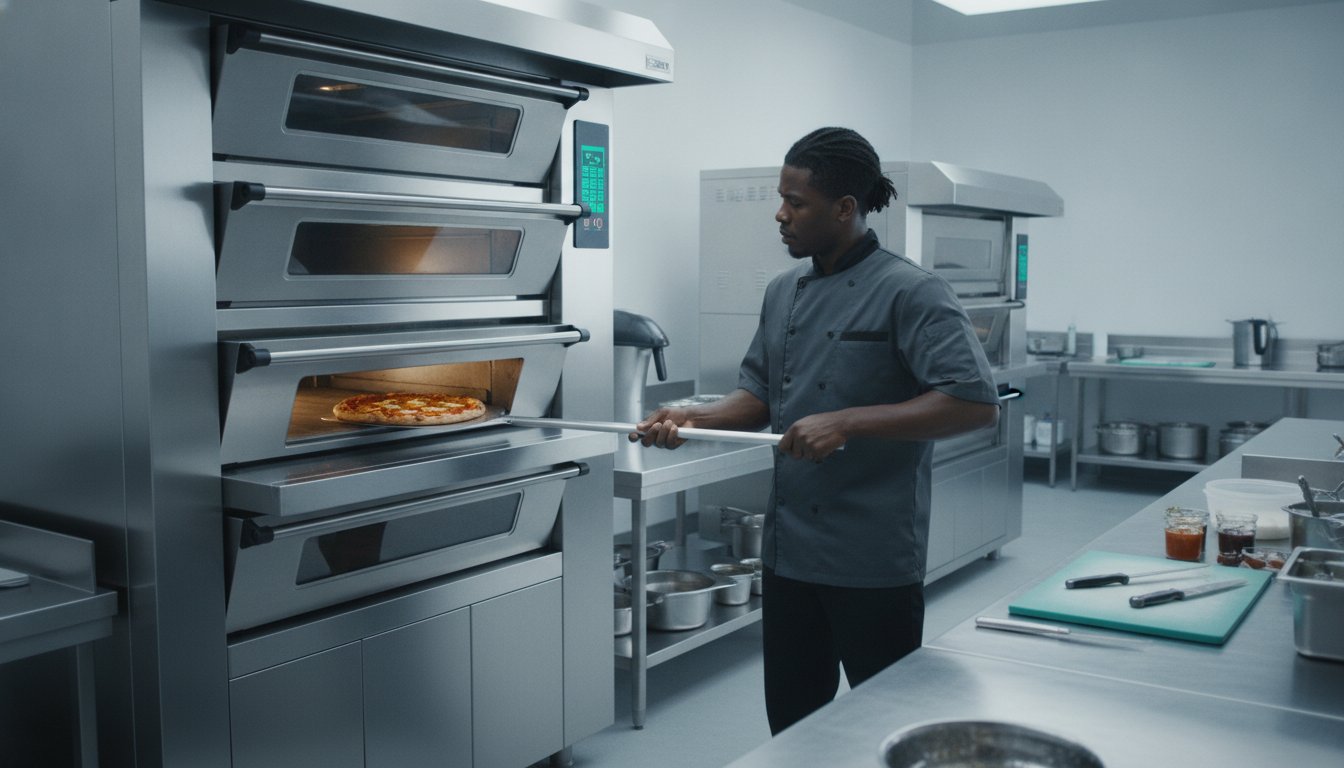
What if the secret to a perfect, golden crust during a Friday night rush isn’t actually your chef’s intuition, but the engineering of your equipment? You’ve likely felt the pressure when tickets pile up and the kitchen heat rises, making it nearly impossible to maintain consistency while your team manages high-maintenance rotations. Understanding the various commercial pizza oven types is the first step toward reclaiming your peace of mind and ensuring every guest receives a premium experience. With new 2026 Department of Energy regulations requiring stricter standby power limits and precise AI temperature controls, choosing the right engine for your kitchen has never been more critical for your bottom line.
We understand that you’re looking for more than just a piece of hardware; you’re seeking a partner in your culinary success. This guide will help you master the technical nuances of modern equipment so you can find a solution that reduces training time and scales your production effortlessly. We’ll walk you through the efficiency of conveyor systems, the artisan quality of deck ovens, and how the latest technology ensures your signature crust remains the same from the first order to the last. Get ready to discover a seamless path to high-volume hospitality that keeps your kitchen cool and your customers coming back for a truly Select experience.
Think of your kitchen as a high-performance vehicle. The oven isn’t just another piece of equipment; it’s the engine that powers your entire operation. While a home cook might prioritize aesthetics or a weekend hobby, a professional operator must view commercial pizza oven types through the lens of industrial reliability. This is likely the single most significant investment you’ll make. It dictates everything from your monthly utility bills to your long-term staffing requirements. Choosing the wrong engine can lead to a kitchen that’s too hot, too slow, or too expensive to run.
We use what we call the “Select” Framework to help our partners make this critical decision. It’s a balanced look at four pillars: Throughput, Labor, Footprint, and Flavor profile. Your business model is the ultimate guide here. A delivery-focused shop needs a scalable, consistent engine that can handle hundreds of orders without a dip in quality. Conversely, a boutique dine-in spot might prioritize the visual appeal and specific crust texture of a stone hearth. Moving beyond a “home pizza” mindset is essential; you’re investing in heavy-duty machinery designed to perform under pressure for years, a standard of excellence also championed by international suppliers like Cyberspace Kitchen & Bakery Equipment.
Peak-hour demand is the only metric that truly matters when the tickets are trailing out the door. You need to calculate your maximum pies per hour to ensure your engine doesn’t stall during a Friday night rush. When evaluating different commercial pizza oven types, the trade-off between artisan control and automated ease is your most important decision. Skilled labor is increasingly rare and expensive. A deck oven requires a master’s touch to rotate and monitor pies; however, a conveyor oven offers “no-look” consistency. This repeatability allows you to scale your production without your quality dipping when your lead chef takes a day off.
The quest for consistent heat usually leads to a choice between gas and electric. Gas remains the gold standard for reliability and fast recovery times in high-volume environments. It provides the raw power needed to maintain temperatures even when the belt is full or the doors are constantly opening. While electric models are excellent for satellite locations with restrictive ventilation codes, Southern Select focuses on high-performance gas-fired industrial solutions because they offer the durability required for 2026’s demanding market. Understanding these Pizza oven types and their fuel requirements ensures you don’t face unexpected utility hurdles during your build-out. We want your kitchen to be a place of hospitality and efficiency, not a source of technical frustration.
When your business transitions from a local favorite to a high-volume powerhouse, your kitchen needs a shift in strategy. Conveyor ovens represent the primary standard for delivery-focused operations among all commercial pizza oven types. These machines utilize a continuous-motion belt that carries your product through a precisely controlled heated chamber. It’s the ultimate “set it and forget it” solution. By automating the bake time and temperature, you eliminate the need for a highly skilled oven master to constantly tend the deck. This reliability ensures that the crust your customers love on a Tuesday is exactly what they receive during the chaotic Friday night rush.
Space is often at a premium in a bustling kitchen, especially in our vibrant coastal communities. One of the greatest advantages of choosing a conveyor system is its inherent stackability. You can double or even triple your production capacity by stacking units vertically without expanding your kitchen’s physical footprint. This allows your business to scale seamlessly as demand grows. If you’re planning for long-term growth, our experts at Southern Select can help you evaluate how a stacked configuration might optimize your specific workflow.
The secret behind the speed of modern conveyors is air impingement. Traditional ovens rely on slow-moving air, but impingement uses high-velocity “fingers” of heat to strip away the cold boundary layer of air that naturally surrounds cold dough. This process allows for a perfect bake in as little as four minutes, which is significantly faster than standard convection. Air impingement is the precision-engineered delivery of vertical hot air jets. This technology doesn’t just cook faster; it provides a crispness and bake quality that was once thought possible only in a traditional hearth.
In a professional environment, downtime is the enemy of hospitality. We focus on brands like XLT and EDGE because they’ve become industry benchmarks for durability and ease of use. Staying ahead of the curve means looking at recent innovations in pizza oven technology, where high-end manufacturers have prioritized tool-less maintenance and quiet operation. A quieter kitchen reduces staff fatigue and creates a more pleasant environment for your team. These ovens are designed for quick cleaning, but to ensure your investment stays in top condition through professional deep-cleaning, you can visit Premium Oven Cleaner for specialized commercial services.
If you’re aiming for that classic, blistered crust that defines an artisan experience, you’re likely considering a deck oven. Among the various commercial pizza oven types, the deck oven is the one that most closely honors the ancient tradition of the stone hearth. These units rely on a combination of conduction heat from a thick stone or ceramic deck and radiant heat from the surrounding air. This dual-action heating creates the unmistakable stone-baked finish that many connoisseurs demand. In an open-kitchen concept, the sight of a chef skillfully sliding a peel into a glowing oven adds a layer of theater and hospitality that makes your guests feel right at home.
However, choosing a deck oven is a commitment to craftsmanship that extends beyond the equipment itself. Unlike automated systems, a deck oven requires a “pilot” who understands the nuances of heat management. You’ll find that your staff needs specialized training to handle the rotation of pies and the monitoring of “hot spots” within the chamber. It’s a rhythmic dance that, when done correctly, produces a superior product, but it leaves little room for error during your busiest hours.
The primary draw of a deck oven is the ability to achieve perfect “leopard spotting” on the crust, a sign of high-quality fermentation and intense heat. But you must weigh this against the operational reality of a high-volume kitchen. The most common pitfall is managing “recovery time.” During a heavy rush, the stone deck loses heat every time a cold pizza is placed on it. If you load too many pies in quick succession, the stone temperature drops, leading to the dreaded “soggy bottom” even if the toppings look cooked. Without a skilled operator to manage the deck’s recovery, you risk serving inconsistent product when your reputation is most at stake.
Many growing pizzerias eventually find that the labor costs of tending multiple decks become unsustainable. This is often the point where they transition to commercial conveyor pizza ovens to maintain consistency while scaling their delivery business. While some purists use a hybrid approach, using a deck for signature pies and a conveyor for high-volume orders, understanding the trade-offs is vital for your long-term success.
| Feature | Pizza Deck Oven | Conveyor Oven |
|---|---|---|
| Labor Requirements | High (Constant tending) | Low (Set and forget) |
| Bake Time | 6 to 10 minutes | 4 to 5 minutes |
| Consistency | Variable (Human-dependent) | High (Automated) |
| Footprint | Large (Harder to stack) | Compact (Highly stackable) |
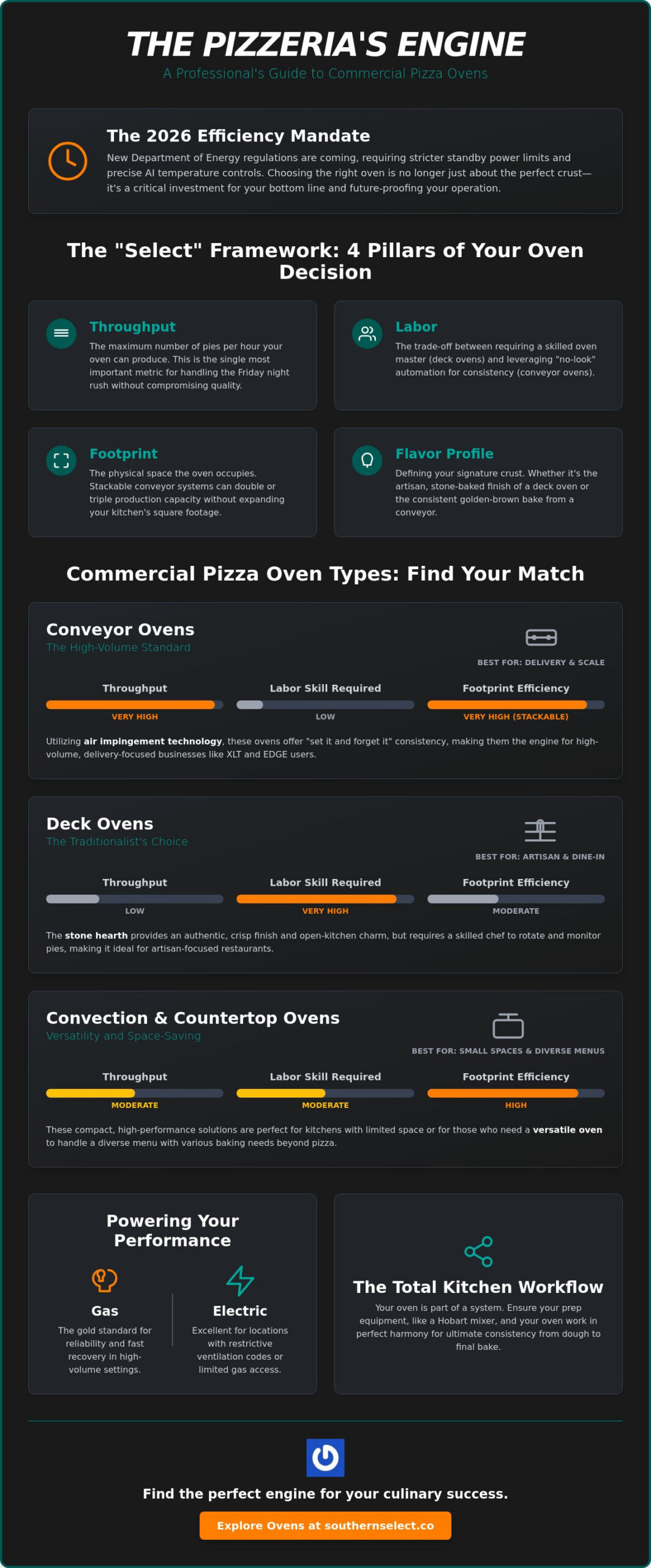
While high-volume conveyors and artisan deck ovens often dominate the conversation, many hospitality venues require a more flexible approach. If you’re running a cafe, a coastal bar, or a kitchen with a diverse menu, you might find that convection and countertop models are the most practical commercial pizza oven types for your specific needs. These units allow you to maximize every square inch of your floor plan while still delivering a quality product to your guests. They act as the jack-of-all-trades in a busy kitchen, handling everything from appetizers to specialty flatbreads with ease.
We often see Lincoln Impinger ovens serving as the perfect solution for mid-volume or specialized prep environments. They offer a level of precision and consistency that bridges the gap between a standard kitchen oven and a heavy-duty industrial conveyor. It’s vital to remember that Southern Select strictly provides professional-grade machinery. We never offer residential units because they simply cannot withstand the rigors of a commercial environment. You need equipment that embodies integrity and reliability, ensuring your kitchen stays operational when it matters most. If you’re ready to find the perfect fit for your unique space, you can explore our full range of commercial pizza ovens to see which model matches your vision.
Standard convection ovens are wonderful for roasting and baking, but they present challenges for traditional pizza. The high-speed fans can often dry out your dough before the cheese has a chance to reach that perfect, bubbly melt. However, they’re an excellent choice for par-baked crusts or flatbreads where a shorter, less intense heat is required. If your pizza volume begins to grow, you’ll eventually reach a point where it’s time to upgrade from a standard oven to a specialized pizza engine. This transition ensures your crust maintains its integrity even during your busiest service hours.
For kiosks, bars, and small cafes, countertop solutions are revenue-generating powerhouses. These compact units allow you to offer hot, fresh food without a massive renovation or a sprawling footprint. When selecting a countertop model, don’t overlook the high-voltage electrical requirements; these small-footprint ovens need significant power to maintain the high temperatures required for consistent baking. You need a unit that’s engineered to withstand 12 or more hours of daily use. Choosing a professional-grade countertop unit from a specialized manufacturer like oemhomeappliances means you’re investing in a reliable partner that won’t quit when the orders start piling up.
Selecting the right engine for your kitchen is a major milestone, but a high-performance oven is only as effective as the system surrounding it. Your kitchen is a living ecosystem where every piece of equipment must work in harmony to deliver that perfect slice. While we’ve mastered the technical differences between various commercial pizza oven types, it’s essential to remember that the baking process actually begins long before the dough hits the heat. If your preparation or storage stages are inconsistent, even the most advanced oven will struggle to produce the results your guests expect.
We believe in building a seamless production line that honors the traditions of hospitality while embracing industrial efficiency. This means looking at your workflow from the initial flour delivery to the final box. When you partner with a trusted guide, you’re not just buying hardware; you’re designing a repeatable process that ensures your signature crust remains the gold standard of your community. Our goal is to help you create a kitchen where the staff feels supported by their tools, allowing them to focus on the neighborly service that defines your brand.
The magic of a great pizza starts in the bowl. Proper gluten development is what gives your dough the “spring” it needs to rise beautifully once it enters the heat. This is why we consistently highlight the critical link between Hobart Mixers and your final bake results. A professional mixer provides the heavy-duty power required for high-hydration doughs that might stall a lesser machine. It’s vital to match your mixer’s capacity to your oven’s hourly throughput. If your mixer can’t keep pace with your oven’s potential, you’ll face bottlenecks that no amount of heat can solve.
Cold chain management is the unsung hero of the high-volume pizzeria. Your commercial refrigerators must maintain a precise, steady environment to ensure your dough proofs at the perfect rate. If your storage temperatures fluctuate, your dough’s sugar content and yeast activity will vary, leading to inconsistent browning regardless of which commercial pizza oven types you utilize. Furthermore, line refrigeration is essential for keeping toppings fresh and safe, especially when they’re sitting adjacent to a 500-degree oven; for businesses prioritizing both safety and presentation, professional display and catering equipment from TFSE Products Ltd offers an excellent example of how to bridge the gap between back-of-house storage and front-of-house service.
The Southern Select promise is about expert guidance from prep to plate. We’re here to ensure your kitchen isn’t just a collection of machines, but a well-oiled engine of hospitality that’s ready for any rush the Gulf Coast lifestyle throws your way.
For pizzerias looking to expand that lifestyle and their brand to new territories, Southern Elite Van Lines offers the professional long-distance moving services required to transport your heavy industrial kitchen setup safely.
Building a successful kitchen requires a blend of culinary passion and industrial precision. By mastering the differences between commercial pizza oven types, you’ve taken the first step toward a more efficient and profitable operation. Whether you choose the automated throughput of a conveyor or the artisan touch of a deck oven, your equipment should serve as a reliable partner that supports your team even during the busiest rushes. A truly seamless workflow integrates every stage, from the initial dough mix to the final cold storage, ensuring your guests always receive the high-quality experience they deserve.
As family-owned professional equipment specialists, we understand that these decisions are about more than just hardware; they’re about your livelihood and your community. We specialize in expert-led sourcing for the hospitality industry, focusing on durable technology that stands the test of time. If you’re ready to upgrade your kitchen’s performance, explore our curated selection of high-volume XLT and EDGE ovens. We’re here to help you find the perfect engine for your business with integrity and expert guidance. Let’s build something exceptional together.
Modern conveyor ovens equipped with advanced insulation and standby power limits of 1W are currently the most energy-efficient commercial pizza oven types. These units utilize AI temperature controls to maintain accuracy within ±1.5°C, ensuring you don’t waste fuel during slow periods. By choosing a model that meets the September 2026 DOE regulations, you’re investing in a kitchen engine that keeps your utility costs low while maintaining high hospitality standards.
A triple-stacked conveyor oven can typically produce between 210 and 300 large pizzas per hour, depending on the belt width and your specific bake time. For instance, a standard 32-inch wide belt allows you to run multiple pies side-by-side. This massive throughput is why high-volume delivery shops prefer these commercial pizza oven types, as they allow you to scale your production vertically without needing extra floor space.
Most local fire codes require a Type I or Type II hood for any commercial countertop oven, even if the unit is smaller than floor models. While some specialized ventless units exist, you should always check with your local building department before installation. Proper ventilation isn’t just about safety; it’s about keeping your kitchen temperature comfortable for your team and protecting the integrity of your other equipment.
Air impingement uses high-velocity jets of hot air to strip away the cold boundary layer surrounding your food, while standard convection simply circulates warm air. This focused energy results in a bake that’s significantly faster than traditional convection. It’s the difference between a gentle breeze and a targeted heat source, providing a crispier crust and perfectly melted toppings in a fraction of the time.
You can absolutely bake a variety of menu items in a conveyor oven, including chicken wings, toasted sandwiches, and even appetizers. The key is finding the right “sweet spot” for time and temperature that works for both your primary pizza dough and your secondary items. This versatility makes the conveyor a true workhorse, allowing your staff to produce a diverse menu with the same consistent ease; for those seeking international inspiration to elevate their grilled offerings, click here to learn how to make an authentic chimichurri for the perfect steak.
A professional-grade XLT or EDGE oven typically lasts 15 to 20 years when you follow a consistent preventative maintenance schedule. These machines are engineered for industrial durability, featuring heavy-duty stainless steel and high-quality components designed for heavy daily operation. Because they’re built with tool-less cleaning in mind, your team can easily keep the internal components in top shape, extending the life of your investment; similarly, for maintaining the efficiency of your high-end household kitchen equipment, PrimeTech Appliance Repair provides the specialized expertise needed to prevent unexpected failures.
Gas ovens are generally better for high-volume delivery because they offer faster heat recovery and lower operating costs in most regions. When you’re loading pie after pie during a rush, gas provides the raw power needed to maintain consistent temperatures without dipping. Electric models are a reliable alternative if your location has restrictive ventilation codes, but gas remains the industry favorite for high-capacity power.
You should choose a conveyor oven if your goal is to minimize labor costs and ensure every customer receives a consistent product regardless of who’s working. Unlike deck ovens, which require a skilled artisan to monitor and rotate pies, conveyors automate the entire process. This “no-look” consistency allows you to focus on growing your business and serving your community rather than worrying about burnt crusts.




Leave a Reply