
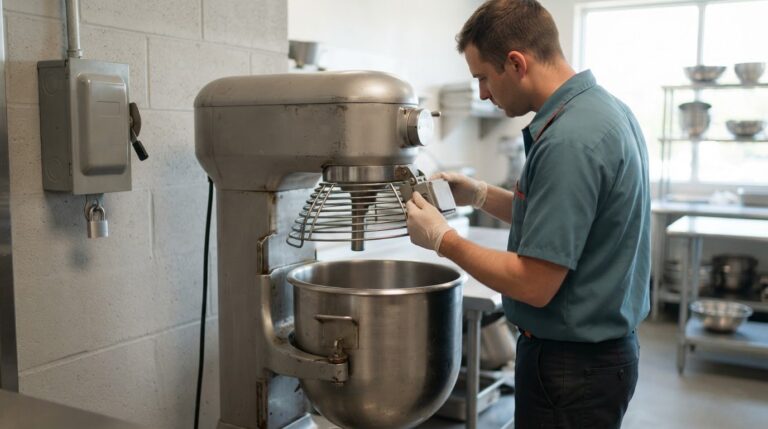
Commercial mixer bowl guards and interlocks should be inspected quarterly. During a planetary mixer bowl guard interlock safety switch inspection, confirm that the switch detects the guard’s position and prevents operation when the guard is open. The guard should be closed before the mixer starts, and closing it should not restart the mixer on its own.
A guard may look secure, but the interlock must communicate its position to the machine’s control system. Understanding how that signal works helps explain why inspection matters and what a safety check should confirm. This article covers how interlocks detect an open or closed guard, what to examine during inspection, and why safe access also requires isolating hazardous energy before maintenance or cleaning.
Key Takeaways
- Understand how the guard’s position is detected and why an open guard should prevent the mixer from starting.
- Learn how the inspection schedule can vary when a safety system’s design creates a risk of fault masking.
- See why closing the guard alone shouldn’t restart the mixer and how a separate start action supports safer operation.
- Recognize why an interlock doesn’t replace hazardous-energy isolation before maintenance or cleaning.
- Explore how safety standards inform interlock design and where Hobart mixers fit into Southern Select Equipment’s commercial equipment offering.
What Is a Safety Interlock Switch and How Does It Work?
A planetary mixer’s bowl guard interlock links the guard’s position to the machine’s control system. When the guard opens, the switch changes state, interrupting the safety function that permits operation. The actuator, a moving part on the guard or switch, triggers that change as the guard moves. The system should prevent startup with the guard open; closing the guard alone should not restart the mixer.
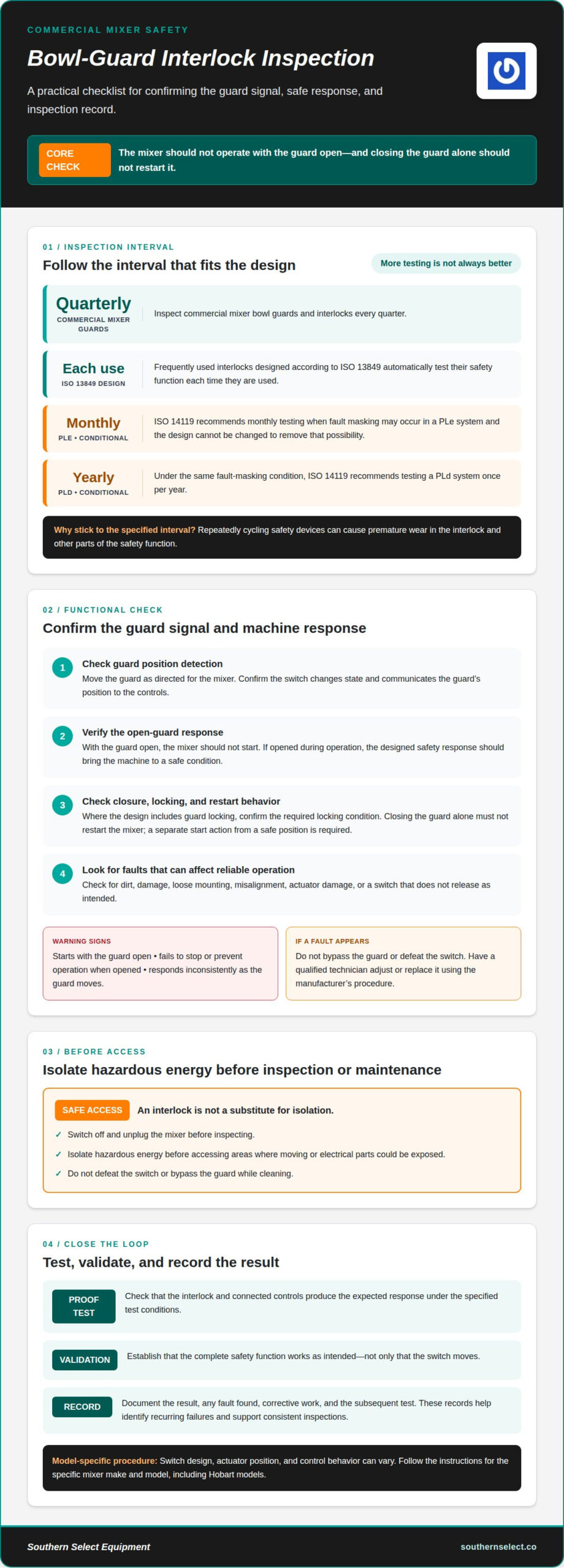
Inspection frequency depends on the interlock design and the risk of fault masking, where a fault can be concealed by another condition. Commercial mixer guards and interlocks should be checked quarterly. Frequently used interlocks designed according to ISO 13849 automatically test their safety function each time they’re used. If fault masking may occur in a PLe system and the design can’t be changed to remove that possibility, ISO 14119 recommends testing the interlocking devices once per month. For a PLd system under the same condition, it recommends testing once per year.
Testing helps monitor the safety function, but more tests are not always better. Repeatedly cycling safety devices can cause premature wear in the interlock and other parts of the safety function, including final control elements. A sound inspection follows the specified test interval and includes regular checks for dirt, damage, loose mounting, and misalignment. Do not bypass the guard or defeat the switch while cleaning.
The inspection procedure depends on the mixer’s make and model because switch design, actuator position, and control behavior can vary. Consult the specific mixer’s instructions for the test method and expected response when the guard opens. For a Hobart mixer, follow the instructions for that model rather than assuming its procedure matches another mixer.
Before inspecting, switch off and unplug the mixer, then isolate hazardous energy before accessing areas where moving or electrical parts could be exposed. Do not rely on the interlock as a substitute for isolation. Warning signs include a mixer that starts with the guard open, fails to stop or prevent operation when the guard opens, or responds inconsistently as the guard moves. Visible actuator damage or a switch that does not release as intended also requires attention.
Repair or replacement costs depend on the switch required, the cause of failure, access to the component, and the work needed to restore and validate the safety function. There is no single typical cost for every model and fault. A qualified technician should adjust or replace the switch according to the manufacturer’s procedure, since a mispositioned actuator can undermine protection.
Proof testing checks that the interlock and its connected controls produce the expected response under the specified test conditions. Validation then establishes that the complete safety function works as intended, rather than confirming only that the switch moves. Record the result, any fault found, corrective work, and the subsequent test. These records help distinguish normal wear from a recurring failure and support consistent inspections.
Allowing operation only when the guard is closed and locked
A guard interlock permits machine operation only when its safety conditions are met. Detecting a closed guard is not the same as confirming that the guard is locked, which matters when access must remain restricted during hazardous movement.
Guard Closure and Locking
A guard interlock sends a signal to the machine’s controls when the guard reaches its required position and, where designed, becomes locked. If the guard is open or its locking condition isn’t met, the control system should prevent operation. This matters because a guard that appears closed may not have engaged the switch or lock correctly. ISO 14119 recommends movable guards be associated with an interlocking device.
Preventing Unsafe Machine Operation
An interlock prevents unsafe operation by interrupting or withholding the control signal required to run the machine. If the guard opens during operation, the designed safety response should bring the machine to a safe condition. This helps limit access to moving parts, but it does not make reaching into a mixer safe while parts are moving or energy remains present.
Guard interlocking devices use different methods to detect position. A mechanical actuator may enter a switch as the guard closes; another design may detect the guard without direct contact. The key inspection question is whether the intended movement produces the correct control response. A loose switch, misaligned actuator, or damaged guard can prevent the signal from changing reliably.
Some systems also lock the guard until hazardous movement has stopped or another safe condition is met. For example, a solenoid-lock interlock uses an electrical signal to control locking. Follow the switch’s design and verify that the guard and lock signals are correct before allowing operation. Closing the guard alone should not restart the machine; a separate start action from a safe position is required.
A trapped-key system uses a physical key to control the sequence between machine operation and access. In a concrete mixer, for example, the access key remains trapped while the hatch is open and can be removed only after the hatch is closed and secured. This makes access and normal operation mutually dependent. Because the mechanism differs from an electrical guard switch, inspect it according to the machine’s design and operating instructions.
During a functional check, the key distinction is whether opening the guard prevents starting or triggers the designed safe response. Then confirm that restoring the guard doesn’t cause an unexpected restart. Record the result and any inconsistent signal, sticking lock, or visible damage; don’t defeat an interlock to keep production running. For broader equipment planning, explore commercial food-service equipment.
Electrical or mechanical isolation before hatch access
Before opening a mixer hatch for cleaning or maintenance, turn the mixer off, unplug it, and isolate hazardous energy. A guard interlock is a protective control, not an energy-isolation device. Electrical interlocks alone don’t replace lockout and tagging procedures. The Occupational Safety and Health Administration says 29 CFR 1910.147 covers control of hazardous energy within its U.S. general-industry scope.
Isolation must account for the mixer’s energy sources and the work being done. Unplugging, for example, addresses the electrical supply, while a mechanically raised bowl or another moving assembly may also need to be secured against movement. If the equipment uses fluid power, stored pressure may remain after the machine stops. Identify each energy source, isolate it using the applicable procedure, and confirm the mixer cannot operate before accessing it.
Interlocks associated with guards can be mechanical or electrical. A mechanical device may rely on direct contact between an actuator and switch; an electrical device changes a monitored circuit when the guard moves. Non-contact safety interlock switches are classified as types 3 and 4 in ISO 14119 (JIS B 9710). The type and application determine how the switch detects access, but neither type replaces isolation before cleaning.
During inspection, examine the guard, actuator, switch mounting, and wiring for visible damage, looseness, or obstruction. A displaced mechanical actuator may not engage the switch correctly. A non-contact switch may also fail to detect the intended guard position if its components are displaced. Keep cleaning materials away from electrical parts, and never bypass the interlock to reach the bowl or hatch.
The bowl lift and height-adjustment parts need attention as separate mechanical components. Some commercial mixer components, such as a sliding bowl height adjustor, may need oiling twice a year. Commercial mixer gears are typically checked weekly for lubrication needs. These intervals do not replace the machine’s maintenance instructions; they show why access work should address relevant mechanical parts as well as the switch.
After cleaning or maintenance, restore the guards and components before returning the mixer to operation. Keep isolation in place while hands or tools remain inside the access area. Then follow the equipment’s procedure for removing isolation and checking normal function. A successful interlock response confirms only one part of the system; it does not establish that a bowl lift, gear, or other mechanical assembly is safe if it is damaged or poorly maintained.
Safety standards for interlocking devices
Standards address different aspects of machinery safety, from risk assessment to control-system design and guard interlocking. For a mixer, their practical value is to help define what the interlock must detect and how its safety function should be assessed.
Industrial Machinery Safety Standards
Industrial machinery standards provide frameworks for assessing hazards and designing safety-related controls. According to the International Organization for Standardization, ISO 13849-1:2023 covers general principles for designing safety-related parts of machinery control systems. ISO 12100:2010 addresses machinery risk assessment and risk reduction. These standards serve different purposes, so identifying the relevant scope helps place a bowl-guard switch within the machine’s wider safety system.
Mixer Guarding Standards
Mixer guarding standards focus attention on how a movable guard and its interlocking device work together. ISO 14119:2024 applies to interlocking devices fitted to guards, doors, or access points. ISO 14119 also recommends associating movable guards with an interlocking device. For an inspection, that means considering the guard’s position, actuator, switch, and control response, rather than treating the switch as an isolated component.
Machinery Safety Standards
Machinery safety standards describe design principles, while a mixer’s manufacturer instructions explain the intended arrangement for that model. IEC 62061:2021+A1:2024 provides a framework for machinery safety-related control systems. The relevant approach depends on the machine’s risk assessment and safety design. This context matters because a switch that appears intact may still be misaligned or unsuitable for its intended safety function.
Use each standard for its proper purpose. ISO 12100:2010 concerns risk assessment and risk reduction; ISO 13849-1:2023 concerns safety-related control-system design; ISO 14119:2024 concerns interlocking devices associated with guards and access points. These scopes help distinguish the guard’s physical protection from the control system’s response when the guard moves.
When inspecting a planetary mixer, compare the intended guard position with the actual switch and actuator alignment. Then check whether opening the guard produces the machine’s designed safe response and whether operation is permitted only through the intended restart sequence after the guard closes. A bent guard, loose mount, or displaced actuator can affect this relationship even when the switch housing looks undamaged.
Standards do not replace instructions specific to the mixer’s design. The manufacturer’s documentation identifies the intended switch type, mounting arrangement, and test method. Keep the model information with inspection findings, especially when replacement or adjustment changes the actuator position. These records help maintenance staff assess whether the interlock remains consistent with the machine’s intended safety design.
How safety interlock switches detect whether a guard is open or closed
A safety interlock detects guard position through a switch and actuator, then communicates that state to the machine’s control system. In a mechanical design, the guard moves an actuator into or away from the switch. In a non-contact design, paired components detect the guard without physical contact—a principle common in industrial automation where sensor developers like Contrinex manufacture smart sensors for machinery and factory applications. In both cases, the control system uses the signal to determine whether normal operation is permitted.
When the guard opens, the switch changes state and the safety circuit interrupts or withholds permission to run. Closing the guard changes the switch state back, but does not necessarily restart the mixer. The machine’s controls should require the intended restart action. This distinction helps prevent an unexpected start while someone is accessing the bowl or moving parts.
Some interlocks include a locking mechanism as well as position detection. The lock keeps the guard closed until the designed release condition occurs; a separate signal monitors whether locking is engaged. A solenoid-lock interlock has a particular circuit behavior: the door is unlocked and can be opened when NC contact D is open and the circuit between terminals 1 and 2 is interrupted. That describes this circuit arrangement, not every mixer interlock.
Inspect the full signal path, not just the switch housing. Check whether the guard and actuator meet in the intended position, whether the switch is firmly mounted, and whether wiring and connectors appear intact. Then observe the machine’s response as the guard moves through its designed range. A loose actuator, obstructed guard, or damaged component can prevent the control system from receiving the expected signal.
A useful functional check distinguishes three conditions: guard open, guard closed, and guard closed with locking engaged, if the mixer has a lock. The expected indication or machine response should match the manufacturer’s instructions for that model. An indicator light alone does not prove that the complete safety function works. Check whether the control system permits or prevents operation correctly in each condition.
Record the observed guard position, switch response, locking behavior, and any inconsistent signal. If the mixer starts with its guard open, fails to respond as the guard moves, or won’t release as designed, stop using it until the fault is addressed. Don’t bypass the circuit to restore production. For commercial mixer options, explore Hobart mixers suited to food-service operations.
Southern Select Equipment: Hobart Mixers
Southern Select Equipment offers Hobart Mixers for commercial food-service operations. If you are evaluating a mixer for a busy kitchen, consider the guard and interlock design alongside the machine’s intended use and your team’s operating needs.
Understanding how an interlock should respond can help you ask more focused questions about a mixer’s safety features and model-specific instructions. Southern Select Equipment can help you explore its Hobart mixer options as part of your commercial equipment planning.
Southern Select Equipment also offers XLT Pizza Ovens, EDGE Pizza Ovens, and Conveyor Ovens for other food-service needs. Contact Southern Select Equipment to discuss Hobart Mixers for your operation.
Make Your Next Equipment Decision With Confidence
A planetary mixer bowl guard interlock safety switch inspection is most useful when its findings guide a clear maintenance or equipment decision. Record unresolved concerns, share them with the person responsible for equipment decisions, and use the model’s instructions to determine the next step. A clear handoff makes safe access part of dependable kitchen operations, not an isolated check.
If you are planning a commercial kitchen or reviewing equipment needs, Southern Select Equipment can help you consider options suited to your operation. Start the conversation with the work your kitchen handles, the equipment already in place, and what you need it to support.
Contact Southern Select Equipment to discuss your commercial equipment needs. A thoughtful next step helps you move forward with care and confidence.
Frequently Asked Questions
Why does bowl lock matter so much for mixer safety?
The bowl lock secures the bowl in its intended position, while the guard interlock monitors access through the guard. They perform different jobs. A guard switch, for example, can signal that the guard is closed, but that signal does not secure an improperly positioned bowl. Check bowl retention and guard interlocking separately, and do not operate the mixer if either component is damaged or fails to engage.
What is the purpose of a planetary mixer bowl guard interlock safety switch?
The interlock detects the bowl guard’s position and prevents operation when the guard is open. The switch sends a signal to the mixer’s control system, which responds according to the machine’s design. For example, the controls may prevent startup with an open guard. The interlock supports safe access, but it does not replace energy isolation before cleaning or maintenance.
How to test whether a planetary mixer guard interlock switch is functioning correctly?
Use the manufacturer’s test procedure to confirm that the control system responds correctly as the guard changes position. With the area clear, check that the mixer will not start when the guard is open, then confirm the specified response when it closes. Closing the guard should not cause an unexpected restart. Do not bypass the switch or put your hands near moving parts to test it.
How often should commercial planetary mixer interlocks be inspected?
Commercial mixer guards and interlocks should be inspected quarterly. For frequently used interlocks designed according to ISO 13849, the safety function is automatically tested each time the interlock is used. If fault masking may occur and the design can’t be changed, ISO 14119 recommends testing interlocking devices once per month for a PLe system, or once per year for a PLd system.
What OSHA or other US requirements apply to commercial mixer bowl guards and interlocks?
The Occupational Safety and Health Administration’s 29 CFR 1910.147 covers control of hazardous energy within its U.S. general-industry scope. Electrical interlocks aren’t a substitute for lockout and tagging procedures; 29CFR 1910.333(b)(2)(B) is the regulatory reference cited for that restriction. In practice, an interlock check and an energy-isolation procedure address different safety needs during access or maintenance.
What risks come from bypassing or operating a mixer with a defective interlock?
Bypassing a defective interlock removes the control response intended to prevent operation with the guard open. The mixer could then run while someone has access to moving parts, creating the exposure the guard system is designed to limit. A failed switch can also send an unreliable signal, so the machine may not respond correctly to the guard’s position. Stop using the mixer until the fault is corrected.