
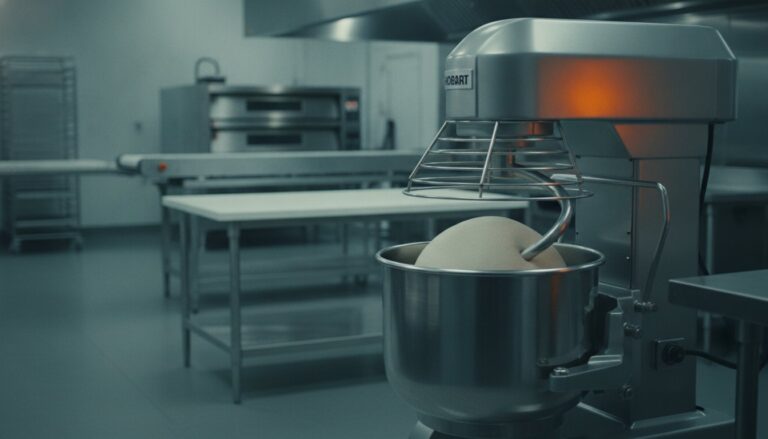
Did you know that mid-tier gear-driven systems fail 40% more often than heavy-duty alternatives, leading to an average of twelve days of lost production every year? In the high-stakes environment of a professional kitchen, those twelve days represent more than just lost revenue; they represent a break in the hospitality you promise your guests. You’ve likely felt the sting of a cheap mixer giving out during a peak rush or struggled with inconsistent dough that compromises your signature crust. That’s why many successful operators view hobart mixers as a non-negotiable partner in their long-term growth.
We believe in providing the expert guidance you need to make a “buy once, cry once” investment that stands the test of time. It’s about finding a equipment solution that offers the same integrity and reliability you put into every dish you serve. In this guide, you’ll discover how the latest 2026 features and updated NSF sanitation standards make these machines more efficient than ever, with new motor technology that can save you $120 annually in energy costs. We’ll walk you through the specific differences between the Centerline and Legacy+ series to ensure you select the perfect model for your volume. Let’s explore how to bring seamless, professional-grade power to your kitchen.
Key Takeaways
- Discover why proprietary planetary mixing action and superior engineering allow these machines to outlast the very kitchens they inhabit.
- Learn the critical differences between the versatile Centerline series and the heavy-duty Legacy series to find your perfect production match.
- Avoid the costly mistake of under-sizing your equipment by mapping specific quart capacities to your actual kitchen volume.
- Extend the lifespan of your hobart mixers with simple daily cleaning protocols and expert bowl clearance adjustments.
- Optimize your entire kitchen workflow by pairing consistent dough results with high-volume conveyor pizza ovens for a seamless guest experience.
Why Hobart Mixers Remain the Professional Industry Standard
Choosing equipment for your kitchen is about more than just checking a box on a list; it’s about building a foundation for your business. When you look at the Hobart Corporation history, you see a legacy of engineering that hasn’t just followed industry trends; it has set them. For decades, hobart mixers have been the heartbeat of high-volume pizzerias and bakeries because they’re built with a “buy once, cry once” philosophy. While other machines might look similar on the surface, the internal engineering is where the true value lies.
To see how professional-grade reliability translates into a successful operation, you can discover Midnight Munchie Company, a specialized bakery that relies on consistency to deliver fresh, baked-to-order treats.
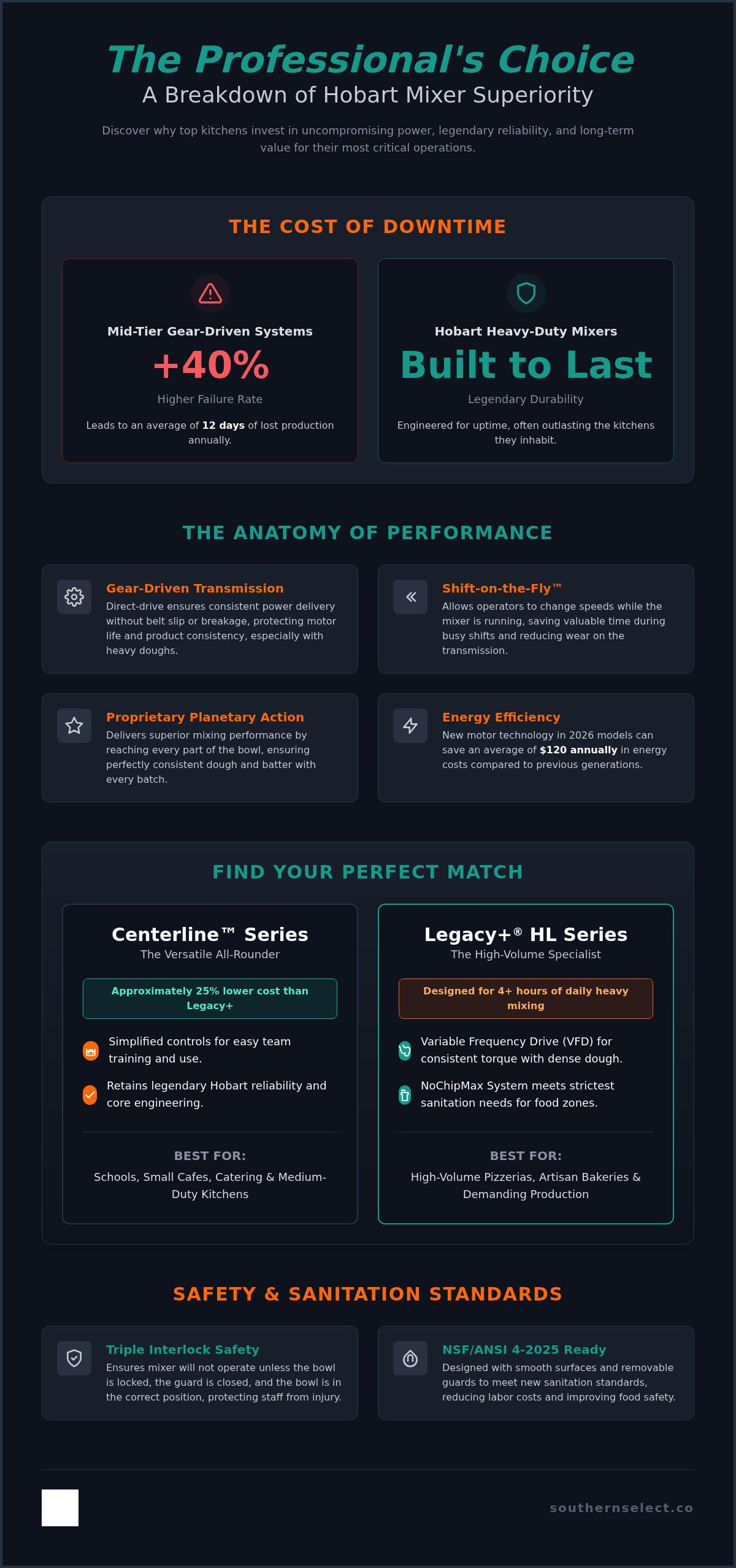
The durability of these machines is legendary. In fact, many hobart mixers actually outlast the kitchens they were originally installed in. This longevity translates directly to your bottom line. Industry data shows that mid-tier gear-driven systems fail 40% more often than these heavy-duty alternatives. When a mixer goes down, you lose production time, staff morale, and potentially customers. Investing in a Hobart means you’re investing in uptime. This reliability is also why these machines hold their resale value so exceptionally well; a used Hobart often fetches a higher price than a brand-new entry-level competitor because the market trusts its integrity.
The Anatomy of a Hobart: Gear-Driven Performance
The secret to this legendary performance is the direct-drive transmission. Most budget mixers rely on belts that can slip, stretch, or snap when you’re working with heavy, high-hydration doughs. Hobart uses a gear-driven system that ensures consistent power through every rotation. This prevents motor slip and protects your product quality. Modern models also feature Shift-on-the-Fly technology. This allows your team to change speeds while the motor is running, which saves time and reduces wear on the transmission during a busy shift.
Standard-Setting Safety and Sanitation
Protecting your staff is just as important as protecting your dough. Hobart’s Triple Interlock system is a masterclass in safety engineering, ensuring the mixer won’t start unless the bowl is locked, the guard is closed, and the bowl is in the proper position. Beyond safety, sanitation is a top priority. With the new NSF/ANSI 4-2025 standards in place, having equipment designed for easy cleaning is vital. Hobart’s easy-clean designs feature smooth surfaces and removable guards that significantly reduce labor costs at the end of the night, allowing your team to focus on hospitality rather than scrubbing gears.
Comparing the Lineup: Hobart Legacy vs. Centerline Series
Choosing between equipment tiers isn’t about finding the “best” machine; it’s about finding the right partner for your specific daily rhythm. In a busy kitchen, your mixer is a member of the team. If you’re running a high-volume pizzeria, you need a workhorse that never tires. If you’re a boutique cafe with a diverse but lower-volume menu, you need versatility without over-investing in power you’ll never use. Understanding the practical differences between these two lines ensures your investment supports your growth without straining your budget.
The Legacy HL Series: For the High-Volume Specialist
The Legacy HL series is the heavy-duty standard for operations that never stop. If your kitchen produces dense pizza dough or heavy bagels for more than four hours a day, this is your machine. Models like the HL120 and HL200 are designed with a Variable Frequency Drive (VFD), which provides a smooth start and consistent torque even under the heaviest loads. This technology prevents the motor from straining when you’re working with low-hydration doughs that would stall a lesser machine. Pizzerias often choose the HL series because of the NoChipMax System, which includes protective covers for the yoke and feet to prevent paint from entering the food zone, meeting the strictest sanitation requirements.
Centerline by Hobart: The Versatile All-Rounder
The Centerline series offers a sophisticated solution for kitchens with medium-duty needs. These hobart mixers, including the HMM20 and HMM30 models, are perfect for schools, small cafes, and catering operations where mixing is a part of the day rather than the entire focus. You get the legendary Hobart reliability at a price point roughly 25% lower than the Legacy line. The controls are simplified for ease of use across different staff shifts, making it a seamless addition to any team. While it lacks the VFD of its larger siblings, it still delivers the proprietary planetary mixing action that ensures every ingredient is perfectly incorporated.
When deciding between the two, consider your duty cycle carefully. The Centerline is rated for less than four hours of use per day. Pushing a medium-duty machine beyond its intended capacity is the fastest way to invite mechanical fatigue. Regardless of which tier you choose, both lines are engineered to meet OSHA safety standards for vertical mixers, featuring mandatory bowl guards and interlock systems that protect your staff during every shift. If you’re ready to see how these models compare in person, our team can help you find the right hobart mixers for your specific production goals.
Ultimately, the sweet spot for your business lies at the intersection of volume and variety. The Legacy series provides the raw power needed for repetitive, heavy tasks, while the Centerline offers the flexibility and value required for a multi-functional kitchen. By matching the machine to your actual output, you ensure a reliable workflow that keeps your hospitality at the forefront of the guest experience.
Selecting the Right Capacity: A Quart-by-Quart Breakdown
Choosing the right capacity for your hobart mixers is one of the most critical decisions you’ll make for your kitchen’s long-term efficiency. It’s easy to look at a bowl and think it fits your needs, but the real question is whether the motor can handle the physical resistance of your specific ingredients. Overloading a mixer doesn’t just result in a poor mix; it places immense strain on the gear-driven transmission, leading to premature wear and costly repairs. We always recommend calculating your batch size based on the total weight of the finished dough, not just the dry flour, to ensure your machine stays within its optimal performance range.
To make high-volume production more manageable, Hobart includes an ergonomic “Bowl-Down” feature on its larger floor models. This allows your team to easily access the bowl and change attachments without straining their backs or shoulders, a small but vital detail that supports a healthy, happy staff. Adhering to commercial mixer safety standards is also easier with these designs, as the bowl guards and interlocks are integrated seamlessly into the daily operation to protect your employees during every shift.
Countertop vs. Floor Models
Small-batch operations, like a boutique cafe or a test kitchen, often find that a 5 to 20-quart countertop model provides the perfect balance of power and footprint. However, once your production requires consistent batches of 30 quarts or more, it’s time to transition to floor mixers. These units, ranging up to 140 quarts, require dedicated floor space and specific electrical configurations, often needing 200-240V or even three-phase power. Before you commit, ensure your kitchen layout allows for the necessary clearance to operate the bowl lift and clean the surrounding area effectively.
Dough Capacities for Common Menu Items
For a 60-quart Hobart HL600, the maximum flour capacity is generally rated at 40 pounds for heavy bread dough, though this varies based on the hydration level of your specific recipe. Density plays a huge role in how you utilize your equipment. For example, a bowl that easily handles 60 pounds of mashed potatoes might only safely manage 30 pounds of dense pizza dough. Using the correct “Dough Hook” attachment is essential here; it’s designed to fold and knead high-volume bread production without allowing the dough to climb the shaft. If you’re unsure which model fits your menu, our team at Southern Select Equipment can help you calculate your exact requirements based on your production goals.
Maintaining Your Investment for Decades of Service
Stewardship of your equipment is a core part of running a successful, hospitable kitchen. When you invest in hobart mixers, you aren’t just buying a machine; you’re securing a partner that can serve your community for decades if treated with the right care. Research shows that regular 6-month maintenance checks can extend a mixer’s life by up to 25%, ensuring that your production never skips a beat during those high-stakes peak hours. Proper maintenance starts with daily habits that prevent small issues from turning into catastrophic failures.
Flour is the primary enemy of internal gears. Fine particles can migrate into the planetary head over time, acting as an abrasive that wears down components. A thorough daily wipe-down of the planetary shaft and the area around the bowl lift is essential. You should also pay close attention to bowl clearance. If the beater is too low, it can scrape the bowl and damage the motor; if it’s too high, you’ll find a “dead zone” of unmixed ingredients at the bottom. Performing a simple “nickel test” ensures your attachments are perfectly calibrated for a consistent mix every time.
The Hobart Maintenance Checklist
- Weekly Sensor Checks: Inspect the bowl guard and interlock sensors to ensure they engage smoothly. If the machine starts with the guard open, it’s a critical safety risk that needs immediate attention.
- Monitor for Leaks: Look for any signs of oil dripping from the planetary seal. While these machines are built for durability, a leak can lead to gear friction and potential food contamination.
- Hub Hygiene: Clean the #12 attachment hub after every use. Built-up debris here can cause attachments to bind, making it difficult to switch between slicing and grinding tasks.
Optimizing Performance with Genuine Attachments
It’s tempting to look for budget-friendly third-party beaters, but these often lack the precise tolerances required for Hobart’s gear-driven system. Using non-genuine attachments can put uneven pressure on the mixer shaft, leading to wobbling or even a snapped drive pin. Genuine Hobart attachments are engineered to match the exact torque of the motor, preserving the integrity of the transmission. To keep your workflow seamless, we recommend storing heavy bowls and dough hooks on dedicated racks rather than stacking them, which prevents warping and ensures they always lock into place perfectly.
Listening to your machine is the best way to catch early warning signs. If you notice unusual grinding noises or a change in the motor’s pitch under a standard load, it’s time to call for professional service before a minor part replacement becomes a major overhaul. If you’re looking to upgrade your current setup to a more reliable solution, explore our curated selection of hobart mixers and see how expert-grade equipment can transform your kitchen’s productivity.
Total Kitchen Efficiency: Pairing Hobart with High-Volume Ovens
Every chef knows that a signature crust starts in the bowl, but it’s perfected in the heat. If your dough isn’t consistent, your oven performance will suffer, regardless of how advanced the technology is. This is especially true when using conveyor pizza ovens, which rely on precise timing and temperature to deliver a perfect bake. If dough density varies because of motor slip in a lesser mixer, your bake times will fluctuate, leading to wasted product and frustrated guests. By utilizing the gear-driven power of hobart mixers, you ensure every batch has the exact same gluten structure and hydration level.
We view your kitchen as a complete ecosystem rather than a collection of separate machines. Consider a high-volume pizzeria scaling its operations; pairing a 60-quart Hobart with XLT Pizza Ovens creates a production line that can handle hundreds of pies an hour without a dip in quality. The Hobart handles the heavy lifting of the dough prep, while the XLT provides the reliable, high-speed finish. This synergy reduces labor strain and keeps your guest experience consistent, which is the heart of true hospitality.
Scaling Your Production for 2026 and Beyond
Future-proofing your kitchen means selecting equipment that grows with your aspirations. You don’t want to replace your primary tools every few years as your volume increases. Integrating high-capacity hobart mixers into a high-speed prep line allows your staff to stay ahead of the rush, even as your ticket counts climb. For more insights on building a durable, scalable operation, see our Commercial Restaurant Equipment Guide: Scaling Your Kitchen.
Why Sourcing from Southern Select Equipment Makes the Difference
At Southern Select Equipment, we don’t just move boxes; we build partnerships. Our “Southern Hospitality” approach to professional kitchen consulting means we take the time to understand your unique workflow and volume needs. We offer a curated selection of industry leaders, including Middleby Marshall and Hobart, because we believe our clients deserve the highest standard of integrity in their equipment. You’re invited to view our current Hobart Mixer inventory and get expert advice from a team that’s as invested in your success as you are. Let us help you find the seamless solutions that keep your kitchen running smoothly for years to come.
Build a Foundation for Lifelong Success
Your commercial kitchen is the heart of your hospitality, and every heart needs a reliable beat. Throughout this guide, we’ve explored how hobart mixers serve as that steady engine, providing the durability and consistency required for high-volume production in 2026. Whether you’re kneading dense pizza dough in a Legacy HL series, whipping up specialty batches in a Centerline model, or outfitting a specialized fry station with bespoke frying ranges, the right choice ensures your product quality remains high while your maintenance costs stay low. It’s about more than just a single purchase; it’s about investing in equipment that holds its value and grows alongside your business aspirations.
At Southern Select Equipment, we’re proud to be your trusted local guide in the world of professional kitchen machinery. We offer a curated selection of industry-leading brands and provide the expert national shipping and support you need to keep your business running smoothly. Our team brings deep expertise in high-volume pizza and bakery workflows to every conversation, ensuring you feel like you’re in capable, friendly hands. We invite you to Find Your Professional Hobart Mixer at Southern Select Equipment today. Let’s work together to make your culinary vision a reality with integrity and expert care.
Frequently Asked Questions
What is the difference between a planetary mixer and a spiral mixer?
Planetary mixers use a single beater that rotates on its own axis while revolving around the fixed bowl, much like a planet orbiting the sun. This design offers incredible versatility for diverse menus because you can swap attachments for whipping, mashing, or slicing. Spiral mixers rotate the bowl itself while the spiral hook remains in place, making them specialized workhorses for large batches of heavy bread dough where minimizing friction heat is vital.
How long does a Hobart mixer typically last in a commercial environment?
A properly maintained Hobart mixer can easily last 20 to 30 years, and it is common to see legacy models still in operation after five decades. These machines are engineered with heavy-duty cast iron and gear-driven transmissions that often outlast the lifespan of the kitchens they inhabit. To reach these durability benchmarks, you should stick to a regular lubrication schedule and perform six-month professional maintenance checks to prevent internal gear wear.
Can I use a Hobart mixer for both dough and delicate pastries?
Yes, the versatility of the proprietary planetary action makes hobart mixers ideal for everything from heavy pizza dough to light meringues. By simply switching from a dough hook to a wire whip or flat beater, you can adjust the machine’s performance to suit different textures. The variable speeds allow you to start slow for thick mixtures and increase velocity for aerating delicate creams or batters without overworking the motor.
What electrical requirements are needed for a floor-model Hobart mixer?
Floor models typically require a 200-240V single-phase or three-phase electrical connection, depending on the specific horsepower of the motor. Smaller countertop units often run on a standard 120V outlet, but high-capacity units like the 60-quart Legacy series need dedicated circuits to handle the increased power draw. You should always consult with a licensed electrician to ensure your kitchen’s wiring meets the specific amperage listed on the machine’s data plate before installation.
Is it better to buy a new Hobart Centerline or a used Hobart Legacy?
The choice depends on your daily duty cycle and specific production volume. A new Centerline is an excellent, budget-friendly choice for kitchens mixing for less than four hours a day, offering the peace of mind of a full factory warranty. However, if you are running a high-volume production line with heavy doughs, a used or refurbished Legacy model might be better because it is built for the continuous, heavy-duty use that medium-duty models cannot match.
How do I know if my Hobart mixer needs its bowl clearance adjusted?
You will know it is time for an adjustment if you see unmixed ingredients at the bottom of the bowl or if the beater is physically scraping the metal surface. A common way to check this is the “nickel test,” where you place a coin in the bowl; the beater should move the coin slightly without catching it. Keeping this clearance precise prevents motor strain and ensures your recipes stay consistent across every batch your team prepares.
What attachments are most useful for a high-volume restaurant kitchen?
The most useful attachments for a high-volume kitchen are the #12 hub accessories, such as the VS9 vegetable slicer and the meat chopper. These tools transform your hobart mixers into multi-purpose prep stations that can shred a 40-pound block of cheese in minutes or grind fresh protein for signature dishes. Utilizing the attachment hub reduces the need for multiple standalone machines, which saves valuable counter space and streamlines your team’s daily prep workflow.