
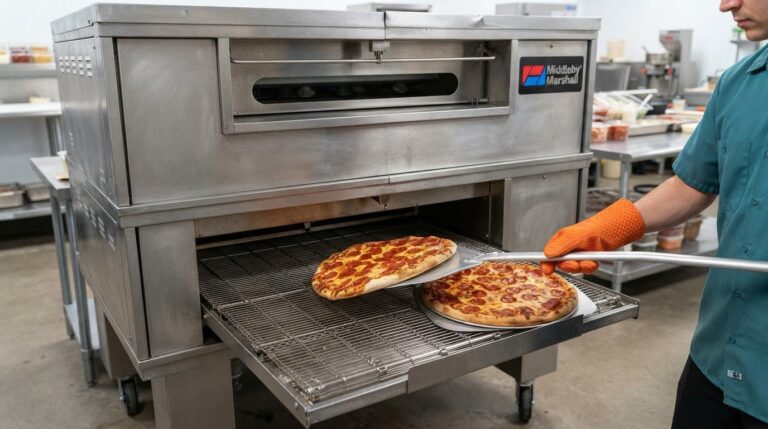
A browned top with a soft base usually signals an imbalance: upper heat is finishing the toppings faster than the oven floor can bake the crust. In top-versus-bottom-heat pizza baking, finger-baffle airflow distribution is part of the equation. Simply extending bake time can scorch the top without fixing the base.
That uneven result is frustrating, especially when the pizza looks ready at a glance. Separate what the upper heat is doing from the contribution of the floor and airflow, then change one factor at a time.
Learn how to troubleshoot a soft base, compare controlled test pizzas, and recognize balanced top and bottom heat. We’ll also explain how airflow across a conveyor oven can affect baking along the belt, helping you identify what to adjust when results vary.
Key Takeaways
- If the toppings brown before the base firms, adding bake time alone can overcook the top; look at the balance between upper heat and heat from the oven floor.
- Change one factor at a time when comparing test pizzas, and allow the oven floor to recover between tests for a more useful comparison.
- Check for consistent baking across the belt by comparing pizzas at the same position and under the same preheat conditions.
- Understand how finger-baffle, impingement, and deck ovens deliver heat before deciding which baking pattern fits your operation.
- Keep oven vents clear; covering them can interfere with airflow and heating performance.
Troubleshooting a soft or uneven pizza base
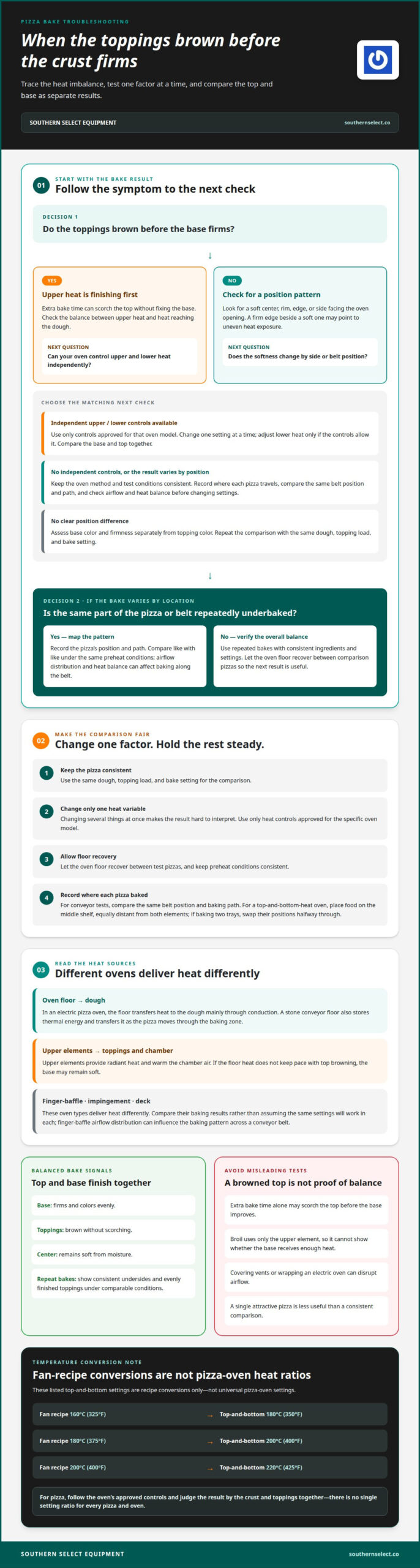
A soft base beneath browned toppings usually indicates an imbalance between upper heat and heat reaching the dough. Change one variable at a time so each test helps pinpoint the cause.
Soft and Uneven Base Symptoms
A soft or uneven base stays pale, flexible, or underbaked while the toppings look finished. That contrast matters: extra bake time may burn the top before the base improves. If one edge is firm and another remains soft, heat exposure may be uneven. Note where the difference appears, such as the center, rim, or side facing the oven opening.
Start with a controlled comparison. Keep the dough, topping load, and bake setting consistent, then change one heat variable. In a stone conveyor oven, independent upper and lower controls allow operators to tune the balance. If the top finishes first, adjust the lower heat only if the oven’s controls allow it. Changing several things at once makes the results hard to interpret.
Comparing Oven Baking Approaches
Finger-baffle, impingement, and deck ovens deliver heat differently, so compare their results rather than assuming the same settings will work in each. In an electric pizza oven, the floor transfers heat to the dough mainly through conduction; upper elements provide radiant heat and warm the chamber air. A stone conveyor floor also stores thermal energy and transfers it as the pizza moves through the baking zone. These differences matter when diagnosing a soft base: floor heat may not keep pace with top browning.
For a useful test, assess base color and firmness separately from topping color. Let the oven floor recover before baking the next comparison pizza. In a top-and-bottom-heat oven, place food on the middle shelf, equally distant from both elements. If you bake two trays, swap their positions halfway through. These steps help distinguish oven-position effects from an overall heat imbalance.
Airflow and Heating Maintenance Issues
Airflow and heating performance depend on keeping the oven’s intended paths clear. Don’t cover vents or wrap an electric oven to retain heat, because blocked openings can disrupt airflow. In a finger-baffle oven, a changed baking pattern across the belt deserves attention: airflow distribution and heat balance both affect the crust. Compare like with like before changing settings.
Use only the heat controls approved for the specific electric pizza oven model. Test one setting change with the same dough and topping arrangement. If the base improves but the top darkens, the comparison shows the heat sources need a different balance. Keep floor recovery consistent between tests, and record where each pizza traveled across the belt. This makes recurring soft spots easier to distinguish from a one-off uneven bake.
Signs of balanced top and bottom heat
Balanced baking shows in the crust and toppings together, not just in a browned surface. Bake settings can vary by oven, so check the model’s instructions when assessing heat distribution. To assess top-versus-bottom heat and finger-baffle airflow distribution in pizza baking, compare the finished top and underside as separate results.
Indicators of Balanced Heat
A balanced pizza has a base that firms and colors as the toppings finish. The top should brown without scorching, while the center of the crust remains soft from moisture. Check the underside, rim, and cheese together. If the cheese darkens while the base stays pale, upper heat is outpacing heat reaching the dough.
Compare pizzas made with the same dough, topping load, and bake setting. Consistent undersides and evenly finished toppings across repeated bakes are more useful signals than one attractive pizza. On a conveyor, compare the same belt position and baking path. If a pizza browns well on only one side, heat exposure may be uneven rather than balanced.
Use the bake setting, not broil, to assess both heat sources. Broil uses only the upper element and browns the top, so it cannot show whether the base receives enough heat. In a top-and-bottom bake, check whether crust and toppings finish together. That paired result is the practical signal to watch.
Top-to-Bottom Heat Ratio
No single top-to-bottom setting ratio suits every pizza and oven. The right balance depends on the oven’s controls, the dough, the toppings, and the finish you want. In a stone conveyor oven with independent upper and lower controls, operators can tune each heat source separately. Judge the result by the top and base together. That’s why top-versus-bottom heat and finger-baffle airflow distribution matter when evaluating pizza baking, rather than relying on a universal ratio.
Change one control at a time, then compare the next pizza using the same ingredients and position. If the top colors too quickly, reduce upper heat or increase lower heat only through controls approved for that model. If the base darkens before the toppings finish, the opposite adjustment may help. Keep the comparison consistent so the changed control remains meaningful.
Recipe conversions offer another useful reference, but they are not a conveyor-oven heat ratio. For a fan-oven recipe at 160°C (325°F), the listed top-and-bottom setting is 180°C (350°F). A recipe at 180°C (375°F) converts to 200°C (400°F), while 200°C (400°F) converts to 220°C (425°F). These examples apply to fan-recipe conversion, not as universal pizza-oven settings.
For pizza, start with the oven’s approved controls and use the finished crust as evidence. A firm, evenly colored base with browned but unscorched toppings indicates a better balance than any single temperature number. In a conveyor oven, look for the same result across comparable belt positions.
How can you diagnose uneven pizza baking across the oven belt?
First distinguish a belt-position pattern from a problem affecting every pizza. Record each pizza’s belt location and describe the result at its center, rim, and leading edge. This creates a simple map of browning differences. The relationship between top-versus-bottom heat, finger-baffle airflow distribution, and pizza baking is easier to assess when each result is tied to a consistent position.
Keep comparison conditions steady. Use the same dough, topping load, and oven setting, and place each test pizza in a recorded location. Note the top and underside separately. For example, a pale strip that repeatedly appears along one side of the belt suggests a position-related pattern. A similarly pale base across several positions points to a broader baking issue.
Before each comparison, check the oven floor at the same point after the prescribed preheat. Readings are difficult to compare if you measure in different locations. An infrared thermometer’s apparent surface-temperature reading can also be affected by surface emissivity, so treat it as a comparative observation. Consider it alongside the pizza’s visible results, not as a stand-alone measure.
- Map the belt: Record each test pizza’s location and the areas that bake differently.
- Keep the product consistent: Match dough and toppings to make position the useful comparison.
- Track separate outcomes: Note top color, underside color, and crust firmness independently.
- Repeat under comparable conditions: Allow the floor to recover before another test.
One unusual pizza is a weak reason to change settings. Repeat the comparison at the same belt locations and look for a pattern that recurs. If one position consistently differs, focus on the baking behavior in that area. If the result follows every pizza, examine the overall heat balance instead. This distinction helps prevent changing a control to address localized variation.
In a stone conveyor oven, the refractory floor stores thermal energy and transfers it to the dough as it moves through the baking zone. Let the floor recover before testing another pizza so the next comparison starts under similar conditions. Consider top-versus-bottom heat, finger-baffle airflow distribution, and pizza baking together, but change only one approved variable after identifying a repeatable pattern.
How do finger-baffle ovens compare with impingement and deck ovens for pizza?
Finger-baffle, impingement, and deck ovens transfer heat in different ways. A setting that works in one oven may not produce the same crust in another.
A finger-baffle conveyor guides heated air through shaped channels above and around the baking area. The baffles direct airflow toward the product, while the moving belt carries each pizza through the oven. Assess the resulting top color and base texture together. Cheese that colors quickly, for example, doesn’t prove that heat reaches the dough evenly.
An impingement oven uses directed air streams to transfer heat to food. Its baking pattern depends on airflow and the pizza’s position in the chamber. Compare the center and rim, then check whether results are similar across the belt. “Impingement” describes how heat is delivered, but its baking pattern is not interchangeable with a finger-baffle oven’s.
A deck oven relies more directly on contact with its heated floor. In an electric pizza oven, the floor transfers heat to the dough mainly through conduction, while upper elements provide radiant heat and warm the chamber air. A stone conveyor floor also stores thermal energy and transfers it to the dough as the pizza travels through the baking zone. These floor-based effects make the base an important point of comparison.
Consider the workflow as well as the crust. A conveyor moves pizzas along a continuous baking path, while a deck oven holds them on a stationary cooking surface. For example, a kitchen comparing batch baking with belt baking should assess each oven using its own appropriate controls. Transferring a recipe or temperature setting between oven types does not preserve the same balance of top and bottom heat.
Evaluate ovens side by side using the product you serve. Keep the dough, toppings, and target finish consistent, then record the top, underside, and edges. In a finger-baffle or impingement conveyor, note whether belt position changes the outcome. In a deck oven, assess how contact with the floor affects the base. The comparison should reflect the oven’s heating method, not just its displayed temperature.
When choosing among oven types, ask which heat delivery method and workflow suit your menu. Finger-baffle and impingement ovens use directed airflow; deck ovens emphasize a heated surface beneath the pizza. For operations that also explore solid-fuel or charcoal-assisted pizza setups, suppliers like Charcoal Kings show how quality hardwood fuel provides the consistent thermal energy needed for proper floor heat. Match the oven’s controls and baking approach to the crust and topping finish you need. Then test within that oven type instead of treating another design’s result as a direct benchmark.
What safety and maintenance issues affect finger-baffle airflow and heating performance?
Finger-baffle ovens rely on directed airflow, so blocked openings or unauthorized adjustments can affect baking. For electric ovens, follow the exact model’s manual and nameplate when setting up or changing heat controls.
Keep vents uncovered. Don’t cover an electric oven’s vents or wrap it to retain heat. These shortcuts can disrupt airflow, which matters in a finger-baffle design that directs heated air through the baking area. Changes in airflow can change pizza results. If openings are obstructed, an otherwise even belt pattern may be harder to interpret.
Use only heat-balance controls approved for the specific oven model. A setting change can affect how quickly the top colors relative to the base, but control options vary by oven. Don’t bypass the model’s intended controls. For a fair comparison, note the current setting, change one approved control, and assess the next bake using the same ingredients and belt position.
Electrical setup matters for an electric oven. Connect it as required by its nameplate and manual, and don’t use an extension cord unless the instructions explicitly permit one. The Electrical Safety Foundation International recommends plugging major appliances directly into a wall outlet and using only one heat-producing appliance per receptacle. These precautions support safe operation without changing the oven’s designed airflow path.
When a baking pattern shifts, distinguish an airflow concern from a recipe change. For example, if pizzas become uneven after the oven’s position or surroundings change, first check whether vents remain open and the oven still follows its prescribed setup. Don’t immediately compensate by increasing heat. That could mask a changed airflow pattern and make the top finish too quickly.
Include maintenance observations in routine production records. Note the oven setting, pizza position, top color, and base result. If a belt area repeatedly produces a different crust, record the pattern before making an approved adjustment. A repeated result under comparable conditions is more informative than one unusual pizza. Keep observations specific, such as “left edge pale” or “top browns before base,” rather than relying on broad labels like “oven weak.”
For cleaning or internal maintenance, follow the instructions for the exact model. Finger-baffle components and airflow paths are part of the oven’s design, so don’t improvise changes to their arrangement. Keep external vents clear, follow the manufacturer’s operating guidance, and use the specified procedures for internal maintenance. Safe setup and consistent observations support airflow performance and make bake comparisons more useful.
Southern Select Equipment
Southern Select Equipment helps food-service operators consider commercial oven options alongside their baking needs. If recurring soft bases or uneven browning have you reassessing your setup, the differences between oven styles and heat delivery can help clarify what matters for your operation. Its offerings include XLT Pizza Ovens, EDGE Pizza Ovens, and Conveyor Ovens. The right choice depends on your menu, workflow, and desired crust, not a single heat setting. For a closer look at equipment options suited to your operation, contact Southern Select Equipment.
Plan your next oven decision with confidence
Understanding top-versus-bottom heat and finger-baffle airflow distribution in pizza baking can turn a recurring crust issue into a clearer equipment decision. Consider the results you need, your kitchen’s workflow, and how consistently your oven handles the pizzas you serve. This provides a practical starting point for choosing a commercial setup, rather than focusing on one setting alone.
Southern Select Equipment offers XLT Pizza Ovens and EDGE Pizza Ovens as part of its restaurant equipment selection. If you’re weighing equipment options for your operation, contact Southern Select Equipment to discuss what may fit your needs. A thoughtful next step can help you move toward a more dependable bake and a smoother service flow.
Frequently Asked Questions
Why is my pizza top done but the bottom soft?
Upper heat is likely browning the toppings faster than heat reaches the crust. A heavy topping load, especially wet ingredients, can also leave the center softer than the edges. Compare a pizza with a lighter, evenly spread topping load while keeping the oven setting and belt position consistent. If the top still finishes first, adjust the oven’s heat balance using its approved controls.
Can I bake pizza with only the top element?
You can use only the top element, but in a United States electric oven that is the broil setting. It browns the top without providing heat from below to bake the base in the same way. For a complete bake, use the setting intended for both upper and lower elements. For ready-to-cook frozen pizza, follow the package’s cooking and resting instructions.
How do upper and lower heat reach the pizza?
Lower heat reaches the dough mainly through contact with the oven floor, while upper elements transfer radiant heat and warm the chamber air. The underside and toppings therefore respond to different heat paths. A browned cheese surface, for example, doesn’t prove the crust has received enough heat. Compare the pizza’s underside with its top, and use both to assess the finished bake.
How do top and bottom heat affect pizza baking in a finger-baffle conveyor oven?
Upper heat contributes to browning toppings, while heat from below helps cook the crust. In a conveyor oven, the pizza travels through a baking zone, so the combined exposure shapes its finished texture. A pizza with a pale base and dark cheese points to a different balance than one with a firm base and lightly colored toppings. Compare these outcomes using the oven’s approved settings.
How do finger baffles distribute hot air across the width of a pizza oven?
Finger baffles guide heated air toward different areas of the oven, shaping how airflow reaches pizzas across the belt. The exact pattern depends on the oven’s design. To check it in practice, compare pizzas baked at different belt positions while keeping the recipe and settings consistent. If one position repeatedly produces a different result, record its location before changing controls or maintenance settings.
How do baffle position and opening size affect airflow and pizza browning?
Baffle position and opening size affect where heated air travels and how it reaches the food. A change can shift browning across the pizza or belt, but no single adjustment suits every oven. The manufacturer’s design determines the intended arrangement. Don’t reposition baffles or alter openings as a trial; use only adjustments permitted for that specific model.
How do top and bottom heat settings affect pizza crust, cheese, and toppings?
More upper heat can brown cheese and toppings sooner, while heat from the floor affects how the crust cooks. If cheese darkens before the base firms, the pizza may look ready but remain soft underneath. If the base gets too dark first, the crust may finish ahead of the toppings. Judge the underside, rim, and topping color together rather than relying on one surface alone.
What adjustments improve airflow distribution in a finger-baffle pizza oven?
Keep external vents clear, and don’t wrap the oven or cover its openings. When a bake is uneven, first determine whether the pattern follows a belt position or appears throughout the oven. Use only model-approved heat controls and don’t alter baffle parts. For frozen, ready-to-cook pizza, follow the package directions instead of changing oven airflow or settings to compensate.