
The oven you choose doesn’t just bake pizza. It defines the pace of your entire kitchen. If you’ve been searching for the right commercial pizza oven for sale and feeling overwhelmed by the options, you’re not alone. Deck ovens, conveyor ovens, impinger ovens. Different heat sources, different footprints, different price points. The choices stack up fast, and the wrong decision can cost you in energy bills, inconsistent output, and frustrated customers during your busiest rushes.
Here’s the truth most buyers already sense: not every oven is built for every kitchen. Volume, menu style, and workflow all shape the right fit for your operation. The good news is that finding that fit doesn’t have to feel like a gamble.
This guide walks you through the essential features to evaluate, the top brands worth considering, including XLT and EDGE ovens, and the practical questions that separate a smart investment from a costly mistake. Whether you’re outfitting a new location or upgrading aging equipment, you’ll leave with a clear, confident path forward.
Key Takeaways
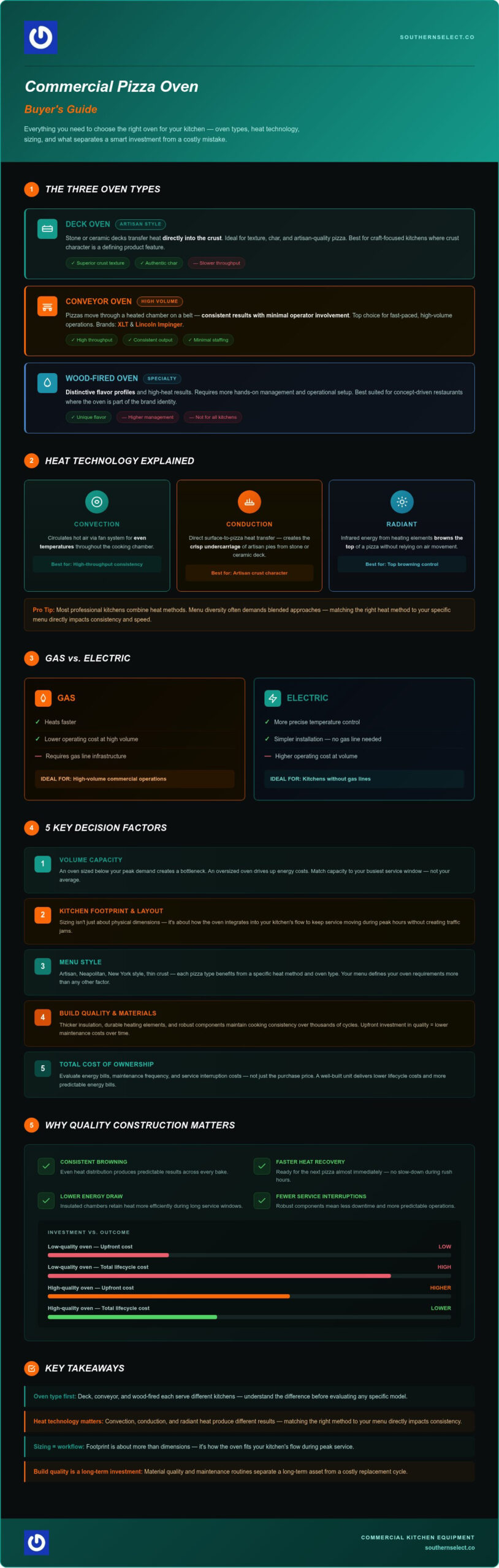
- Not every commercial pizza oven fits every kitchen – understanding the difference between deck, conveyor, and impinger styles is the first step toward a decision that actually serves your volume and workflow.
- Heating technology matters more than most buyers realize: convection, conduction, and radiant heat each produce different results, and matching the right method to your menu can directly impact consistency and speed.
- When evaluating a commercial pizza oven for sale, sizing isn’t just about physical footprint – it’s about how the oven integrates into your kitchen’s layout to keep service moving during peak hours.
- Material quality and a proactive maintenance routine are what separate a long-term asset from a costly replacement cycle – the right oven should be built to perform, not just to impress on day one.
- Expert consultation, like the guidance Southern Select Equipment provides, takes the guesswork out of sourcing reliable equipment and helps you invest with confidence rather than compromise.
Understanding Commercial Pizza Ovens: Key Features and Benefits
The features that set commercial pizza ovens apart are specific and practical. Precise temperature control allows operators to dial in exact cooking conditions for different crust styles and topping loads. Faster heat recovery means the oven is ready for the next pizza almost immediately after the last one comes out. Insulated chambers retain heat more efficiently, reducing energy draw during long service windows. These aren’t luxury features. They’re the baseline for any kitchen running at a professional pace.
Workflow benefits are just as significant as the cooking performance itself. A well-matched oven reduces the bottlenecks that slow down service, keeps ticket times predictable, and gives your kitchen team a reliable tool they can actually work with rather than work around. Food quality follows naturally: even heat distribution produces consistent browning, properly melted cheese, and crusts that hold their texture rather than going soggy or overdone.
Types of Commercial Pizza Ovens
Choosing the right style starts with understanding what each type is built to do:
- Deck ovens use stone or ceramic decks that transfer heat directly into the crust, making them a strong choice for artisan-style pizzas where texture and char matter.
- Conveyor ovens move pizzas through a heated chamber on a belt, delivering high-volume consistency with minimal operator involvement. Brands like XLT and Lincoln Impinger ovens are well-regarded in this category.
- Wood-fired ovens produce distinctive flavor profiles and high-heat results, though they require more management and may not suit every operational setup.
Gas ovens typically heat faster and cost less to operate in high-volume settings, while electric models offer more precise temperature control and simpler installation in spaces without gas lines. Capacity matters too: an oven sized below your peak demand creates a bottleneck, while one that’s oversized drives up energy costs unnecessarily.
Why Quality Matters
High-quality construction directly affects how an oven performs under pressure. Thicker insulation, durable heating elements, and robust internal components don’t just last longer; they maintain cooking consistency over thousands of cycles. When you’re evaluating a commercial pizza oven for sale, the upfront investment in a well-built unit typically translates into lower maintenance costs, fewer service interruptions, and more predictable energy bills over time. Southern Select Equipment’s curated selection focuses specifically on this standard, connecting operators with ovens built to perform reliably rather than just impress at first glance. That’s the kind of equipment that earns its place in a serious kitchen.
Technical Specifications: Understanding Oven Technology
Once you’ve identified the oven style that fits your operation, the next layer of decision-making gets more technical. How an oven generates and transfers heat directly shapes what ends up on the plate. Three core mechanisms are at work in virtually every commercial pizza oven: convection, conduction, and radiant heat. Understanding what each one does, and what it can’t do, is what separates a well-matched purchase from a frustrating mismatch.
Convection heat circulates hot air through a fan system, producing even temperatures throughout the cooking chamber. It’s fast, consistent, and well-suited to high-throughput environments. Conduction heat transfers energy directly from a surface, typically a stone or ceramic deck, into the base of the pizza. This is what creates that characteristic crisp undercarriage in artisan-style pies. Radiant heat works through infrared energy emitted from heating elements above or below the food, browning the top of a pizza without relying on air movement.
Comparing Heating Methods
Each method has a clear performance profile. Convection excels at speed and volume but can dry out toppings if temperatures aren’t carefully calibrated. Conduction delivers exceptional crust texture but requires longer preheat times and more attentive management. Radiant heat adds finishing power and surface color, making it a useful complement rather than a standalone solution. Hybrid ovens combine two or more of these methods, giving operators the flexibility to adjust cooking profiles by product type without swapping equipment. For kitchens running a varied menu, a hybrid unit can be a genuinely practical investment rather than an unnecessary upgrade.
Energy Efficiency and Operational Costs
Energy consumption is one of the most underestimated line items in a kitchen’s operating budget. A high-output oven that runs inefficiently can quietly erode your margins over months. Equipment carrying an Energy Star certification has been independently verified to meet specific performance benchmarks while consuming less energy than standard alternatives. That matters most in kitchens running long service windows where ovens stay on for hours at a stretch.
Digital controls play a meaningful role here too. Programmable temperature settings, timed standby modes, and precise zone management all reduce unnecessary energy draw without sacrificing cooking performance. When you’re evaluating any commercial pizza oven for sale, look at the control interface as a functional tool, not just a convenience feature.
Insulation quality ties directly into this equation. Thicker, better-engineered insulation retains heat more effectively, which means the oven works less to maintain temperature during busy service. Over time, that efficiency compounds into real savings. Southern Select Equipment’s focus on curated, high-quality inventory means the ovens in their selection are built with these operational realities in mind. If you’re ready to match technology to your specific kitchen demands, explore their commercial oven selection and get pointed in the right direction from the start.
Sizing and Layout: Ensuring Optimal Workflow
An oven that’s technically excellent but physically wrong for your kitchen will still slow you down. Size and placement aren’t afterthoughts; they’re decisions that shape every service shift. Getting them right means understanding not just what fits in the room, but what fits the rhythm of how your team actually works.
Choosing the Right Size for Your Needs
Commercial pizza ovens are generally categorized by their cooking capacity, measured in the number of pizzas they can produce per hour or the number of pies that fit simultaneously. A single-deck oven typically handles lower-volume operations well, while double or triple-deck configurations support higher output without requiring additional floor space. Conveyor ovens, like those from XLT and Lincoln Impinger, are sized by belt width and tunnel length, which directly determines throughput during peak service.
Before committing to any commercial pizza oven for sale, work backward from your busiest hour. How many pizzas does your kitchen need to produce in that window? Add a reasonable buffer for growth. An oven that’s already maxed out on day one isn’t a foundation; it’s a ceiling.
Physical footprint matters too, but not just in terms of square footage. Consider:
- Clearance requirements on all sides for ventilation and safe operation
- Door swing and loading access so staff can work quickly without awkward angles
- Utility connections including gas lines, electrical capacity, and hood placement
- Service access for maintenance and cleaning without moving the unit
Workflow Layout for High-Volume Operations
Placement is where most kitchen planning goes wrong. An oven positioned too far from the prep line adds unnecessary steps that compound across hundreds of tickets. The goal is a linear flow: dough preparation, topping assembly, oven loading, and boxing or plating should follow a single direction without staff crossing paths or doubling back.
Ideally, your prep station sits directly adjacent to the oven’s loading end. Ingredient stations should be within arm’s reach of the assembly point. In conveyor setups, the exit end of the oven should flow naturally toward the finishing area where pizzas are cut and boxed. That sequence reduces ticket times and keeps the kitchen calmer under pressure.
For kitchens with limited square footage, stacked deck ovens can dramatically increase capacity without expanding the footprint. Countertop conveyor models are another option worth exploring for lower-volume or secondary locations. The right layout doesn’t just accommodate your oven; it makes the entire kitchen perform better around it. That’s the kind of integrated thinking Southern Select Equipment brings to every equipment conversation, helping operators find solutions that work in the real world, not just on paper.
Durability and Maintenance: Protecting Your Investment
Buying a commercial pizza oven is a capital decision. How long it performs at full capacity depends less on the brand name on the door and more on what’s inside it, and how consistently it’s cared for after installation. Two ovens can look identical on a spec sheet and perform very differently over three years of heavy service. Material quality and maintenance discipline are what separate them.
Material Quality and Construction
Stainless steel is the standard for commercial kitchen equipment, but not all stainless steel is equal. The two grades you’ll encounter most often are 304 and 430. Grade 304 contains a higher nickel content, which gives it superior corrosion resistance and makes it significantly more durable in high-heat, high-moisture environments. Grade 430 is a ferritic steel that costs less to produce but offers lower resistance to oxidation over time. For any commercial pizza oven for sale you’re seriously evaluating, ask specifically which grade is used in the cooking chamber, door frames, and exterior panels. The answer tells you a great deal about how the manufacturer thinks about long-term performance.
Beyond steel grade, look at the weight and fit of the components. Heavy-gauge construction in the oven floor, door hinges, and conveyor belt housing signals that the unit was built for sustained commercial use rather than light-duty performance. Doors that seal tightly without play, burner assemblies that don’t rattle, and control panels with tactile, well-spaced buttons are all indicators of thoughtful engineering. These details matter most at hour ten of a double-shift service.
Maintenance Tips for Commercial Pizza Ovens
A consistent cleaning and inspection routine is the single most effective way to extend oven life. At a minimum, operators should:
- Wipe down exterior surfaces and control panels daily to prevent grease buildup that can damage seals and electronics
- Clean conveyor belts and stone decks according to manufacturer guidelines, typically after each service period
- Inspect door gaskets and seals weekly for cracking or compression loss, which causes heat to escape and energy costs to rise
- Check burner performance and ignition systems monthly to catch degradation before it affects cooking consistency
- Schedule a professional service inspection at least annually, or more frequently in high-volume operations
Certain warning signs should never wait for a scheduled service visit. Uneven browning across the cooking surface, longer-than-normal preheat times, unusual odors during operation, and fluctuating temperature readings all indicate something needs attention now. Catching these early prevents a minor repair from becoming a full component replacement.
Warranties and service agreements deserve the same scrutiny as the oven itself. A strong warranty reflects a manufacturer’s confidence in their product. Service agreements, particularly those that include priority response and access to genuine replacement parts, protect your operation from extended downtime when something does go wrong. Always clarify what the warranty covers, what voids it, and how quickly service can be dispatched before you commit.
If you want guidance on which ovens are built to last and backed by reliable support, connect with Southern Select Equipment and get pointed toward inventory that’s curated with exactly these standards in mind.
Making Your Purchase: Navigating the Market for Quality Ovens
You’ve worked through the technical specs, the sizing considerations, and the durability questions. Now comes the part where research turns into a real decision. The commercial equipment market is crowded, and not every seller operates with the same standards. Knowing how to navigate that landscape is what protects your investment before the purchase order is ever signed.
Why Choose Southern Select
Southern Select Equipment isn’t a general-purpose equipment warehouse. The inventory is curated specifically around commercial kitchen performance, with a focus on brands that hold up under sustained, high-volume use. XLT ovens, EDGE ovens, Lincoln Impinger ovens, and the broader conveyor oven category all reflect that standard. When you’re searching for a commercial pizza oven for sale, that kind of focused expertise changes the conversation entirely.
Rather than sorting through pages of listings without context, you get guidance that’s actually grounded in kitchen operations. The right questions come up early: What’s your peak hourly output? What’s your gas or electrical infrastructure? How does your prep line flow? Those answers shape the recommendation, not the other way around.
On financing, it’s worth asking directly about available options during your consultation. Southern Select can point you toward the right conversation, but confirming specific terms and structures is a step you’ll want to take directly with their team rather than assume in advance.
Next Steps for Successful Equipment Acquisition
Before your consultation, do the groundwork on your end. Measure your available floor space with clearance requirements in mind, not just the oven’s footprint. Confirm your utility connections, including gas line capacity, electrical panel availability, and hood system compatibility. These details determine what’s actually installable in your kitchen, and having them ready saves time on both sides of the conversation.
When you connect with a specialist, bring your peak volume numbers and a rough sketch of your kitchen layout. That information lets the conversation move quickly from general recommendations to specific configurations that will actually work in your space.
Delivery and installation logistics deserve attention too. Confirm lead times, access requirements for your building, and whether installation support is included or needs to be coordinated separately. A smooth installation sets the tone for how the equipment performs from day one.
Every strong kitchen runs on reliable tools. If you’re ready to stop second-guessing and start building around equipment that’s built to last, explore Southern Select Equipment’s commercial oven inventory and take the first step toward a kitchen that performs exactly the way you need it to.
Your Kitchen Deserves Equipment That Works as Hard as You Do
Finding the right commercial pizza oven for sale comes down to three things: understanding how different oven types and heating methods match your menu, sizing your equipment to your actual peak demand rather than your average day, and choosing a unit built from materials that hold up under years of sustained service. Get those three things right, and the rest of your kitchen operation gets easier.
That’s where expert guidance makes a genuine difference. Southern Select Equipment brings a curated selection of leading brands, including XLT, EDGE, and Lincoln Impinger ovens, alongside the focused knowledge to help you match the right unit to your specific kitchen demands. You don’t have to sort through endless listings and hope for the best.
The right oven is out there, and it’s closer than you think. Explore Southern Select Equipment’s commercial pizza oven selection today and take the first confident step toward a kitchen that’s built to perform.
Frequently Asked Questions About Commercial Pizza Ovens
What is the difference between a commercial pizza oven and a residential one?
Commercial pizza ovens are engineered for sustained, high-volume output in ways residential units simply aren’t. They operate at higher temperatures, recover heat faster between bakes, and are built from heavier-gauge materials designed to handle continuous daily use across years of service. A residential oven might bake a dozen pizzas on a busy weekend. A commercial unit is built to handle that before lunch.
The engineering differences extend to insulation quality, control precision, and the thickness of internal components. Southern Select Equipment carries only commercial-grade ovens, including XLT, EDGE, and Lincoln Impinger models, specifically because residential equipment doesn’t belong in a professional kitchen environment.
How long does it take to preheat a commercial pizza oven?
Preheat times vary by oven type and fuel source. Gas conveyor ovens typically reach operating temperature in 30 to 45 minutes. Deck ovens, particularly those with stone or ceramic surfaces, often require 45 to 60 minutes to reach full thermal saturation because the deck itself needs to absorb and hold heat evenly. Electric models can take slightly longer depending on element capacity.
Planning your preheat schedule around your service window is a practical step most operators underestimate early on. Building that startup time into your opening routine prevents the inconsistent results that come from loading pizzas into an oven that hasn’t fully stabilized.
What maintenance is required for a commercial pizza oven?
Daily cleaning of exterior surfaces, control panels, and cooking chambers prevents grease accumulation that degrades components over time. Conveyor belts and stone decks need attention after each service period, and door gaskets should be inspected weekly for compression loss. Burner systems and ignition components benefit from monthly checks to catch performance degradation before it affects cooking quality.
An annual professional service inspection is the minimum for most operations, with higher-volume kitchens scheduling more frequently. Staying ahead of small issues is what keeps a commercial pizza oven for sale today performing like a reliable asset three years from now rather than becoming a repair headache.
Can I use a commercial pizza oven for other types of cooking?
Yes, and many operators do. Conveyor ovens handle sandwiches, flatbreads, and appetizers effectively because the consistent airflow and belt timing translate well to other products with similar cook profiles. Deck ovens work well for artisan breads and certain roasted dishes that benefit from direct surface contact heat.
The practical limit is temperature range and timing flexibility. Some menu items require cooking conditions outside what a pizza-focused oven is calibrated for. If your menu is genuinely diverse, it’s worth discussing multi-use capability directly with a specialist who can match the right oven configuration to your full range of needs.
How do I determine the right size pizza oven for my restaurant?
Start with your peak hourly demand, not your average. Calculate how many pizzas your kitchen needs to produce during your busiest service window, then add a reasonable buffer for growth. An oven that’s already at capacity on opening week creates a ceiling rather than a foundation. For conveyor ovens, belt width and tunnel length are the primary throughput variables. For deck ovens, the number of decks and each deck’s capacity determine your ceiling.
Physical footprint is only part of the sizing equation. Clearance requirements, utility connections, and how the oven integrates into your prep line flow all shape which size actually works in your specific kitchen. Getting those measurements and infrastructure details together before any purchasing conversation saves significant time.
What features should I look for in a high-quality pizza oven?
Prioritize precise temperature control, fast heat recovery, and robust door seals that hold heat consistently across long service windows. Heavy-gauge construction in the oven floor, door hinges, and any moving components signals that the unit was built for commercial demands rather than occasional use. Control interfaces that allow programmable settings give your team reliable consistency across shifts without relying on individual judgment each time.
For conveyor models specifically, belt speed adjustability and independently controlled top and bottom heat zones add meaningful flexibility. These aren’t premium extras; they’re practical tools that directly affect how consistently your product comes out during a busy rush.
Are there energy-efficient options for commercial pizza ovens?
Energy-efficient commercial pizza ovens are widely available, and the operational savings over time make them worth evaluating carefully. Equipment carrying Energy Star certification has been independently verified against specific consumption benchmarks. Better insulation, programmable standby modes, and digital zone controls all reduce unnecessary energy draw during long service windows without sacrificing cooking performance.
Southern Select Equipment’s curated inventory reflects a strong focus on energy-efficient solutions, which matters most in kitchens running extended hours where ovens stay on for the majority of the day. Asking specifically about energy ratings during your equipment consultation is a straightforward way to factor long-term operating costs into your purchasing decision from the start.
What is the average lifespan of a commercial pizza oven?
A well-built commercial pizza oven maintained consistently can perform reliably for 10 to 15 years or more. The variables that most affect longevity are material quality, frequency of use, and how diligently the maintenance routine is followed. Ovens built with higher-grade stainless steel and heavier internal components tend to hold up significantly better under sustained daily use than units built to a lower price point.
Warranty terms are a useful signal here. Manufacturers confident in their construction tend to back their equipment with stronger coverage. Pairing a quality unit with a proactive service schedule is the combination that consistently produces the longest, most cost-effective equipment lifespan in a professional kitchen environment.