
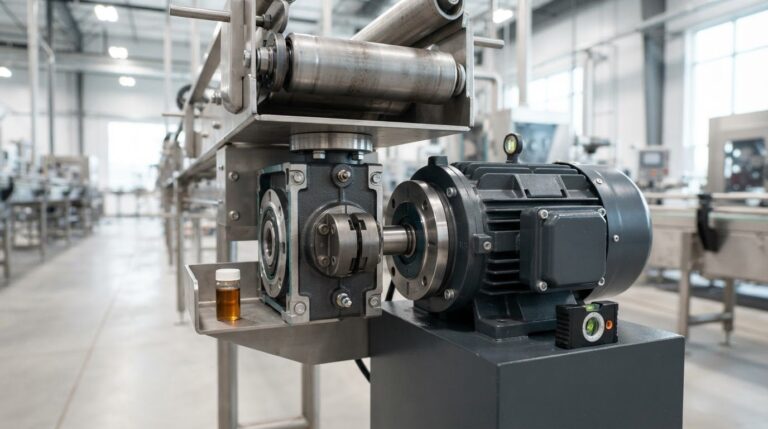
For a main conveyor gearbox, a common baseline is to sample the oil every 500 operating hours. Reliable conveyor drive motor gearbox maintenance and lubrication also depends on taking samples from the same point under similar load conditions, so results can be compared over time. Oil analysis can help reveal water contamination and equipment wear.
It’s easy to focus on the oil-change date, but lubricant condition and drive performance matter just as much. Misalignment, contaminated grease, leaks, heat, and unusual noise can all signal problems that need attention.
This guide explains how to inspect coupling grease, assess shaft alignment, evaluate oil condition, and set practical sampling and change routines. You’ll also learn how lubricant selection and basic gearbox checks support dependable conveyor operation.
Key Takeaways
- Use every 500 operating hours as a common baseline for sampling oil from a main conveyor gearbox, and take samples consistently to make trends meaningful.
- Investigate new noise, rising vibration, heat, or leaks promptly; these can signal alignment, mounting, lubrication, or wear issues.
- Inspect coupling grease for contamination or particles, and use the equipment’s lubrication guidance to inform servicing.
- Treat 4,000–8,000 operating hours as a general oil-change guideline, not a substitute for checking oil condition and the gearbox manufacturer’s interval.
- Choose gearbox lubricant for the application and keep oil within the manufacturer’s level indicators to support reliable operation.
1. Why does coupling alignment matter for gearbox life?
A coupling transfers torque between the motor and gearbox, so alignment affects the load on both shafts. Misalignment can create vibration and heat while placing uneven forces on gear teeth and bearings. Over time, this strain can accelerate wear, damage seals, and contribute to lubricant leaks. A new vibration pattern is a practical reason to inspect alignment rather than simply tighten components.
Follow a repeatable inspection routine. Check the coupling and shaft area for visible damage, loose mounting hardware, and signs of movement. Listen for unusual noise during startup, steady operation, load changes, and shutdown. A sound that becomes louder, quieter, or newly irregular deserves attention. Compare casing temperature with the gearbox’s established baseline, and investigate noticeable deviations rather than judging temperature by touch.
For conveyor drives above 75 kW, quarterly coupling-alignment checks are recommended. Also inspect after work that disturbs the motor, gearbox, coupling, or mounting base. Confirm the base is level and rigid, and that debris is not trapped between mounting surfaces. These checks help identify conditions that can shift alignment before vibration or heat becomes more pronounced.
Vibration measurements add evidence that a visual inspection cannot provide. Record readings at consistent locations and operating conditions, then compare them with earlier results. The ISO 20816 series is a reference for general machine vibration evaluation. A strong vibration peak at 2× running speed can indicate excessive coupling misalignment, although vibration patterns need to be considered alongside operating conditions and other symptoms.
Thermal imaging can help locate motor hot spots and airflow problems. An infrared pyrometer lets you compare temperatures across the motor and gearbox; log readings from consistent points. Pair temperature trends with vibration and noise records. A rising temperature alongside new noise or vibration gives maintenance teams a clearer reason to investigate than a single observation.
For preventive maintenance, perform basic visual checks weekly and schedule full maintenance inspections every 3–6 months. Include coupling condition, mounting elements, gearbox casing temperature, noise, and available vibration data. During frequency analysis, compare the measured vibration pattern with the drive’s normal baseline. If readings rise or a new frequency peak appears, inspect alignment, fasteners, and bearings before returning the conveyor to its usual load.
Keep inspection findings together so changes in sound, temperature, and vibration can be assessed as connected signs. Regularly check conveyor gearbox coupling and shaft alignment: misalignment causes vibration that accelerates wear. If gearbox vibration or noise becomes noticeable, investigate possible misalignment or loose parts instead of assuming the drive is operating normally. A sound that becomes unusually loud, quiet, or irregular typically needs attention.
Investigate new or intensifying gearbox noises during startup, load changes, and shutdown. Where monitoring is possible, include vibration data alongside visual inspections, temperature checks, and noise monitoring as part of conveyor gearbox preventive maintenance. Gearmotor oil and vibration analysis can also help identify potential component failures early. Together, these observations provide a better basis for deciding when a closer inspection is needed. Tracking recurring symptoms helps maintenance teams recognize changes from the drive’s usual condition and respond before wear progresses.
2. Coupling lubrication and grease inspection
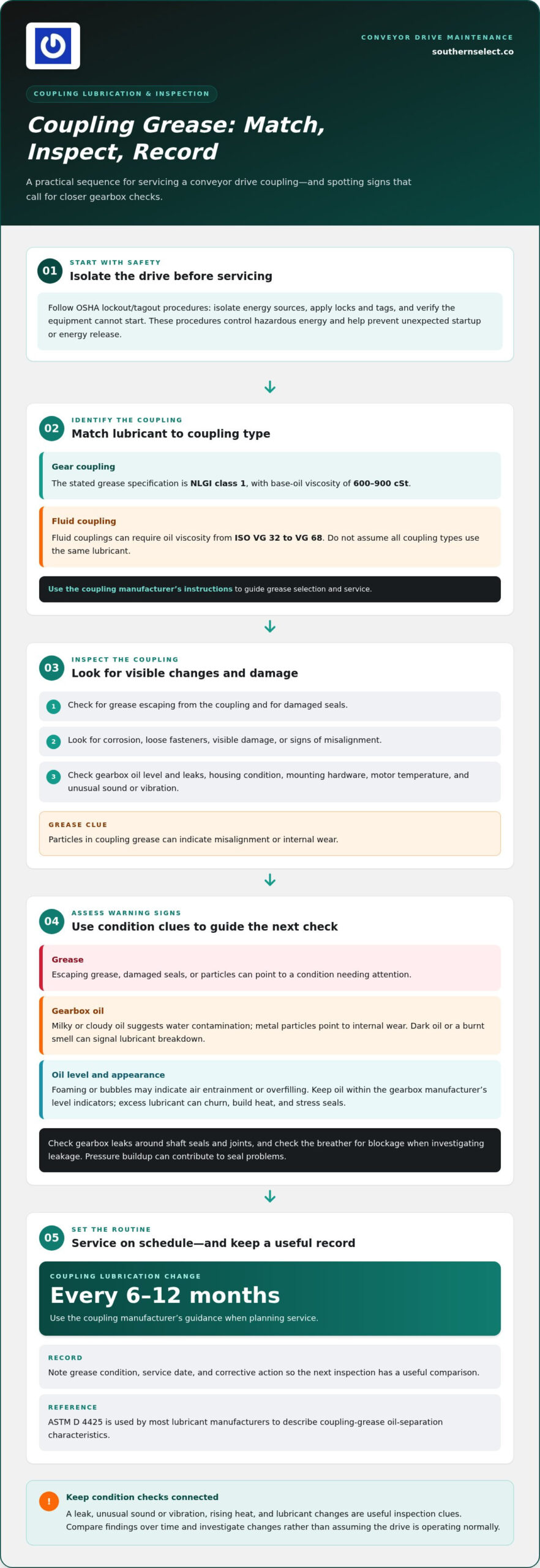
OSHA lockout/tagout procedures control hazardous energy during servicing and help prevent unexpected startup or energy release. Before inspecting a conveyor drive, isolate its energy sources, apply locks and tags, and verify that the equipment cannot start. Routine checks include coupling grease, gearbox oil level and leaks, housing condition, mounting hardware, motor temperature, and unusual sound or vibration.
Use the coupling manufacturer’s instructions to guide grease selection and service. For gear couplings, the stated grease specification is NLGI class 1, with base-oil viscosity of 600–900 cSt. Coupling lubrication should be changed every 6 to 12 months. Don’t assume all couplings use the same grease; fluid couplings can require oil viscosity from ISO VG 32 to VG 68. Match the lubricant to the coupling type.
During a visual inspection, look for grease escaping from the coupling, damaged seals, corrosion, loose fasteners, and signs of misalignment. Particles in coupling grease can indicate misalignment or internal wear. ASTM D 4425 is used by most lubricant manufacturers to describe coupling-grease oil-separation characteristics. Record the grease condition, service date, and any corrective action, so the next inspection has a useful comparison.
Check for gearbox oil leaks around shaft seals and joints, and inspect the housing for damage. A leak may be related to a worn seal, vibration, misalignment, or internal pressure. When investigating leakage, check the breather for blockage, since pressure buildup can contribute to seal problems. Low oil can accelerate gear and bearing wear; milky or cloudy oil suggests water contamination, while metal particles point to internal wear.
Listen for new grinding, knocking, or irregular sounds, and note whether they change with load. Dark oil or a burnt smell can signal lubricant breakdown. Foaming or bubbles may indicate air entrainment or overfilling. Keep oil within the gearbox manufacturer’s level indicators. Excess lubricant can churn, build heat, and stress seals, so adding more is no substitute for checking the correct level.
Motor checks should cover temperature, visible damage, mounting security, and electrical condition. Measuring voltage can help identify imbalanced electrical output; insulation testing can assess contamination, cracking, and solvent degradation. For motor bearings, follow the motor’s lubrication routine and keep the purge port clear during regreasing so old grease can escape. The National Institute of Standards and Technology (NIST) recommends checking conveyor drives for damage, malfunction, or wear, including slippage or spillage.
When investigating a suspected leak, use UV dye and an inspection light to trace conveyor gearbox oil leaks, then record the findings in the service log.
3. Shaft alignment and its effect on gears and bearings
Alignment keeps the motor shaft, gearbox input, and driven machine in one mechanical line. If the shafts are out of position, the coupling transfers additional force into the gearbox. That force can load gear teeth unevenly, fatigue bearings early, and increase vibration. Misalignment can also create heat, wear seals, and allow lubricant to escape. Damage may develop inside the housing before the conveyor belt shows an obvious change.
Check the complete drive train, not just the coupling faces. Confirm that the motor and gearbox shafts align, then check the gearbox output against the driven machine shaft. A coupling can appear properly joined even when the motor or gearbox mounting position creates strain. Inspect the base for rigidity and level, and clean the mating surfaces so debris cannot tilt the assembly.
Use a consistent sequence after installation or mechanical work. First, inspect the coupling for wear, looseness, and visible damage. Next, measure shaft alignment using an appropriate method and compare the result with the equipment manufacturer’s tolerance. Correct the motor or gearbox position, secure its mounting, and repeat the measurement. Don’t use the coupling to pull misaligned shafts into place.
Alignment errors affect bearings because shaft forces no longer follow their intended path. The added load can shorten bearing life and increase friction, raising operating temperature. Gear teeth may also experience edge loading instead of sharing contact across their working faces. As wear progresses, the gearbox may develop noise, vibration, seal damage, or lubricant leaks.
Consider a conveyor belt drive that starts vibrating after a motor replacement. The coupling may be intact, but a shifted motor base can leave the shafts misaligned. Check the mounting surfaces, shaft positions, and coupling condition before attributing the vibration to gearbox failure. If adjustment changes the vibration pattern, record the alignment correction and operating conditions for future comparisons.
Keep the mounting arrangement stable after correction. Tighten mounting elements evenly, then recheck alignment because securing the base can shift the motor. Inspect again after work that disturbs the motor, gearbox, coupling, or driven equipment. A repeatable alignment record helps distinguish a recurring mechanical shift from developing gear or bearing wear.
Pair alignment measurements with observations of noise, vibration, and temperature. A new symptom after adjustment may signal that the load path remains uneven or another component needs inspection. Correcting alignment early helps protect seals, bearings, and gears from avoidable mechanical stress.
4. Industrial gearbox oil-change intervals
Check gearbox oil level at the start of operation and during running, and sample it on a schedule. For a main conveyor gearbox, every 500 operating hours is a common baseline for oil sampling. A general oil-change guideline for standard industrial gearboxes is every 4,000–8,000 operating hours. These are starting points, not substitutes for the gearbox manufacturer’s interval or oil-condition checks.
Sampling shows how lubricant and internal components change over time. Take each sample from the same point under similar load conditions; consistent collection makes trend analysis more useful. Periodic oil analysis can check for water contamination and equipment wear. Compare each result with previous samples, and investigate changes in condition instead of relying only on elapsed hours. Record sample dates and operating hours to build a useful history.
Temperature, load, speed, and environment all affect how quickly oil degrades. High heat can accelerate breakdown, while heavy loads place greater demands on the lubricant film between gear components. Dusty conditions make it especially important to follow the equipment’s maintenance schedule and monitor oil condition. For mining conveyor gearboxes, follow OEM intervals and shorten them in dusty or high-heat conditions.
Oil condition can also indicate when to investigate. Milky or cloudy oil can signal water contamination; metal particles can point to gear or bearing wear. Dark oil, a burnt smell, or reduced viscosity may indicate oil breakdown. Foaming or bubbles can suggest air entrainment or overfilling. These signs call for investigation, not an assumption that changing the oil alone will resolve the cause.
A conveyor drive motor gearbox maintenance and lubrication plan should match lubricant grade and viscosity to the gearbox recommendation. Viscosity affects how readily oil flows and forms a protective film under operating conditions. Changing oil type or grade can alter that protection, so base selection on the manufacturer’s instructions and service demands. Log oil type, operating hours, sample date, temperature, and corrective work to connect results with equipment history.
For a practical schedule, record recurring level checks, sample collection, and oil changes. Use operating hours alongside condition analysis rather than treating the calendar as the only trigger. If trends show rising contamination, wear, or viscosity changes before the usual interval, investigate the source and review the plan. Consistent conveyor drive motor gearbox maintenance and lubrication records can help teams identify developing failures before they cause unplanned downtime.
5. Conveyor gearbox lubrication
Gearbox lubricant reduces friction between moving components, carries heat away, and helps protect gears and bearings during operation. The right choice depends on the gearbox manufacturer’s recommendation, operating temperature, load, and environment. Mineral oils suit standard gearbox applications; synthetic oils can suit high-temperature conditions or extended service life. Sanitary environments may require food-grade oil, while high-load applications call for lubricants with extreme-pressure additives.
How do synthetic and mineral gearbox oils compare for conveyor drives? Mineral oil is used in standard applications, while synthetic oil can suit high-temperature operation or extended service life. Choose according to the gearbox manufacturer’s guidance and the drive’s working conditions, not oil type alone.
How much does conveyor gearbox oil, maintenance, or replacement typically cost in the United States? The total depends on lubricant type and volume, labor, access to the gearbox, replacement components, and any downtime. Replacing damaged gears or bearings involves different cost factors from routine oil service.
Keep the oil level within the manufacturer’s indicators. Too little oil reduces lubrication and can accelerate internal wear; overfilling can cause foaming or air entrainment. Inspect the breather for obstruction or saturation, since pressure buildup can contribute to seal leaks. A correctly positioned breather supports normal pressure equalization, while a blocked or poorly positioned one can stress seals.
How do you safely lubricate a conveyor motor and gearbox step by step? Follow the site’s energy-control process before servicing, then use the equipment manual to identify the specified lubricant, fill point, level, and bearing routine. Clean around service points, apply only the prescribed amount, and record the work before returning the drive to operation.
- Review the gearbox and motor instructions for lubricant type, level, and service points.
- Isolate the drive under the site’s lockout process before opening ports or handling bearings.
- Clean fill and drain areas so contamination doesn’t enter the housing.
- Check the oil level and condition, then add or replace lubricant as directed.
- For motor bearings, keep the purge port clear during regreasing so old grease can leave.
- Secure plugs and guards, inspect for leaks, and document lubricant type and service performed.
Never mix lubricants without technical review. A change in oil formulation can affect viscosity and the protective film, so confirm compatibility before switching. If oil appears foamy, burnt, or contaminated, detect and address the cause rather than simply adding fresh lubricant. For commercial kitchens considering conveyor equipment, explore commercial conveyor ovens for your operation.
Southern Select Equipment: XLT Pizza Ovens
Southern Select Equipment offers XLT Pizza Ovens and Conveyor Ovens for commercial food service operations. If you’re evaluating equipment for a kitchen or planning a replacement, consider how the oven will fit your workflow and daily production needs alongside your maintenance plan.
Southern Select Equipment also offers EDGE Pizza Ovens and Hobart Mixers. Explore these commercial equipment options as you plan your operation’s needs. For equipment information, contact Southern Select Equipment or visit southernselect.co.
Make Maintenance Records Work for You
Turn inspection notes into a practical decision tool. A clear record of observations, operating conditions, and completed work helps your team spot recurring patterns and plan maintenance around the equipment’s history. Assign responsibility for updating the log, and make it easy for operators to report changes in sound, heat, or performance. Consistent records also help maintenance staff explain schedule adjustments or why they investigated a developing issue.
A reliable approach to conveyor drive motor gearbox maintenance and lubrication is built over time, through careful observation and informed follow-up. Use what your team learns to refine its routine and make the next maintenance decision with greater context. If you’re also planning commercial kitchen equipment needs, Southern Select Equipment offers options for food-service operations.
Contact Southern Select Equipment to discuss your equipment needs. A thoughtful plan today can help your team move forward with confidence.
Frequently Asked Questions
How often should gearbox oil be sampled on a main conveyor drive?
A common baseline is every 500 operating hours. For useful comparisons, collect samples from the same point under similar load conditions, and log the operating hours and sample date. If a result shifts from the gearbox’s prior trend, consider the oil’s condition alongside operating temperature and equipment observations. This helps distinguish a developing change from a sample taken under different conditions.
What current deviation from baseline should trigger an inspection?
A motor-current reading roughly 8% above its commissioning baseline at equivalent conveyor load is a suggested starting alert threshold for inspection. Compare like with like: record current while the belt carries a similar load and the drive runs under comparable conditions. A change can prompt checks of the motor, driven load, and drivetrain rather than identifying one failed component by itself.
What is a Gearbox?
A gearbox is a mechanical assembly of gears that transfers power between an input and output shaft. In a conveyor gearmotor, the gearbox reduces the electric motor’s output speed so the drive can deliver greater output torque. For example, the motor may turn faster than the conveyor drive requires; the gearbox provides the speed and torque relationship needed to move the belt.
Why does coupling alignment matter for gearbox life?
Coupling alignment matters because it keeps connected shafts in their intended relationship. If the motor and gearbox shafts are offset, forces can concentrate unevenly on gears, bearings, and seals. The drive may then show excess vibration, heat, or leakage. After motor or gearbox work, check the assembled shaft line and coupling condition before treating new noise as an internal gearbox failure.
What type and viscosity of lubricant is recommended for conveyor gearboxes?
Use the lubricant type and viscosity specified for the gearbox and its operating conditions. Mineral oil suits standard applications; synthetic oil can suit high-temperature use or extended service life, while food-grade oil serves sanitary environments. Load and ambient temperature also affect viscosity choice. Don’t transfer a grease or fluid-coupling viscosity specification to a gearbox; follow the gearbox manufacturer’s recommendation.