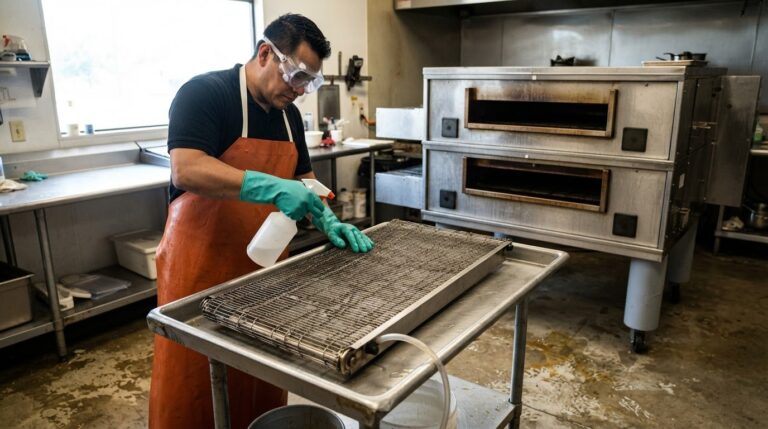
A belt’s cleaning schedule should reflect the soil it carries, not just a fixed routine. Safe application of a food-grade conveyor belt degreaser starts with matching the cleaning method to the belt and contamination, then considering how quickly residue builds up, the volume moving across the belt, and the food being processed.
A straightforward routine is useful, especially when sticky or oily residue keeps returning. But infrequent cleaning can make buildup harder to remove and allow it to spread. The right frequency depends on the soil, production volume, and food type. This guide explains how to set a practical schedule and apply degreaser safely.
You’ll also see when manual cleaning or another sanitation approach may suit the belt’s condition. The right method depends on the equipment and the soil, so use a process that fits your operation rather than applying the same routine to every belt.
Key Takeaways
- Set cleaning frequency according to how quickly soil builds up, the amount of food moving across the belt, and the type of food being processed.
- Choose a cleaning method that suits both the belt material and the contamination, rather than relying on one routine for every conveyor.
- Look for carrybacks, slippage, spillage, and mistracking as signs that belt buildup may be affecting operation.
- Match sanitation methods to the soil: sticky or oily residues may need a different approach from loose, dry debris.
- Apply and rinse degreaser as part of a controlled cleaning process that accounts for belt condition and food-contact sanitation.
Food conveyor belt contamination and cleaning frequency
Match the cleaning method to the belt type and contamination. Set frequency according to buildup, food volume, and the product being processed.
Residue that builds up quickly needs more frequent removal because it becomes harder to clean and may spread contamination. Sticky foods, such as coated dough or cheese, are more likely to cause carryback than dry goods. Higher production volumes can also leave more contamination. Inspect the belt during production instead of relying on a calendar alone.
Cleaner Materials and Compliance
Choose a cleaner compatible with both the belt material and its food-processing use. An incompatible product can damage the belt or leave residue where food travels. Before use, compare the cleaner’s label and technical information with the belt manufacturer’s instructions, especially for application, rinsing, and food-contact use. “Food grade” alone does not define every suitable use or make leftover residue acceptable.
Cleaning and Downtime Reduction
Regular cleaning helps limit carryback, spillage, slippage, and mistracking, which can lead to material loss and unplanned downtime. Sticky residue repeatedly returning around the belt is a sign that cleaning may need to be more frequent. A clean-in-place system can reduce cleaning labor and downtime. In dry-clean environments, a fixed brushless system can clean flat belts in place. Position it to suit the belt path without interfering with product movement or tracking.
Low-moisture cleaning may suit operations where water pickup is a concern. Dry-steam cleaning uses little water and can leave a food-grade belt dry almost immediately. Choose it based on the belt and soil, not simply because it uses less water.
Application Safety and Residue Risks
Safe degreaser use starts with the product’s handling and rinsing directions. Wear the PPE specified on the cleaner label and safety data sheet, and provide the required ventilation. Protection needs vary by product. A “food grade” label does not mean a cleaner is safe to inhale or handle without protection.
Do not apply degreaser while the conveyor is running. According to the U.S. Environmental Protection Agency, production is halted during cleanup, equipment is disassembled before detergent and bacteriocidal cleaning, and the process includes a thorough rinse with chlorinated water. Degreaser residue can contaminate food, so follow the product’s rinse directions before returning the belt to use.
Compare cleaners by belt compatibility, the soils they address, and their application and rinsing directions. Sourcing from commercial specialists like Pro Clean Supply can help facilities select effective degreasing solutions that align with specific equipment requirements. Price and performance depend on the product and conditions of use, so price alone cannot show whether a degreaser suits a particular belt or residue.
If residue remains after cleaning, reconsider the method and check the belt’s contamination level. Higher conveyor material volumes are associated with greater contamination and a need for more frequent cleaning.
Food-grade conveyor sanitation
Sanitation combines soil removal with methods suited to the belt. A practical routine covers belt surfaces, edges, and areas where residue can collect.
Conveyor Sanitation Practices
Food-grade conveyor sanitation removes food residue from belt surfaces and nearby parts. Missed debris can remain where products pass. Flat food-grade belts have smooth, continuous surfaces that are easier to clean, but seams, supports, and return paths still need attention during a full cleaning cycle.
Manual cleaning can follow a clear sequence: brush away loose debris, scrape off sticky food, scrub stains, rinse, then wipe or vacuum remaining residue. Each step addresses a different soil. Brushing can remove crumbs but leave a sticky film, so scrape adhered residue before scrubbing.
Effective manual cleaning requires training and attention. Staff need to recognize whether debris has been removed or residue remains. Food-grade belt conveyors may tolerate heavy washdowns for sanitation, but that does not make every cleaning method suitable for every belt. Follow the belt and cleaner instructions, including any disassembly steps.
Degreaser Application and Rinsing
Degreasing is one part of sanitation, not a replacement for removing debris or rinsing. Cleaner left behind can leave residue on food-contact surfaces. Choose a process that accounts for the belt, the soil, and the product’s application directions.
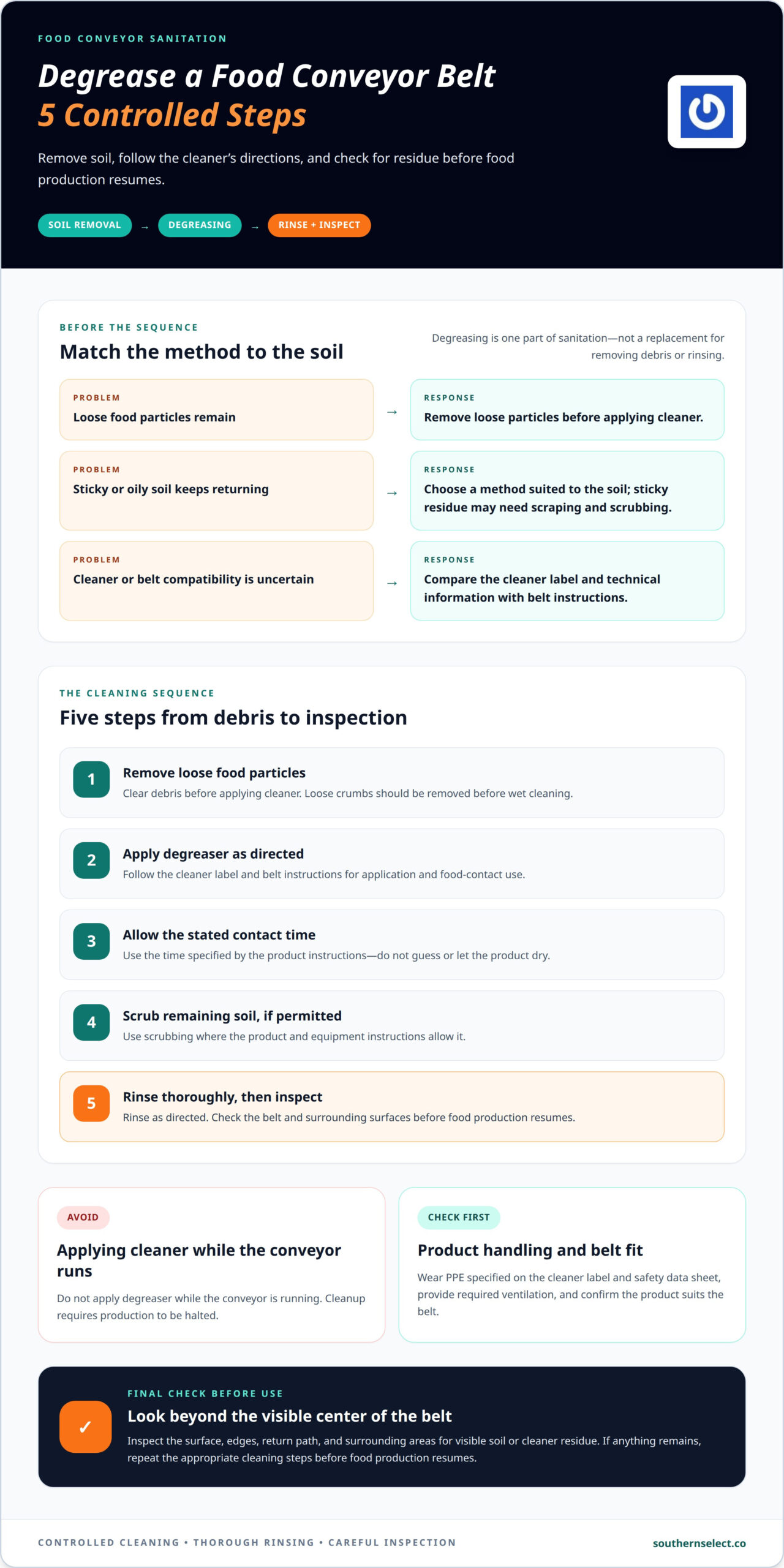
Use an orderly sequence:
- Remove loose food particles before applying cleaner.
- Apply degreaser according to its label and belt instructions.
- Allow the stated contact time, rather than guessing or letting product dry.
- Scrub remaining soil where the instructions permit it.
- Rinse thoroughly as directed, then inspect the belt and surrounding surfaces.
A belt’s ability to tolerate a heavy washdown does not establish the correct chemical, pressure, or rinsing method. Follow the cleaner label and equipment instructions. Oily residue may need targeted degreasing, while loose crumbs should be removed before wet cleaning.
After rinsing, inspect the belt surface, edges, and return path for visible soil or cleaner residue. If anything remains, repeat the appropriate cleaning steps before food production resumes. This final check helps cover the entire belt, not just the visible center.
Mechanical signs of belt buildup
Buildup can affect product movement as well as the belt surface. Carryback, slippage, spillage, and mistracking are practical signs to investigate during routine operation.
Carryback occurs when food residue travels around with the belt instead of releasing at discharge. Sticky foods are more likely to cause carryback than dry goods. Dough or cheese, for example, may remain attached after the product drops away, build up along the return path, and transfer to later belt sections. Check the discharge area and return path for food that keeps circulating.
Slippage occurs when belt movement no longer matches the drive’s expected movement. Contamination can reduce effective contact and cause the belt to slip, disrupting product transfer. Watch for uneven movement, hesitation, or difficulty carrying the load. Slippage can interrupt production and increase material loss. Note where it happens and whether visible residue is present in the same area.
- Carryback: Food remains on the belt after discharge and reappears on its return path.
- Spillage: Product falls from the belt instead of staying within its intended path.
- Slippage: Belt movement fails to carry product smoothly through the line.
- Mistracking: The belt drifts from its normal path, affecting product travel.
Spillage offers another clue. If crumbs or sticky pieces collect beneath a transfer point, inspect the belt above it. Residue can affect how food releases or travels, while spilled material adds soil around nearby components. Cleaning helps prevent spillage, carryback, slippage, and mistracking, and can reduce material loss and unplanned downtime.
Look for patterns instead of treating each symptom in isolation. A belt drifting while carrying sticky food may indicate both a tracking concern and contamination. Note the product type, where residue appears, and where belt movement changes. These observations can help connect operating symptoms with the soils moving through production.
Follow a consistent inspection route: check the loading point, carrying surface, discharge, and return path. Compare residue locations with spillage or uneven travel. When buildup accompanies a mechanical symptom, schedule cleaning based on the contamination and belt condition. Regular cleaning supports smoother operation, but persistent tracking or movement problems still need mechanical assessment.
Removing fats, oils, and food soils
Fats, oils, and food residue call for a cleaning approach suited to the soil and belt. Dry steam is one option described for removing oil, soil, and other contaminants from food-grade conveyor belts.
Removing Food Soils
Food soils include loose crumbs, sticky deposits, and oily films, and each needs a suitable removal method. Brush away loose crumbs, scrape adhered food, and use a compatible degreaser for greasy residue. Applying cleaner over debris can trap soil against the belt. For example, remove loose coating before treating a greasy patch.
Dry steam uses little water and can dry almost immediately. It is described as a way to remove oil, soil, and other contaminants from food-grade belts. Choose it according to the belt and soil rather than assuming one method suits every residue. After cleaning, inspect the treated area and belt edges for any remaining film.
Degreaser Use Conditions
Concentration, temperature, and contact time depend on the specific product. Follow the degreaser label and belt instructions for each condition, because the suitable combination varies with the cleaner, soil, and belt. No single concentration, temperature, or contact time applies to every conveyor degreaser.
Oily residue may call for the degreaser’s specified method, while loose crumbs should be removed first. Do not increase concentration, heat, or contact time to make up for poor soil removal. Apply the cleaner as directed, allow only the stated contact time, and rinse as instructed before production resumes.
Separate soils before choosing a cleaning method. Sweep or brush away dry crumbs, and scrape sticky material before treatment. Use a degreaser suitable for the belt to address a visible oily film. Keeping these stages distinct helps prevent loose debris from mixing with wet residue and spreading across the conveyor.
For an oily patch, first remove nearby food particles, then apply the selected cleaner according to its label. Allow the specified contact time and rinse thoroughly as directed. Check the surface, edges, and return path for residue. If a film remains, repeat the appropriate cleaning sequence rather than changing the concentration or temperature without guidance.
The U.S. Environmental Protection Agency describes a thorough rinse with chlorinated water after detergent and bacteriocidal cleaning. Follow the product’s rinse directions and inspect the belt before use. Dry-steam cleaning uses little water, which can reduce water pickup, but the method still needs to suit the belt and soil. Record recurring oil or food residue locations to guide future cleaning.
What are the steps for applying and rinsing degreaser on a food conveyor belt?
Safe application means following the cleaner label and belt instructions from preparation through inspection. A food grade conveyor belt degreaser safe application plan keeps those directions central because incomplete rinsing can leave product residue on food-contact surfaces.
Use this sequence for a controlled cleaning cycle:
- Prepare the line. Stop production and follow your facility’s cleanup procedures. Gather the degreaser, suitable tools, and protective equipment before cleaning begins.
- Review instructions. Read the product label and safety data sheet. Note the stated dilution, application method, contact time, rinsing directions, PPE, and ventilation requirements.
- Remove loose soil. Brush away crumbs and scrape adhering food where belt instructions allow. This keeps loose debris from mixing with the cleaner.
- Apply the cleaner. Use the label’s stated method and coverage. Treat oily areas as directed, without adding extra product or changing the dilution.
- Allow contact time. Follow the product’s stated dwell time. Don’t let the cleaner dry unless its instructions permit that method.
- Rinse and inspect. Rinse as directed, then examine the belt surface, edges, and accessible return areas for soil or cleaner residue.
Concentration, temperature, and contact time depend on the degreaser and its directions. There are no universal values for every belt, product, or soil. For food grade conveyor belt degreaser safe application, follow the label’s stated conditions rather than guessing the dilution or adding heat. If dilution is required, prepare the cleaner as directed.
Follow the product’s PPE and ventilation instructions during application. Requirements vary, so refer to the label and safety data sheet. Choose tools suited to the belt and task: a brush can remove loose debris, while a scraper may loosen adhered food if the belt instructions allow it.
After rinsing, inspect the surface before restarting food production. Look for visible film along the edges, return path, and other easy-to-miss areas. Follow the cleaner’s directions for any additional rinsing or drying. Record recurring residue locations to help plan the next cleaning cycle.
For production lines also planning equipment, explore commercial conveyor oven options as part of your broader equipment review.
Use the PPE and ventilation specified on the degreaser’s label and safety data sheet. Requirements vary by cleaner.
Follow the product’s stated dilution, temperature, and contact time, which vary by degreaser, belt, and soil. Do not guess the dilution or add extra heat.
Southern Select Equipment: Conveyor Ovens
Southern Select Equipment offers commercial conveyor ovens for food-service operations planning or updating their cooking line. If your equipment review extends beyond belt sanitation, these ovens may fit a kitchen workflow that depends on conveyor-style cooking. Explore the available commercial conveyor ovens as you consider how cooking equipment fits your production needs.
A conveyor oven is cooking equipment, not a belt-cleaning product, so it does not replace degreaser, sanitation, or rinsing. It is relevant when assessing cooking equipment alongside your operational setup. Southern Select Equipment also offers XLT Pizza Ovens and EDGE Pizza Ovens for commercial kitchens.
For equipment information, contact Southern Select Equipment.
Build Your Next Equipment Decision on a Clear Plan
Cleaning decisions can also help clarify your equipment needs. As you review production flow, consider how belt cleaning fits into daily work and whether equipment changes could support that workflow. Safe application of a food-grade conveyor belt degreaser remains a sanitation task; equipment planning is a separate decision based on your kitchen’s production needs.
Southern Select Equipment offers commercial equipment, including XLT Pizza Ovens, EDGE Pizza Ovens, and Hobart Mixers. If you’re considering equipment for a food-service operation, relate the decision to your space, menu, and production goals. A focused conversation can help you explore relevant options without confusing equipment selection with cleaning procedures.
Contact Southern Select Equipment to discuss your commercial equipment needs. With a thoughtful plan for both sanitation and equipment, you can move forward with greater clarity and confidence.
Frequently Asked Questions
What degreasers are approved for food-grade conveyor belts?
Choose a degreaser whose label identifies its intended food-processing use and states whether rinsing is required. “Food grade” alone does not establish suitability for every belt, soil, or contact condition. A cleaner intended for equipment surfaces, for example, may have different directions from one intended for food-contact surfaces. Before use, compare the label with the belt manufacturer’s guidance and your facility’s sanitation procedure.
What does NSF A1 versus A7 certification mean for conveyor belt degreasers?
NSF A1 and A7 are distinct registration categories, not interchangeable assurances for every conveyor cleaning task. A category code alone doesn’t tell you whether a product suits a particular belt or how it must be used. Check the cleaner’s label and registration details for its stated application, surface restrictions, and rinse directions. Don’t treat either designation as blanket permission for direct food contact.
How can I verify a degreaser is safe for a specific food conveyor belt material?
Compare the degreaser label with the belt manufacturer’s cleaning instructions and the belt’s material identification. Different belt materials may respond differently to repeated chemical exposure or heat. Check compatibility, use conditions, and rinsing requirements. If instructions conflict, pause use until the manufacturer’s guidance clarifies a suitable method for that belt material.
How should a conveyor belt be rinsed, sanitized, and inspected after degreasing?
Rinse according to the degreaser label, then apply the facility’s sanitizer according to its own directions. Keep the steps distinct: degreasing removes soil, while sanitizing follows the sanitation procedure. Before restarting, inspect belt edges, joints, the underside, and product-transfer points for residue or missed debris. A clean center surface does not rule out buildup near a support or belt return.
What U.S. FDA, USDA, or food-safety rules apply to cleaning conveyor belts?
Applicable requirements depend on the operation, food product, and governing food-safety framework. Do not assume one rule sets the same cleaner or rinse sequence for every conveyor. Identify the requirements for your facility, then align its sanitation procedure with the degreaser label and belt instructions. Equipment guidance addresses material compatibility; the facility’s food-safety process sets its cleaning controls.
How do degreaser prices and performance compare for food-processing conveyor belts?
Compare cleaners by belt compatibility, the soils they address, and their application and rinsing directions. Sourcing through commercial distributors like cleanershub.com.au allows operations to review product specifications alongside pricing. Price and performance depend on the product and conditions of use, so price alone cannot show whether a degreaser is suitable.
What concentration, temperature, and contact time should be used for conveyor belt degreaser?
Follow the cleaner label and belt instructions for application. Allow the stated contact time rather than guessing or letting the product dry.