
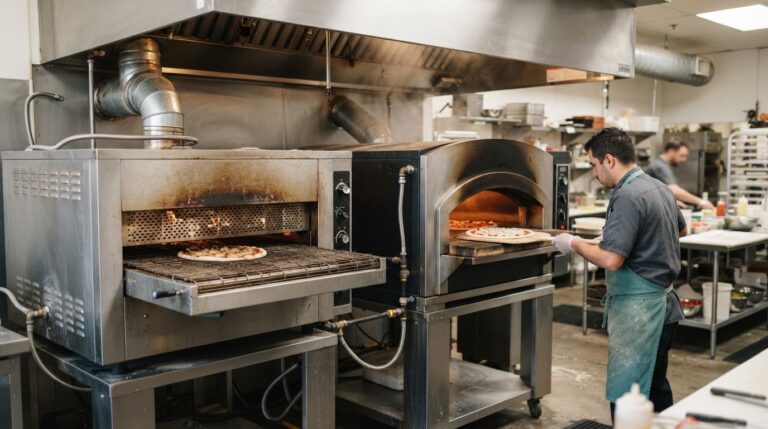
Radiant heat isn’t automatically more expensive to install. In the forced-air impingement vs radiant heat commercial baking comparison, cost depends on what you’re installing: an oven’s heating system or heat for the wider facility, as well as the equipment, utilities, controls, and layout involved. There’s no single installation-cost winner for every setup.
It’s reasonable to focus on upfront cost, but the heat source also affects how products brown and how precisely you can manage temperature and moisture. A lower initial outlay may not suit your baking goals if it makes consistent results harder to achieve.
This guide compares how impingement and radiant heat transfer energy, what each can mean for browning and moisture retention, and when a hybrid configuration may make sense. It also covers the installation factors that influence the decision, so you can weigh each system against your production needs rather than comparing heat sources in isolation.
Key Takeaways
- Compare installation needs in context: the oven or facility layout, utilities, controls, and production goals all shape the choice.
- High-velocity impingement disrupts the insulating boundary layer around food, which can speed surface heat transfer and support more even browning.
- A hybrid setup can pair general air handling with radiant heat in selected work zones, matching heat delivery to how each area is used.
- Temperature control affects more than bake consistency; it also influences moisture retention, so weigh both outcomes when choosing a system.
- Use the difference between radiant heat and impingement to clarify which commercial oven configuration best fits your baking operation.
Impingement compared with convection and radiant heat
For commercial baking, the choice between forced-air impingement and radiant heat affects how energy reaches each product, as well as bake timing, surface finish, and equipment needs. Installation and operating costs depend on the oven configuration and site requirements, so compare complete systems designed for the same production needs.
Heat Transfer Methods
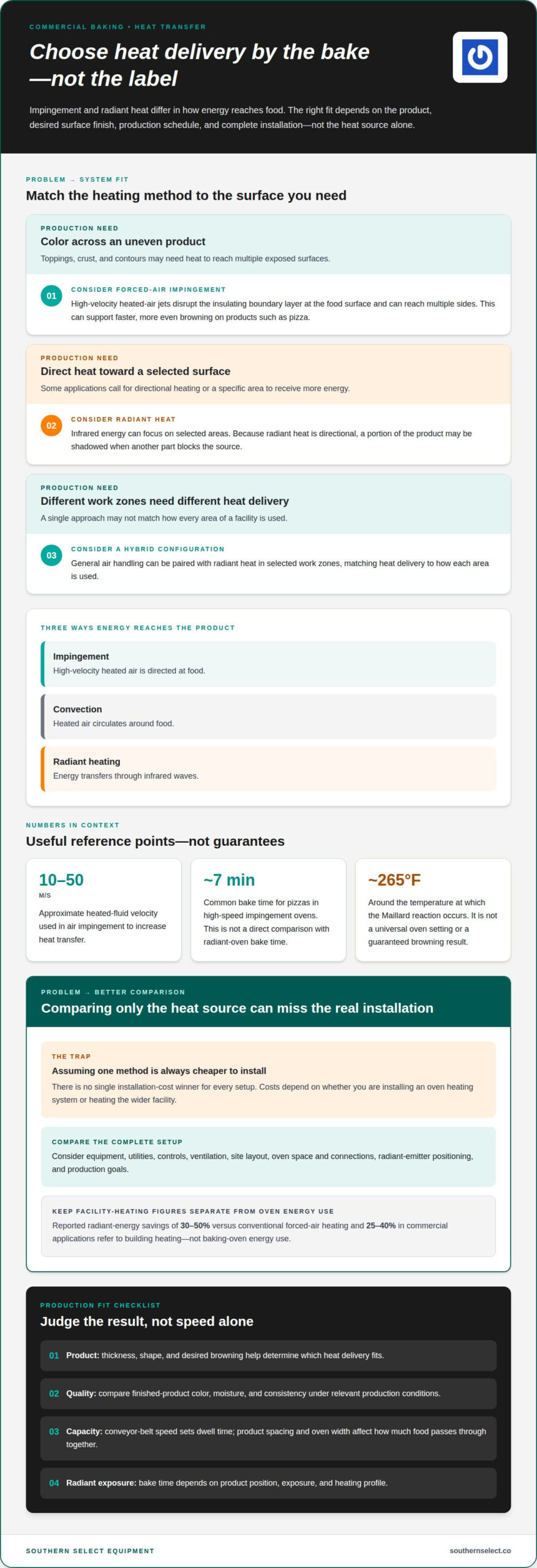
Impingement directs high-velocity heated air at food, convection circulates heated air, and radiant heating transfers energy through infrared waves. Airflow direction affects how heat reaches exposed surfaces: impinged air can reach surfaces that a radiant source may leave in shadow, while radiant heat can focus energy on selected areas. This distinction is central to comparing forced-air impingement with radiant heat in commercial baking.
Heat Transfer Rates and Bake Times
Air impingement uses heated fluid moving at approximately 10-50 m/s to increase heat transfer. High-speed impingement ovens commonly bake pizzas in approximately 7 minutes. These figures describe impingement applications, not a direct bake-time comparison with radiant ovens. Radiant bake time depends on product position, exposure, and heating profile. Compare finished-product results alongside the required schedule when assessing forced-air impingement versus radiant heat for commercial baking.
Product Suitability
Impingement suits products that benefit from rapid, broad surface heating, such as pizzas that need color across both toppings and crust. Its airflow disrupts the insulating boundary layer and can reach multiple sides. Radiant heat suits applications that call for directional or zoned heating, such as targeting a selected surface. Product thickness, shape, and desired browning help determine the right fit. Let the product guide the comparison, not the heating label alone.
Throughput and Production Capacity
Throughput depends on heat transfer and the time each product remains inside. In a conveyor oven, belt speed sets dwell time; product spacing and oven width influence how much food passes through together. Impingement can support shorter bake cycles, including the approximately 7-minute pizza example. Radiant capacity depends on the heating zone and exposure. Compare output at the required bake quality, not speed alone.
Installation, Operating Costs, and Requirements
Installation costs depend on equipment, utilities, controls, ventilation, and site layout. Impingement ovens require space and suitable connections; radiant systems need correctly positioned emitters and controls. No single method is automatically less expensive to install. Facility-heating comparisons report radiant energy savings of 30-50% versus conventional forced-air heating and 25-40% in commercial applications. Those figures concern building heating, not baking-oven energy use. Cleaning, maintenance, and ventilation depend on oven design, fuel, residue, and exhaust. Applicable U.S. safety codes, emissions rules, and ventilation standards depend on the equipment and jurisdiction.
How high-velocity air accelerates surface browning
Impingement can produce faster, more even browning by directing hot-air jets at food and disrupting its insulating boundary layer. Radiant ovens transfer infrared energy directionally, so exposed surfaces may brown while shielded areas receive less direct heat.
The boundary layer is a thin layer of air at a product’s surface that slows heat transfer. High-velocity jets disturb it, bringing heated air closer to the food and increasing heat transfer. This can be especially useful for uneven products, as targeted airflow can reach contours that still air may not reach as readily. Faster transfer can help develop surface color in less time.
Browning depends on surface conditions as well as oven settings. The Maillard reaction, which contributes to browned color and flavor, occurs at around 265°F. That figure describes the reaction threshold, not a universal oven setting or a guaranteed result. In practice, the product’s surface, moisture, thickness, and time under heat all affect the finish. A pizza with varied toppings, for example, may need airflow that reaches both exposed crust and toppings.
Impinged airflow can brown the top, bottom, and sides of a product, supporting more uniform color across uneven surfaces. Radiant heating can concentrate energy on selected areas, making it useful for targeted browning. Its directional transfer can also leave a shadow where another part of the product blocks the source. The right balance depends on which surfaces you want to color and how consistently the product sits in the heating zone.
Crust and moisture matter as much as color. Impingement cooking can enhance moisture retention and improve reheating quality and processor yields, while rapid surface heating can help develop a browned exterior. Smaller pieces cook especially quickly, which can make browning more challenging at the same temperature used without impingement. The product may need a different balance of exposure and temperature to achieve the desired crust and interior quality.
Separate oven performance from building-heating efficiency. Reported savings of 25-40% for commercial radiant heating relate to facility heating, not baking-oven energy use. A warehouse heating system and a baking oven have different loads and operating patterns, so those savings don’t predict an oven’s energy use. For a baking line, compare finished-product color, moisture, and consistency under the production conditions that matter.
Hybrid radiant and convection configurations
A hybrid heating plan combines moving heated air with radiant energy, assigning each method to the work it handles best. In a bakery, distinguish oven heat, which controls product baking, from facility heating, which affects comfort around production, loading, and staff areas. These decisions are related, but a building-level hybrid system isn’t the same as a hybrid oven chamber.
For facility heating, forced air can support ventilation, cooling, filtration, humidity management, or general air-temperature control. Radiant heat can serve selected work zones, perimeter areas, or loading docks. For example, an air handler can manage the overall indoor environment while radiant heating warms a cold packing station. This separates whole-room air handling from heat directed toward specific surfaces and occupied areas.
Ceiling height helps determine whether that division makes sense. ASHRAE Journal identifies infrared radiant heating as particularly effective in spaces with ceilings exceeding 16 feet. In a tall production room, warm air can gather near the ceiling, while radiant energy reaches people and objects directly. A typical lower-ceiling area with evenly distributed workstations may make broader forced-air control more practical.
Hybrid design also depends on how the building is used. If doors open often near a loading area, outside air can disrupt the temperature maintained by warm-air heating. Radiant heat in that zone can direct warmth toward workers and surfaces without relying on the temperature of the entire room. Production areas that need ventilation or humidity management still benefit from air-handling equipment.
Installation choices depend on system components and construction sequence. A forced-air approach needs air-moving equipment and distribution, while radiant systems need heat sources positioned for their intended zones. Hydronic radiant systems require careful planning and integration into construction phases; electric radiant systems are generally quicker to install with less disruption. Existing buildings may therefore favor targeted zones, while planned construction can accommodate radiant elements more easily.
For baking itself, evaluate the oven’s heat delivery separately from facility comfort. A radiant source can target product surfaces, while convection moves heated air through the baking space. A bakery might use general convection for a production line and radiant heating for a distinct task area, but the product’s browning and moisture goals still determine its oven requirements. This distinction keeps a facility-heating decision separate from a bake-performance comparison.
Compare hybrid options by mapping each area’s purpose: baking, ventilation, staff comfort, or loading. Then match the heating system to the task. This avoids treating one method as a universal solution and clarifies the trade-offs between installation planning, operating needs, and targeted heat.
Temperature control and moisture retention
In commercial baking, temperature control means managing the heat reaching the product, not simply choosing an oven setting. Impingement airflow, radiant exposure, product position, and loading pattern all affect heat transfer. A pizza loaded near the edge of a belt, for example, may experience a different balance of airflow and radiant exposure than one centered in the chamber.
Impingement can enhance moisture retention, reheating quality, and processor yields. Its rapid heat transfer also changes how quickly products reach the desired finish. Smaller pieces cook faster with impingement, so the same temperature used in a non-impingement oven may not allow enough time for surface browning. For consistent results, assess the interior and exterior color rather than relying on the set point alone.
Radiant heat offers another control option: zones can heat selected areas to different temperatures. This can help in a production space where a particular station or product area needs targeted warmth. In an oven, directional infrared exposure makes product placement important. A tray or topping that blocks the radiant path can create uneven exposure, and changing the product’s orientation can alter which surfaces receive direct heat.
Airflow affects temperature consistency in another way. Drafts and natural convection can carry warm air beyond the area where it is useful, making air movement harder to control. For example, frequent door openings can disturb conditions near an oven entrance. Radiant heating can provide more even warmth and reduce drafts or cold spots in commercial environments, while ventilation must still meet the space’s air-handling needs.
Moisture retention and browning are related, but they aren’t interchangeable measures. A browned crust alone doesn’t show how much moisture remains inside. For a reheated product, compare crust color, interior texture, and moisture together. A high-velocity process may improve reheating quality and yields, yet smaller products may need adjusted exposure to develop the intended color.
Evaluate each product in a consistent sequence: keep its size, recipe, and loading pattern the same; assess the baked surface and interior; then adjust exposure or temperature control. For a mixed menu, compare a thin item with a thicker product under the same airflow pattern. If one reaches color quickly while the other needs more time, separate zones or product-specific settings can help manage the competing requirements.
In short, temperature control should follow the product’s quality targets. Impingement provides fast-moving air and can support moisture retention; radiant zones direct heat selectively. The useful comparison is the finished bake across repeated loads, including color, texture, moisture, and consistency.
How does forced-air impingement baking work in commercial ovens?
In an impingement oven, heated air travels through jets directed at food. The jets disrupt the insulating boundary layer at each product’s surface, increasing heat transfer. Unlike general convection, which circulates warm air through the chamber, impingement concentrates airflow where it meets the product. That distinction helps explain why the system suits fast, repeatable baking.
The process begins when a product enters the heated chamber, often on a conveyor. Air jets strike exposed surfaces, transferring heat as the product moves through the oven. A pizza, for example, has toppings, crust, and edges that may respond differently. Airflow across those areas supports more even exposure than heat reaching only one face.
Air velocity is one defining feature. Thermal processing with impingement uses heated fluid moving at approximately 10-50 m/s. That range describes the method, not a setting for every commercial oven. Product size, oven design, and desired finish affect how the airflow is applied. More forceful air transfer can shorten processing, but results depend on the product and its exposure.
In conveyor applications, belt movement determines how long food remains in the heated chamber. The operator’s practical task is to balance dwell time with the product’s surface and interior requirements. A faster belt reduces exposure; a slower belt extends it. If toppings brown before a thicker crust finishes, the desired result may require a different balance of airflow, temperature, and travel time.
Air jets can reach the top, bottom, and sides of products, helping color uneven surfaces. Product spacing matters because crowded loading can obstruct airflow. For example, pizzas placed too close together may restrict air reaching their edges. Consistent size and spacing make it easier to assess repeatable results across successive conveyor loads.
Operationally, the baking team can compare the same product under consistent loading, then assess crust color, interior texture, and moisture. If the surface darkens too quickly, exposure or temperature may need adjustment. Smaller pieces can cook especially quickly under impingement, making surface browning harder to achieve at the same temperature used without impingement. Aim for a balanced finish, not simply the shortest bake.
For a commercial kitchen weighing this process against radiant heat, explore commercial impingement oven options to see equipment built around directed hot-air baking.
Southern Select Equipment: XLT Pizza Ovens
Southern Select Equipment offers XLT Pizza Ovens for commercial kitchens evaluating oven options for pizza production. If you’re weighing impingement against radiant heat, start with the product you need to bake, your preferred production flow, and the results you want from each batch. These priorities help keep the equipment decision grounded in your operation.
Explore XLT Pizza Ovens, EDGE Pizza Ovens, and Conveyor Ovens as you consider commercial baking equipment. Each category gives you a practical starting point for matching an oven choice to your kitchen’s workflow and menu. Southern Select Equipment can help you explore its available commercial oven options as you narrow the comparison.
Visit southernselect.co to explore the equipment selection or contact Southern Select Equipment with your questions.
Plan Your Next Equipment Decision
Before choosing a system, put your operating priorities into a short equipment brief. Note the products you expect to bake, how your menu may change, your production schedule, and the space available for installation. This gives your team a shared basis for comparing options and keeps the decision connected to the work the oven must support.
Then consider how the choice will fit into your kitchen over time, including staff routines and possible menu changes. The forced-air impingement vs radiant heat commercial baking decision is most useful when it reflects your operation’s priorities, not just the heating method in isolation. A clear brief also makes equipment discussions more focused.
If you’re ready to discuss commercial kitchen equipment for your operation, contact Southern Select Equipment. A thoughtful next step can help you move toward an equipment choice with confidence.
Frequently Asked Questions
Is radiant heating more expensive to install than convection heating?
Not necessarily. Installation cost depends on the system design and the building or oven being equipped. A radiant setup may require positioned emitters or planned radiant surfaces, while convection needs air-moving equipment and distribution. In an existing bakery, available space, utility connections, ventilation needs, and construction changes can affect the total. Compare complete installed systems for the same application rather than judging by heat source alone.
What Do Comparative Studies Show?
Comparisons of facility heating suggest radiant heat’s advantage can come from directing warmth toward occupied areas, rather than transferring more heat into the building overall. An ASHRAE Journal review notes this distinction, particularly in high-ceiling commercial and industrial spaces. That finding concerns building heating, not baking-oven performance. For ovens, compare product quality and production requirements under equivalent operating conditions before drawing conclusions.
What Is Convection Heat?
Convection transfers heat through moving air inside an oven. In a commercial baking chamber, heated air moves around the product, warming exposed surfaces and the surrounding space. A tray of rolls, for example, is heated by air circulating around the tray and between the products. Air movement and loading arrangement affect exposure, so consistent spacing makes results easier to compare across batches.
What Is Radiant Heat?
Radiant heat transfers energy through infrared waves to surfaces in its path. In a commercial oven, product position and exposure determine which areas receive the most direct energy. A pan or topping can block some of that path, creating uneven exposure across the product. Radiant systems can also use zones, allowing selected areas to receive different heat levels for distinct production needs.
Which System Is the Better Choice?
The better system is the one that matches your product, production flow, and desired finish. A bakery focused on fast, repeatable surface heating may favor impingement; a process needing directional or zoned exposure may suit radiant heat. Consider a mixed menu: delicate toppings and thick crusts can respond differently to the same conditions. Evaluate each product’s color, texture, and interior doneness against your operation’s priorities.
How does radiant heat baking work in commercial ovens?
Radiant baking uses infrared energy that travels from a heat source toward exposed product surfaces. The oven’s layout and the product’s position determine how directly that energy reaches the food. In a zoned setup, operators can direct heat toward selected areas rather than treating every area identically. This can suit products or stages that need focused surface heating, while blocked surfaces receive less direct exposure.
What are the energy efficiency and operating costs of commercial impingement vs radiant ovens?
Oven energy use and operating cost depend on the equipment, heat source, production schedule, and how consistently the oven runs. Compare systems while producing the same product at the required quality and throughput. Include warm-up periods, idle time, and ventilation needs in the evaluation. Facility-heating savings figures don’t predict baking-oven efficiency, because ovens process food rather than heat an entire building.
What are typical purchase prices and installation costs for commercial impingement and radiant ovens?
Purchase and installation costs depend on the oven’s configuration, capacity, heat source, utility requirements, and work needed to prepare the site. Installation may also involve ventilation, electrical or fuel connections, and changes to the production layout. Compare complete equipment proposals with the same intended output and installation scope. This provides a clearer basis for evaluating the initial investment alongside the oven’s fit for daily operations.