
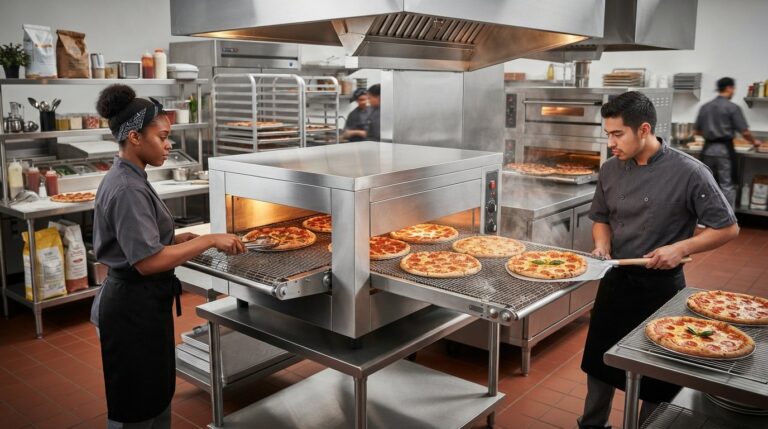
More output doesn’t always require a wider conveyor. An edge conveyor pizza oven such as the EDGE 3270 is stated to increase production of 16-inch pizzas by 75% compared with a standard 40-inch conveyor oven, while using the same 32-inch-wide belt. That increase requires 30 more inches of floor space.
In a busy kitchen, steady flow and consistent results matter as much as peak capacity. An edge conveyor pizza oven moves pizzas through a heated chamber at a controlled pace, so belt capacity, baking time, oven configuration, and kitchen space all affect whether it fits your operation.
This guide explains how an edge conveyor pizza oven works and what to consider for high-volume service. You’ll learn how pizzas travel through the baking chamber, how stacked ovens can affect production, and which practical details, including ventilation and utilities, to plan for. These factors can help you assess whether an EDGE oven’s production style suits your menu, workflow, and kitchen layout.
Key Takeaways
- Understand how a moving belt carries pizzas through a heated chamber at a controlled pace, supporting a steady kitchen workflow.
- Compare production claims with the belt width and floor space they require to judge whether the oven fits your service goals.
- Consider stacked configurations as one way to increase oven capacity, while accounting for your available kitchen layout.
- Factor ventilation and utility requirements into planning, since they affect where and how an oven can operate.
- Use your menu, expected order flow, and workspace constraints to decide whether an EDGE oven or another conveyor option is the better fit.
Edge conveyor pizza oven
An EDGE conveyor pizza oven moves pizzas through a heated chamber on a continuous belt. Belt speed and oven heat together determine baking time and influence output. Rather than loading pizzas into separate decks and removing them by hand, staff place them on the belt and collect them as they exit. This steady movement can organize a high-volume line, especially for repeatable menu items. The key is to match belt capacity, oven configuration, and installation requirements to your service pattern.
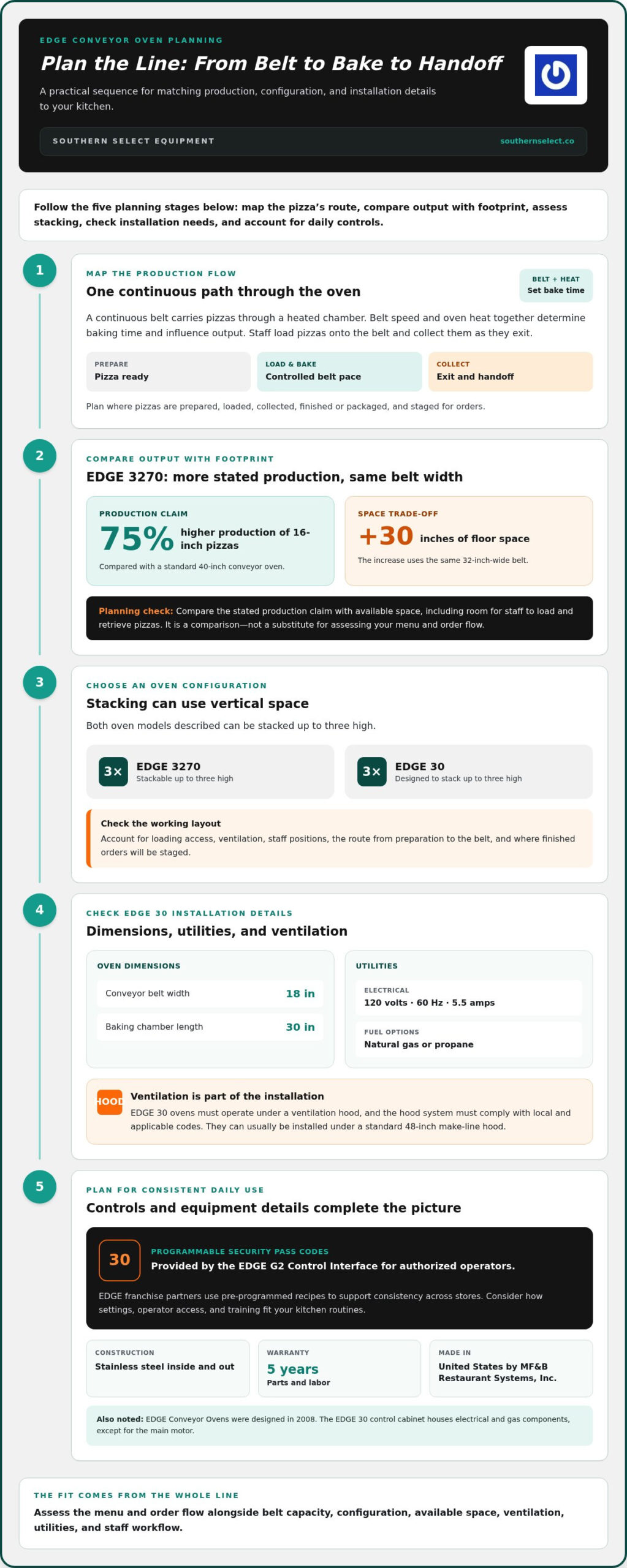
The EDGE 3270 illustrates how production capacity can change without widening the conveyor. It is stated to produce 16-inch pizzas at a rate 75% higher than a standard 40-inch conveyor oven, while using the same 32-inch-wide belt. That increase requires 30 additional inches of floor space. For a kitchen weighing the model, compare the added output with the available footprint, including space needed for staff to load and retrieve pizzas. The production claim is a comparison, not a substitute for assessing your own menu and order flow.
Stacking offers another way to configure capacity. EDGE 3270 ovens can be stacked up to three high, and EDGE 30 ovens are also designed for stacking up to three high. A stacked arrangement uses vertical space, but still requires a layout that accommodates the oven, loading access, ventilation, and service workflow. Consider where staff will stand, how pizzas will move from preparation to the belt, and where finished orders will be staged. Those steps help reveal whether adding ovens supports a smoother line or creates a pinch point.
EDGE 30 dimensions and utilities
Each EDGE 30 has an 18-inch-wide conveyor belt and a 30-inch-long baking chamber. These dimensions help frame the products and kitchen workflow the oven may suit. The EDGE 30 operates on 120 volts at 60 Hz and draws 5.5 amps. It is available for natural gas or propane. Those details give operators specific utility requirements to incorporate into equipment planning rather than treating an oven as a standalone purchase.
Ventilation is also part of the installation picture. EDGE 30 ovens must operate under a ventilation hood, and the hood system must comply with local and applicable codes. They can usually be installed under a standard 48-inch make-line hood. Plan the oven’s position alongside the hood and adjacent equipment, so belt access and staff movement remain practical. The cooking line should support a clear sequence: prepare the pizza, load it, collect it after baking, and finish or package the order.
Controls, consistency, and daily use
The EDGE G2 Control Interface provides 30 programmable security pass codes for authorized operators. EDGE franchise partners use pre-programmed recipes to support consistency across stores. In a multi-location operation, repeatable settings can help staff follow the same product process. During evaluation, consider how recipes, operator access, and training fit your kitchen’s routines. A control system contributes to consistency only when people use the intended settings and follow the established preparation steps.
The EDGE 30 control cabinet houses electrical and gas components, except for the main motor. EDGE 30 ovens are made with stainless steel inside and out. EDGE ovens are made in the United States by MF&B Restaurant Systems, Inc., and EDGE Conveyor Ovens were designed in 2008. EDGE ovens also come with a five-year parts-and-labor warranty. These details round out an evaluation alongside belt width, chamber dimensions, available floor space, utilities, and the pace of your kitchen.
- Map the route from pizza preparation to the oven exit, including staging and order handoff.
- Compare the 3270’s stated production increase with its added floor-space requirement.
- Account for the EDGE 30’s belt, chamber, electrical supply, fuel, and hood placement.
- Consider whether stacking and programmable controls suit your kitchen’s layout and operating routines.
The EDGE 3270 conveyor pizza oven can be stacked up to 3 high, a configuration to consider when evaluating vertical capacity.
Treat that figure as an estimate based on those assumptions, not a universal hourly expense. For a useful operating-cost plan, account for the temperatures and utility costs that apply to your kitchen.
Southern Select Equipment: XLT Pizza Ovens
Southern Select Equipment offers EDGE Pizza Ovens and XLT Pizza Ovens for commercial kitchens considering conveyor cooking. When comparing an EDGE configuration with other options, weigh your menu, order flow, available space, and kitchen workflow. A conveyor oven can support a consistent production sequence, and the surrounding equipment matters too. Southern Select Equipment also offers Hobart Mixers and other conveyor ovens to consider alongside your pizza production needs.
Bring your priorities into the conversation: the products you serve, your service pace, and the layout your team works in. This context can help narrow down equipment that fits your operation. For a closer look at commercial pizza oven options, contact Southern Select Equipment.
Choose the Oven That Fits Your Next Service Goal
Turn your equipment research into a clear operating priority. Decide what your kitchen needs most: a smoother handoff during rushes, a better fit for your menu, or flexibility to adjust production as demand changes. Use that priority to guide your search for an edge conveyor pizza oven and the equipment around it.
Southern Select Equipment offers XLT Pizza Ovens, EDGE Pizza Ovens, and Hobart Mixers. Share your menu and workflow needs with the team to focus the discussion on equipment suited to your operation. A thoughtful choice starts with what your team needs to deliver each shift, not simply with a model name.
When you’re ready to explore the next step, contact Southern Select Equipment. A clear picture of your kitchen’s priorities can help make the conversation practical and productive. Keep your service goals at the center, and you’ll be better prepared to choose equipment with confidence.