
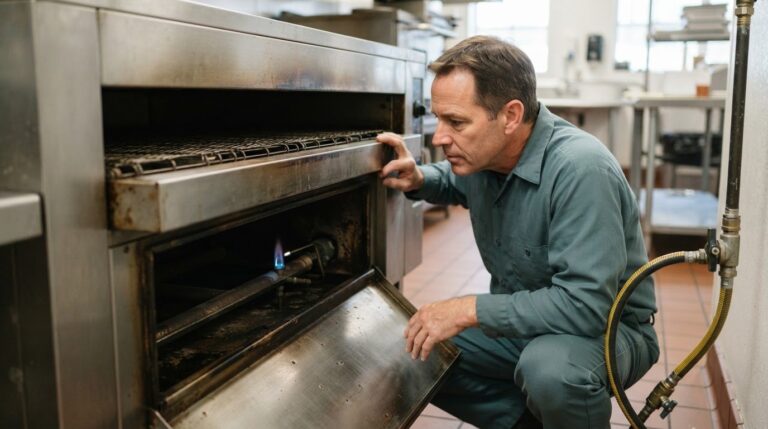
A pilot light that won’t stay lit is more than a service interruption; it can signal a gas-supply or safety-control problem. Pilot light troubleshooting for a commercial gas pizza conveyor starts with checking the gas supply and quick disconnect, then observing the pilot flame and sensor. Never bypass the safety system or manually light the main burners.
It’s understandable to want the oven back in operation quickly, especially during a busy service. But careful checks matter: a weak or extinguished pilot may indicate an issue that needs a qualified technician. If you smell gas, leave the area and contact the gas company or a certified gas technician, as advised by the U.S. Consumer Product Safety Commission.
This guide explains what to look for in the gas supply, pilot flame, thermocouple, and thermopile, and why some lighting attempts can be risky. You’ll also learn which observations are useful and when to stop troubleshooting and call for expert help.
Key Takeaways
- Start by checking whether the gas supply is on and the quick disconnect is properly connected; a detached hose must be reinstalled to the oven.
- Assess the pilot flame and sensor carefully. A match won’t generate enough heat to prove the pilot is working, and a propane torch can damage the sensor.
- A faulty pilot safety valve can allow gas to continue flowing after the pilot goes out, so don’t try to light the main burners manually.
- Thermocouples and thermopiles use different voltage levels, and pilot shutoff behavior is a safety check best handled by a technician.
- If you smell gas, leave the area immediately and call the gas company or a certified gas technician, according to the U.S. Consumer Product Safety Commission.
Checking the gas supply valve and quick disconnect
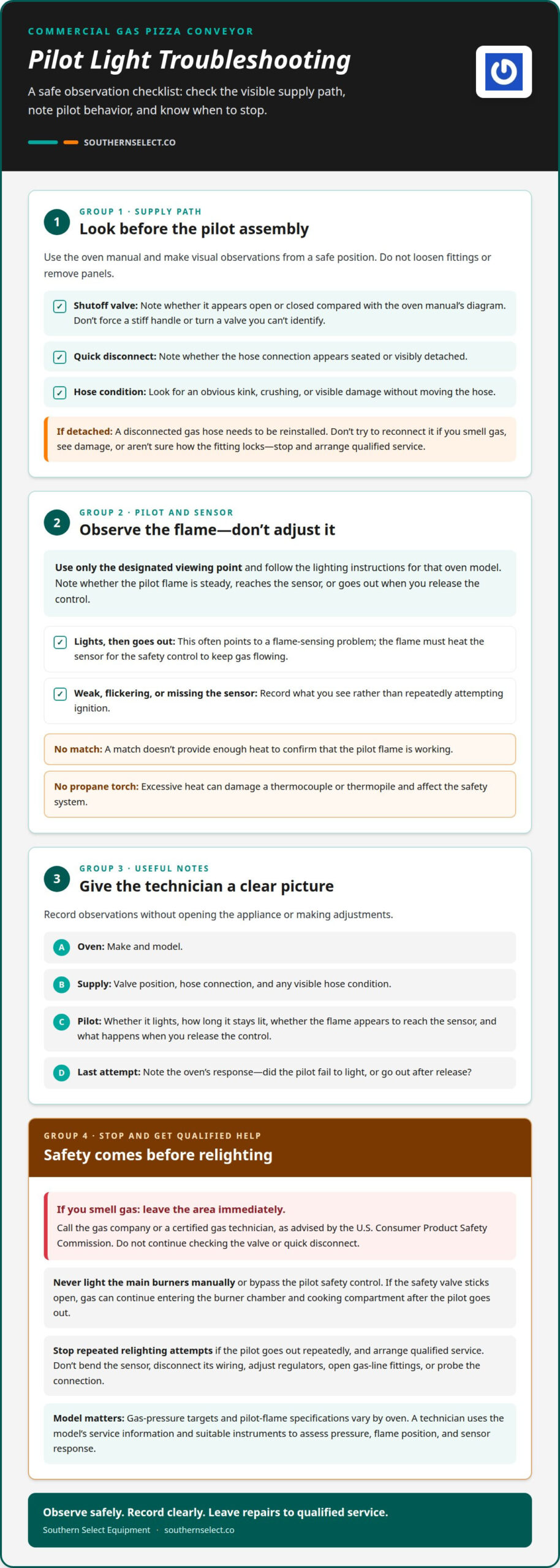
Start with the supply path, not the pilot assembly. A closed shutoff valve or disconnected hose can prevent gas from reaching a commercial conveyor oven. Keep the controls in the positions specified by the manufacturer, and inspect the visible supply connection without loosening fittings or removing panels.
For commercial gas oven repair and ventilation in the United States, requirements vary by jurisdiction and installation. Applicable rules come from codes adopted by the relevant state or local authority. A technician must identify the provisions that apply to the site.
Use the manual’s gas-supply diagram to compare the oven’s visible setup. Locate the manual shutoff valve and see whether its handle appears to be in the open position shown in the diagram. Don’t force a stiff handle or turn a valve you can’t identify confidently. An open-looking valve doesn’t prove gas is flowing, but it helps narrow the initial check.
Next, inspect the quick disconnect and hose from a safe position. Look for an obvious gap, a separated coupling, kinks, crushing, or damage. A disconnected gas hose needs to be reinstalled. Don’t try to reconnect it if you smell gas, see damage, or aren’t sure how the fitting locks. Stop and arrange qualified service instead.
Use these observations to describe the problem clearly:
- Valve position: Note whether the shutoff appears open or closed compared with the oven manual.
- Hose connection: Record whether the quick disconnect is seated or visibly detached.
- Hose condition: Point out any kink, crushing, or visible damage without moving the hose.
- Oven response: Note whether the pilot fails to light or goes out after release.
These observations can help distinguish a supply interruption from a pilot or sensor fault. If the valve appears open and the hose is connected, repeated failed ignition attempts still won’t establish the cause. Don’t adjust regulators, open gas-line fittings, or probe the connection. Those tasks require the proper service procedure and equipment.
Pay attention to odors. If you smell gas near the oven, leave the area immediately and call the gas company or a certified gas technician, as advised by the U.S. Consumer Product Safety Commission. Don’t continue checking the valve or quick disconnect.
After visually assessing the supply path, share the oven’s make and model, the valve position, and what happened during the last ignition attempt with the technician. This concise record helps focus the next diagnostic step without risking further adjustments to the gas connection.
Pilot flame strength and sensor issues
A pilot that lights but goes out when you release the control often points to a flame-sensing problem. The flame must heat the sensor for the safety control to keep gas flowing. If the flame misses the sensor, flickers, or appears weak, note what you see instead of repeatedly attempting ignition.
For pilot light troubleshooting on a commercial gas pizza conveyor, observe the flame only through the oven’s designated viewing point. Follow the model’s lighting instructions, then note whether the flame stays steady, reaches the sensor, or goes out when you release the control. Don’t remove panels or adjust the pilot assembly. A match doesn’t provide enough heat to confirm that a pilot flame is present.
A propane torch isn’t a safe workaround. Excessive heat can damage a thermocouple or thermopile, complicate diagnosis, and potentially affect the safety system. If the pilot won’t stay lit, describe whether it goes out immediately after you release the control or struggles while you hold it. This pattern can help a technician distinguish a flame or sensor issue from another fault.
Commercial conveyor ovens don’t have one universal gas-pressure target or pilot-flame specification. Correct values and appearance depend on the oven model and manufacturer’s instructions. A technician uses the model’s service information and suitable instruments to assess pressure, flame position, and sensor response. Don’t adjust a regulator based on another oven’s settings.
Repair costs in the United States depend on the diagnosis, required parts, and labor. Cleaning or adjusting a pilot differs from replacing a sensor or addressing a gas-control problem, so there’s no single price that applies to every oven.
Pilot light troubleshooting for a commercial gas pizza conveyor should focus on safe observations, not guesses about which part to replace. Record the oven’s make and model, whether the pilot lights, how long it stays lit, and what happens when you release the control. Note whether the flame appears to touch the sensor. These details give a technician a clearer starting point without requiring you to open the appliance.
If the pilot goes out repeatedly, stop trying to relight it and arrange qualified service. Commercial repair and maintenance providers such as hey-key.com can provide the professional diagnostics needed to resolve lingering heating and ignition faults. Don’t use a torch, bend the sensor, or disconnect its wiring. If you smell gas, leave the area immediately and call the gas company or a certified gas technician, as advised by the U.S. Consumer Product Safety Commission.
Risks of manually lighting burners
Relight a commercial conveyor oven’s pilot only by following the manufacturer’s instructions for that model. Never use a hand flame to light the main burners or bypass a pilot safety control.
The pilot and main burners have different safety roles. The pilot safety valve should prevent gas from reaching the main burners while the pilot is off. If the valve sticks open, gas can continue entering the burner chamber and cooking compartment after the pilot goes out. Manually lighting a burner in that situation risks igniting accumulated gas.
Follow the oven’s printed lighting instructions, including any specified control positions and ignition method. Steps vary by model, so a procedure for another conveyor oven may not apply. If the instructions are missing, unclear, or don’t match the controls, stop and arrange qualified service rather than improvising.
Before an approved relighting attempt, check for a gas odor from a safe position. If you smell gas near the appliance, leave the area immediately and call the gas company or a certified gas technician, as advised by the U.S. Consumer Product Safety Commission. Don’t operate switches, use a flame, or continue troubleshooting.
Even without an odor, don’t repeat failed ignition attempts. A pilot that won’t light or stay lit may indicate a problem with the flame-sensing system or pilot safety valve. Repeatedly opening controls or applying an outside flame can conceal the fault rather than resolve it. Note what happened and stop if the manufacturer’s procedure doesn’t restore the pilot.
Use this distinction to guide your next step:
- Pilot won’t ignite: Stop after following the model’s instructions. Don’t light the main burner by hand.
- Pilot goes out: Don’t assume the safety valve has shut off gas. Have the pilot and safety system assessed.
- Gas odor appears: Leave immediately and call the gas company or a certified gas technician.
When describing the issue to a technician, provide the oven’s make and model, the step where ignition failed, and whether the pilot stayed lit after you released its control. These observations help distinguish a lighting problem from a safety-control fault without opening the appliance or adjusting gas components.
A commercial oven’s burner chamber isn’t a safe place to test a flame manually. If the pilot safety system may not be controlling gas flow, leave the appliance off and have the fault diagnosed before returning the oven to service.
Thermocouple and thermopile operation
In pilot light troubleshooting for a commercial gas pizza conveyor, the thermocouple or thermopile helps the safety system respond to pilot heat. If the sensor doesn’t register enough heat, the control may stop gas flow and the pilot may not stay lit. The sensor type depends on the oven design, so identify the model before interpreting symptoms or test results.
A thermocouple is designed to produce a peak voltage of 30 millivolts. A thermopile is designed to produce a peak voltage of 750 millivolts. These are different components with different peak outputs, not interchangeable targets. A reading must be understood in relation to the oven’s specific service information and test conditions.
If the pilot lights but goes out when you release its control, the flame may not be heating the sensor properly. The sensor connection or safety control may also need attention. A technician checks the flame’s position, the sensor’s condition, and its electrical output together. This helps avoid assuming the sensor itself has failed.
For commercial gas pizza conveyor pilot-light troubleshooting, voltage testing and adjustments belong to a qualified technician. Don’t bend the sensor, disconnect wires, or try to recalibrate it yourself. On an oven whose pilot won’t ignite, a thermocouple may need readjustment or recalibration. A technician can determine whether that applies by following the manufacturer’s service procedure.
The pilot safety valve is another part of the diagnosis. It should prevent gas from reaching the main burners when the pilot isn’t lit. A technician should check that the safety system shuts off gas within about a minute after the pilot burner goes out. This confirms whether the system responds as intended when its heat signal disappears.
Help the technician narrow down the issue by recording the oven’s make and model, the pilot’s behavior, and whether the flame stays lit after you release the control. Mention any recent change, such as a pilot that used to stay lit but now goes out. These details support a focused inspection without requiring you to open the appliance.
If the pilot repeatedly fails, leave sensor tests and gas-control adjustments to qualified service. Sensor assessment is an important part of pilot light troubleshooting for a commercial gas pizza conveyor, but it doesn’t identify the failed component on its own. If you smell gas, leave the area immediately and call the gas company or a certified gas technician, as advised by the U.S. Consumer Product Safety Commission.
When to call a qualified service technician
Call a qualified technician if the pilot repeatedly fails, goes out, or won’t stay lit after you follow the manufacturer’s lighting procedure. These symptoms can involve the pilot assembly, sensor, gas control valve, or another part of the safety system.
Replace the pilot assembly or gas control valve only after a technician identifies a faulty component. The technician should assess the assembly and confirm that the safety valve prevents gas from reaching the main burners when the pilot is out. The pilot safety system should also shut off gas within about a minute after the pilot burner goes out.
Leave gas-control adjustments, component replacement, and safety-system testing to qualified service. Qualified specialists such as PSP & Gas Engineering can provide professional gas safety inspections to ensure commercial equipment and ventilation pathways remain fully safe and compliant. Don’t remove panels, disconnect gas fittings, or try to test a valve by manually lighting a burner. These actions can expose you to gas or interfere with the controls that protect the oven.
Some oven problems extend beyond ignition. If a commercial pizza oven gets too hot or doesn’t get hot enough, an authorized service technician may need to recalibrate its thermostat. A broken thermostat needs replacement by an authorized service technician. Don’t adjust the thermostat to compensate for inconsistent heating; the underlying fault needs proper diagnosis.
Contact a technician promptly if you notice any of these conditions:
- Repeated pilot failure: The pilot won’t ignite or goes out after the control is released.
- Suspected safety-control fault: The oven’s gas shutoff behavior needs assessment after the pilot extinguishes.
- Temperature problems: The oven runs too hot, stays too cool, or has a broken thermostat.
- Visible damage: A gas component, wire, or connection appears damaged or displaced.
If you smell gas near a commercial cooking appliance, leave the area immediately and call the gas company or a certified gas technician, as advised by the U.S. Consumer Product Safety Commission. Don’t stay to inspect the oven or try another lighting attempt.
Before arranging service, note the oven’s make and model, the symptoms, and what happened during the last approved lighting attempt. Include whether the pilot stayed lit, whether the oven reached its normal cooking temperature, and whether the problem returned. These details help the technician focus the inspection without asking you to open the appliance.
Once the fault is identified, the technician can determine whether adjustment, recalibration, or replacement is appropriate. A pilot that goes out doesn’t automatically mean the whole assembly needs replacing. The right repair depends on the component’s condition and the safety system’s response.
Southern Select Equipment: Conveyor Ovens
Southern Select Equipment can help when a pilot-light fault leads you to consider replacing or selecting a commercial oven. Its conveyor pizza ovens and commercial pizza oven offerings include XLT and EDGE models. This is an equipment option, not a substitute for having a qualified technician diagnose a gas or safety-control fault.
If the oven is unsafe or repeatedly fails after the approved lighting procedure, keep it out of operation until it has been assessed. Once you know whether repair or replacement is the right path, Southern Select Equipment can help you explore commercial oven options for your food-service operation.
Contact Southern Select Equipment to discuss commercial pizza ovens.
Keep Your Kitchen Moving With the Right Next Step
Careful troubleshooting of a commercial gas pizza conveyor’s pilot light can help you decide whether the oven needs qualified attention or whether it’s time to consider different equipment. Keep any oven with a suspected gas or safety-control fault out of operation until it has been assessed.
If you’re weighing replacement options, Southern Select Equipment offers XLT Pizza Ovens and EDGE Pizza Ovens for commercial kitchens, as well as heavy-duty food-service machinery. The right equipment choice depends on your kitchen’s needs and the role each piece must fill.
For help discussing your commercial equipment needs, contact Southern Select Equipment. A thoughtful next step can help you move forward with confidence and keep service planning on track.
Frequently Asked Questions
How does the pilot light and ignition system work on a commercial gas conveyor pizza oven?
The pilot flame provides the heat signal that lets the oven’s safety control keep gas available for operation. If the flame goes out, the safety system should stop gas from reaching the main burners. For example, a pilot that lights briefly but won’t stay lit may indicate that the flame-sensing or safety-control sequence isn’t completing. Ignition steps vary by oven model, so follow the manufacturer’s instructions.
What causes a commercial gas pizza oven pilot light to go out repeatedly?
Repeated outages can result from a pilot flame that doesn’t properly heat its sensor, a sensor that needs attention, or a problem in the pilot or gas-control assembly. The timing offers a useful clue: note whether the flame falters before you release the control or goes out immediately afterward. Record the pattern along with the oven’s make and model. A technician can use these observations to guide diagnosis instead of replacing parts by guesswork.
How to check the thermocouple, thermopile, gas valve, and pilot assembly on a conveyor oven?
Limit your own checks to observing the pilot through its designated viewing point and noting whether the flame reaches the sensor. Don’t remove panels, disconnect wires, or open gas fittings. A qualified technician can identify whether the oven uses a thermocouple or thermopile, test its output, inspect connections, and assess the valve’s shutoff response. Share the oven’s model and symptoms so the technician can use the correct service information.
What safety steps should be followed when troubleshooting a commercial gas oven pilot light?
Use only the oven manufacturer’s lighting procedure. Don’t manually light the main burner or heat a sensor with a torch. Stop troubleshooting if the pilot repeatedly fails or any gas component appears damaged. Consumer Product Safety Commission. Don’t stay nearby to inspect or relight the oven.
When should you shut off the gas and call a licensed commercial appliance technician?
Call qualified service if the pilot won’t stay lit, the safety control may not be stopping gas flow, or the oven’s thermostat is faulty. If you smell gas, leave immediately and call the gas company or a certified gas technician, as advised by the U.S. Consumer Product Safety Commission. Don’t operate controls or attempt repairs in the affected area. For repeated ignition trouble without a gas odor, stop using the oven and arrange professional diagnosis.