
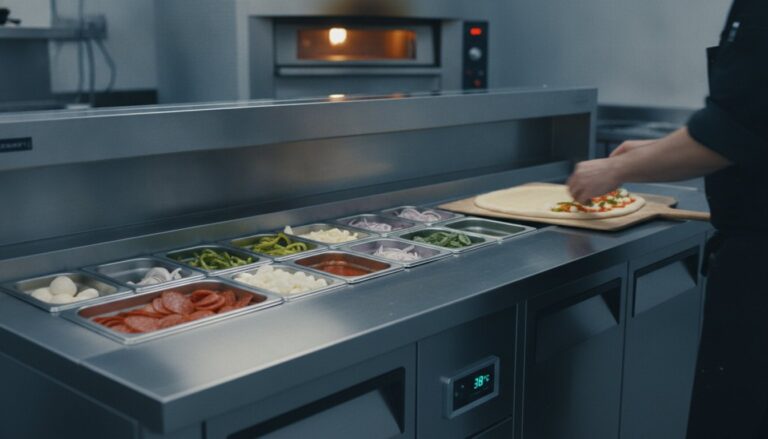
Imagine it is a Friday night rush on the Gulf Coast and your high-volume conveyor oven is pumping out perfect pies, yet your line has ground to a halt because the ingredients in your rail have started to wilt. It is a nightmare every kitchen manager fears, especially when the heat of a professional kitchen meets the demands of a hungry crowd. You likely already know that your prep station is the tactical command center of your operation. Selecting the right commercial pizza prep tables is about more than just finding a cold box; it is about protecting your workflow and your commitment to hospitality.
At Southern Select, we believe your equipment should be as reliable as a local guide. This guide will show you how to choose a unit that keeps your toppings at the FDA-mandated 41°F or below while standing up to a decade of heavy use. We will explore the shift to R290 refrigerants, smart temperature monitoring, and the ergonomic layouts that ensure a seamless experience for your staff and a safe, delicious product for your guests. Whether you are upgrading an existing line or building a new kitchen, the right choice today ensures your business stays cool under pressure for years to come.
Key Takeaways
- Understand how a dedicated prep station serves as your kitchen’s tactical command center to ensure a seamless flow during peak hours.
- Identify the specific refrigeration technologies that maintain food safety standards and ingredient freshness even in high-heat professional kitchens.
- Select the right size and configuration for your commercial pizza prep tables by accurately matching pan capacity to your unique menu requirements.
- Synchronize your preparation speed with high-volume conveyor ovens to maximize throughput and keep your service moving without interruption.
- Protect your long-term investment with expert maintenance strategies designed to extend the life of your machinery for a decade or more.
The Command Center: Why Commercial Pizza Prep Tables Define Kitchen Flow
Your kitchen’s pulse is measured by the speed of the line, and at the center of that rhythm sits your prep station. A pizza prep table is far more than a simple refrigerator with a flat top; it’s a specialized workstation designed to handle the unique physics of pizza assembly. While the history of this dish is long, modern high-volume pizzerias rely on standard and purpose-built pizza preparation tables to maintain the pace of a coastal dinner rush. These units are built to keep ingredients at the FDA-mandated 41°F or below, even when the lids are open and the kitchen is humming with the heat of nearby ovens.
Choosing the right equipment means understanding that commercial pizza prep tables are the primary guardians of food safety and workflow efficiency. They’re engineered to meet NSF/ANSI Standard 7, which requires the refrigerated rail to maintain internal temperatures between 33°F and 41°F. When your staff can trust that their ingredients are safe and within reach, they can focus on the craft of the perfect crust and the hospitality that keeps your guests coming back. At Southern Select, we’ve seen how a curated equipment choice can transform a chaotic line into a seamless operation.
Pizza vs. Sandwich Prep Tables: More Than Just Size
It’s a common mistake to assume a sandwich unit can pull double duty in a pizzeria. The differences are subtle but critical for professional performance. Pizza assembly requires significantly more space; therefore, these tables feature deeper cutting boards, typically 18 to 20 inches, to accommodate large pies without the dough hanging off the edge. This extra depth prevents cross-contamination and keeps your workspace clean during a hectic shift.
- Raised Rail Height: The ingredient rail is positioned higher and closer to the chef, which provides ergonomic access to toppings without constant bending.
- Cooling Power: Because they often sit near high-output conveyor ovens, these tables utilize heavier-duty refrigeration systems to combat ambient heat and frequent lid openings.
- Construction: Professional units often use Type 304 stainless steel for food-contact surfaces to ensure durability and easy sanitation.
The Ergonomics of a High-Volume Line
In a high-demand kitchen, “reach-fatigue” is a real threat to your team’s stamina. Every extra inch a chef has to stretch for a pepperoni slice adds up over hundreds of orders. A well-configured table minimizes these movements, allowing for faster assembly speeds per minute. Workspace depth plays a vital role here; it provides enough room for the dough to be worked while keeping the topping rail within a natural arm’s reach.
Temperature retention is another area where quality matters. Stainless steel lids are generally superior to plastic alternatives during lulls in service because they provide better insulation and durability. The commercial pizza prep table serves as the tactical command center where ingredient accessibility meets rigorous temperature control to ensure every pie leaves the line at peak quality. By investing in a unit that prioritizes these ergonomic details, you’re not just buying a machine; you’re supporting the hands that build your business.
Critical Features for Maintaining Freshness in High-Heat Environments
A professional kitchen is a place of intense heat, especially when your conveyor ovens are running at full capacity. This environment puts immense pressure on your refrigeration. To keep your operation running smoothly, you need commercial pizza prep tables that are engineered to fight back against high ambient temperatures. While many entry-level units struggle when the room hits 85°F, professional-grade models utilize high BTU (British Thermal Unit) ratings and thick, foamed-in-place insulation to maintain a steady internal climate. Digital temperature controls with external displays are no longer a luxury; they’re a necessity for at-a-glance monitoring during a busy shift.
Forced-Air Cooling and Ingredient Integrity
The debate between forced-air and cold-wall refrigeration often comes down to how you use your station. Forced-air systems use powerful fans to create an “air curtain” over the top of your condiment pans. This curtain acts as a barrier against the warm kitchen air, ensuring that your cheese and meats stay chilled even when the lid is open for hours. Adhering to FDA food safety guidelines requires keeping these perishable items below the 41°F “Danger Zone” threshold at all times. It’s about reliability and the peace of mind that comes from knowing your guests are safe.
However, poor-quality forced-air units can lead to “top-freezing,” where the air is so cold and direct that it freezes the surface of your delicate vegetables. A well-designed system balances airflow to maintain consistency without damaging your product. If you’re unsure which cooling method suits your specific kitchen layout, the experts at Southern Select can help you evaluate your workflow needs to find a seamless solution.
Durability and Material Standards
Longevity in a high-volume environment depends on the materials used in construction. 304-series stainless steel is the professional industry standard for a reason. It offers superior resistance to rust and corrosion caused by food acids and cleaning chemicals. While 430-series steel is often used on back panels to save costs, your high-touch surfaces and interior should always be the higher grade. It’s a hallmark of equipment built to last a decade or more.
- Cutting Boards: High-density polyethylene (HDPE) boards are preferred over wood-fiber alternatives because they are non-porous and won’t warp or harbor bacteria.
- Mobility: Heavy-duty casters are essential. You need to be able to move these heavy commercial pizza prep tables easily for nightly cleaning to maintain a sanitary environment.
- Cabinet Walls: Look for walls with at least two inches of high-density insulation. This ensures the compressor doesn’t have to work overtime, which saves on energy bills and prevents premature equipment failure.
By focusing on these technical details, you’re investing in the stability of your business. A prep table that maintains its temperature under pressure is the silent partner that keeps your kitchen moving and your reputation intact.
Finding the Perfect Fit: Sizing and Configuration Strategies
Finding the right fit for your kitchen is about balancing your current menu with your aspirations for growth. When selecting commercial pizza prep tables, the first question isn’t just how long the unit is, but how many distinct ingredients your signature pies require. A complex menu with twenty toppings demands a different configuration than a high-volume shop focusing on the classics. You want a setup that feels like a natural extension of your hands, where every ingredient is exactly where you expect it to be, shift after shift.
At Southern Select, we understand that your equipment needs to be a reliable partner in your success. Choosing between a standard top and a Mega Top is one of the most important decisions you’ll make. Standard tops provide a single row of pans, which is ideal for kitchens with a streamlined menu. Mega Tops add an extra row, giving you the variety you need without expanding the footprint of the table. However, you must ensure that the added pan capacity doesn’t eat into the cutting board space required for stretching and topping your largest doughs.
Pan Mapping for Peak Efficiency
Pan mapping is the art of organizing your workspace for peak efficiency. Most rails are designed to accommodate 1/3, 1/6, or 1/9 size pans. We recommend placing your high-turnover items, like mozzarella and tomato sauce, in larger 1/3 pans at the center of the line. Specialty toppings fit perfectly in 1/9 pans on the periphery. This layout minimizes movement and keeps your staff focused on assembly rather than reaching. It is a simple way to increase your pies-per-hour without adding labor costs.
Choosing between doors and drawers is another matter of personal workflow. Drawers allow your staff to pull out backup ingredients without bending down, which can shave seconds off each order and reduce physical strain. Conversely, door models provide more vertical space for large bulk containers. Whichever configuration you select, maintaining a clean environment is vital. Following OSHA sanitation standards ensures your kitchen remains a safe place for your team to work and your guests to eat, grounding your professional authority in every dish you serve.
Space Optimization in the Back-of-House
Space in the back-of-house is often at a premium, especially in bustling coastal communities. When measuring your line, don’t just look at the footprint of the table. You need to account for door swings and the necessary gaps for airflow. Front-breathing units are a lifesaver in tight kitchens because they pull and exhaust air from the front. This design allows you to push the equipment flush against walls or other machinery, creating a built-in look that maximizes every square inch of your floor plan.
Matching your table length to your dough stretching station is the final piece of the puzzle. A seamless transition from your Hobart mixer to the prep table, and finally to your high-volume conveyor oven, creates a workflow that feels effortless. When your machinery is synchronized, your kitchen operates with a sense of calm and competence that is the hallmark of a truly professional operation.
Synchronizing Your Prep Line with High-Volume Conveyor Ovens
Your kitchen is a finely tuned ecosystem where every second counts. While an XLT or EDGE conveyor oven provides the consistent heat needed for high-volume success, its output is strictly limited by how quickly your team can assemble each pie. If your commercial pizza prep tables aren’t synchronized with your oven’s bake times, you’ll find yourself with a line of hungry guests and a half-empty conveyor belt. It’s a common frustration, but one that’s easily solved by matching your recovery times and layout to your oven’s capacity.
High-volume ovens require more than just a cold surface; they demand refrigeration that can handle constant lid openings. When you’re pulling ingredients every thirty seconds, the compressor has to work overtime to keep the rail below 41°F. At Southern Select, we specialize in integrating these systems so your workflow remains seamless from the first stretch to the final box. We understand that a professional kitchen is about more than just individual machines; it’s about how those machines work together to support your staff.
The ‘Bottleneck’ Effect: When Prep Can’t Keep Up
The assembly line is where most delays occur before they ever hit the heat. If your staff has to walk across the kitchen to grab more dough or refill a cheese pan, the rhythm of the entire shift breaks. Identifying these delays early is the key to maintaining a steady pace. A high-performance prep table prevents ‘oven-idling’ by ensuring that every dough ball is perfectly chilled and every topping is within reach the moment the oven belt has an opening.
- Bulk Storage: Use refrigerated drawers for bulk dough storage directly under the stretch station to eliminate unnecessary steps.
- Recovery Speed: Ensure your table has a high-BTU compressor that can recover temperature quickly after the lid has been open during a rush.
- Workflow Mapping: Position your Hobart mixer and dough press in a direct line with your prep table to create a logical ‘Stretch, Top, Bake’ sequence.
Heat Management Strategies
Radiant heat from a conveyor oven can be a silent killer for ingredient freshness. If your prep station is positioned too close to the oven mouth without proper shielding, your cheese will sweat and your greens will wilt. This is where the synergy between commercial refrigerators and specialized prep stations becomes vital. You need equipment designed with superior insulation to maintain a robust thermal barrier against the ambient heat of your cooking line.
Optimizing the ‘Landing Zone’ is the final step in this synchronization. This is the area where finished pizzas exit the oven to be boxed and sliced. If this area is cluttered or poorly positioned relative to your prep table, it creates a cross-traffic nightmare. We’ve helped countless local pizzerias map out these zones to ensure a steady, hospitable flow that keeps the kitchen calm even during a busy weekend. Contact Southern Select today to discuss how we can help you sync your prep line with the industry’s best conveyor ovens for maximum efficiency.
Investing in Longevity: Selection and Maintenance for Professional Kitchens
Owning a high-volume kitchen means managing high-stakes machinery every single day. When you invest in commercial pizza prep tables, you aren’t just buying a refrigerated box; you’re securing a decade of service for your business. It is a long-term partnership between your staff and your equipment. While entry-level units might look identical to professional-grade models on a spec sheet, the hidden costs of cheap refrigeration quickly surface through frequent service calls, spoiled ingredients, and skyrocketing energy bills. We’ve found that the most successful operators prioritize heavy-duty, repairable machinery that can withstand the rigors of a coastal summer rush.
Choosing a unit with a robust warranty and readily available replacement parts is essential for minimizing downtime. In a professional setting, a broken hinge or a torn gasket shouldn’t mean waiting three weeks for a proprietary part to ship from overseas. At Southern Select, we focus on brands that offer professional-grade reliability and local serviceability. This ensures that when a component eventually wears out, it can be replaced quickly to keep your kitchen’s rhythm steady and your hospitality uninterrupted.
The Maintenance Routine for 24/7 Operations
A proactive maintenance schedule is the best way to protect your investment. Dust and grease are the primary enemies of any refrigeration system. When condenser coils become clogged, the compressor has to work twice as hard to maintain the same temperature, which leads to premature burnout. We recommend a simple monthly cleaning of the coils using a soft brush or vacuum to ensure your system breathes easily. It is a small task that can add years to the life of your equipment.
- Gasket Inspection: Check your door and drawer gaskets weekly. A cracked or brittle seal is the number one culprit for temperature loss and high energy consumption.
- Sanitization: Daily cleaning of the high-density polyethylene cutting boards and pan rails prevents cross-contamination and ensures you remain in compliance with local health codes.
- Drain Lines: Clear the condensate drain lines monthly to prevent water buildup and potential icing issues inside the cabinet.
The Southern Select Difference
Our commitment to your success goes beyond a simple transaction. We take pride in our role as a Trusted Local Guide, helping you find equipment that matches the unique demands of your menu and your volume. This includes navigating restaurant equipment supply for national operators who require consistency and durability across multiple locations. We curate only high-performance brands because we know that your reputation depends on the reliability of your tools.
By choosing commercial pizza prep tables that are built for longevity, you are creating a stable foundation for your kitchen team. Our neighborly approach ensures you get the right equipment the first time, backed by expert knowledge of professional kitchen workflows. Whether you’re stretching dough for a single shop or managing a regional fleet, we’re here to ensure your refrigeration remains a seamless part of your success story.
Elevate Your Kitchen’s Command Center
Building a successful, high-volume pizzeria requires a layout where every movement counts and every ingredient stays perfectly chilled. You’ve seen how the right cooling technology, ergonomic design, and synchronization with your conveyor ovens are the foundations of a seamless workflow. By prioritizing durability and food safety today, you’re ensuring that your kitchen remains productive for years to come. Investing in premium commercial pizza prep tables is more than an equipment purchase; it’s a commitment to your team’s stamina and your community’s trust.
At Southern Select, we combine family-owned expertise with genuine Southern hospitality to serve as your trusted local guide. We specialize in high-volume kitchen efficiency and offer national shipping to ensure you have access to the best machinery, regardless of your location. Our team is ready to help you navigate professional sourcing with integrity and expert insight. Explore Our Professional Pizza Prep and Refrigeration Solutions to find the perfect partner for your cooking line. We look forward to helping you build a kitchen that thrives under pressure.
Frequently Asked Questions
What is the difference between a pizza prep table and a sandwich prep table?
Pizza prep tables feature deeper cutting boards, usually 18 to 20 inches, to accommodate large dough rounds that would hang off a standard sandwich unit. They also include a raised ingredient rail that sits closer to the chef for better ergonomics. While sandwich units are designed for speed in smaller assemblies, pizza tables are built with heavier-duty refrigeration to handle the heat of a nearby oven.
How many pans can a standard 72-inch pizza prep table hold?
A standard 72-inch pizza prep table typically holds nine to twelve third-size pans in its refrigerated rail. Your specific capacity depends on whether you choose a standard or mega top configuration. You can further customize this space by using pan adapters to mix and match smaller sixth-size or ninth-size pans for specialty toppings, ensuring your most popular ingredients stay at the center of the line.
Does a pizza prep table need a floor drain for condensation?
Most modern units do not require a floor drain because they utilize a self-contained condensate evaporator system. This system uses the heat from the compressor to evaporate any moisture collected during the defrost cycle. However, you should still check your local building codes and the manufacturer’s specifications to ensure your specific model doesn’t require a direct plumbed connection in high-humidity coastal environments.
Can I use a mega top prep table for pizza assembly?
You can use a mega top unit for pizza assembly, but you’ll likely sacrifice the deep cutting board space required for stretching large pies. Mega tops add an extra row of pans, which is excellent for menus with high topping variety. If you go this route, ensure your dough stretching happens on a separate station so your staff isn’t struggling with a cramped workspace during a dinner rush.
How often should I clean the condenser coils on my prep table?
You should clean your condenser coils at least once a month to prevent compressor failure and maintain energy efficiency. In high-volume kitchens with flour and grease in the air, you might need to perform this task every two weeks. A simple vacuuming or brushing of the coils ensures your refrigeration system doesn’t have to work overtime, which protects your long-term investment and keeps your ingredients safe.
Are refrigerated drawers better than doors for pizza prep?
Refrigerated drawers are often better for high-volume speed because they allow staff to access backup ingredients without bending down or reaching deep into a cabinet. This ergonomic advantage can significantly reduce fatigue during a long shift. However, door models remain popular for kitchens that need to store large bulk containers or dough trays that won’t fit within the standard dimensions of a drawer system.
What temperature should a commercial pizza prep table be set at?
Your commercial pizza prep tables should be set to maintain an internal temperature between 33°F and 38°F. This setting ensures your ingredients stay below the FDA-mandated 41°F threshold even during peak hours when the lid is frequently open. Always use an independent thermometer to verify the rail temperature, as the digital display on the cabinet reflects the air temperature rather than the internal temperature of your toppings.
How do I ensure my prep table stays cold next to a hot conveyor oven?
Ensuring your commercial pizza prep tables stay cold requires a combination of front-breathing design and tactical positioning. Placing a heat shield or a small air gap between the oven and the prep station prevents radiant heat from overwhelming the refrigeration system. You should also ensure the lid is closed during any lulls in service to help the unit recover and maintain the integrity of your chilled air curtain.