
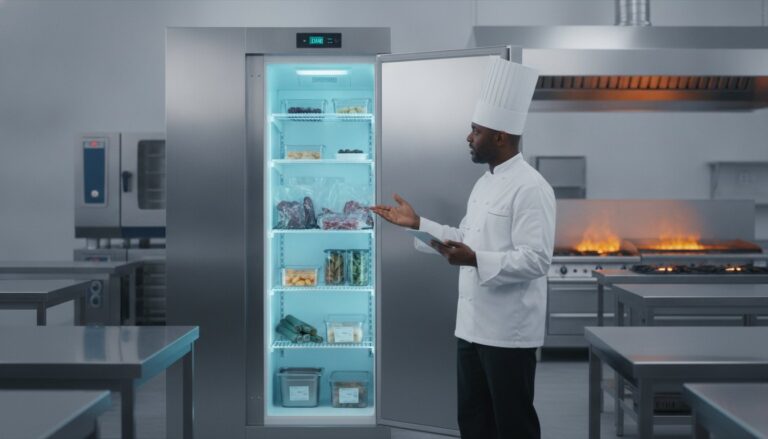
What if your back-of-house storage acted as a silent partner in your profitability rather than a constant source of stress? Investing in walk-in freezers for restaurants is one of the most significant decisions you’ll make for your kitchen’s infrastructure. It is natural to worry about rising energy bills or the sudden heartbreak of a compressor failure during a busy holiday weekend. You deserve a system that works as hard as your team does; one that maintains the integrity of your ingredients without the constant fear of inventory loss or floor space headaches.
This 2026 guide is designed to help you master the technical and operational nuances of these heavy-duty units. We’ll show you how to ensure your kitchen achieves strict food safety compliance while securing a significantly reduced total cost of ownership. We will walk through the latest EPA refrigerant regulations regarding A2L transitions, energy-efficient insulation standards, and smart technology integrations that create a seamless workflow. By the end, you’ll have the expert knowledge to select a freezer that offers both professional-grade reliability and the welcoming peace of mind your business deserves.
Key Takeaways
- Learn why rapid pull-down times are essential for food safety and how consistent temperature recovery protects your high-value inventory.
- Navigate the latest 2026 EPA refrigerant standards and energy efficiency requirements to ensure your walk-in freezers for restaurants remain compliant and cost-effective.
- Discover how to properly measure your kitchen’s path of entry and electrical capacity to avoid common installation delays or equipment mismatches.
- Understand the strategic differences between reach-in and walk-in units to optimize your kitchen’s daily workflow and long-term bulk storage capacity.
- Gain professional insight into selecting high-density insulation and compressor horsepower that can withstand the intense heat of a high-volume kitchen environment.
Beyond Cold Storage: Why Walk-In Freezers are Critical for Food Safety
Think of your freezer as the silent heartbeat of your kitchen’s safety protocol. While many see a simple stainless steel box, we see a sophisticated defense system against spoilage and waste. Investing in high-quality walk-in freezers for restaurants is about more than just finding a place to put your bulk orders; it’s about protecting the integrity of every plate you serve. At Southern Select Equipment, we believe that professional-grade equipment should offer you the same peace of mind that a trusted neighbor provides.
The primary difference between a professional unit and a standard model lies in the recovery time. When your team loads fifty pounds of room-temperature poultry or fresh seafood, the internal temperature of the cabinet naturally rises. A professional system utilizes a robust Vapor-compression refrigeration system to strip away that heat rapidly. This rapid “pull-down” is what keeps your ingredients out of the window where bacteria thrive. Residential units simply don’t have the insulation or the compressor strength to maintain a steady 0°F under the intense heat and humidity of a working Southern kitchen.
Understanding the Thermodynamics of Food Safety
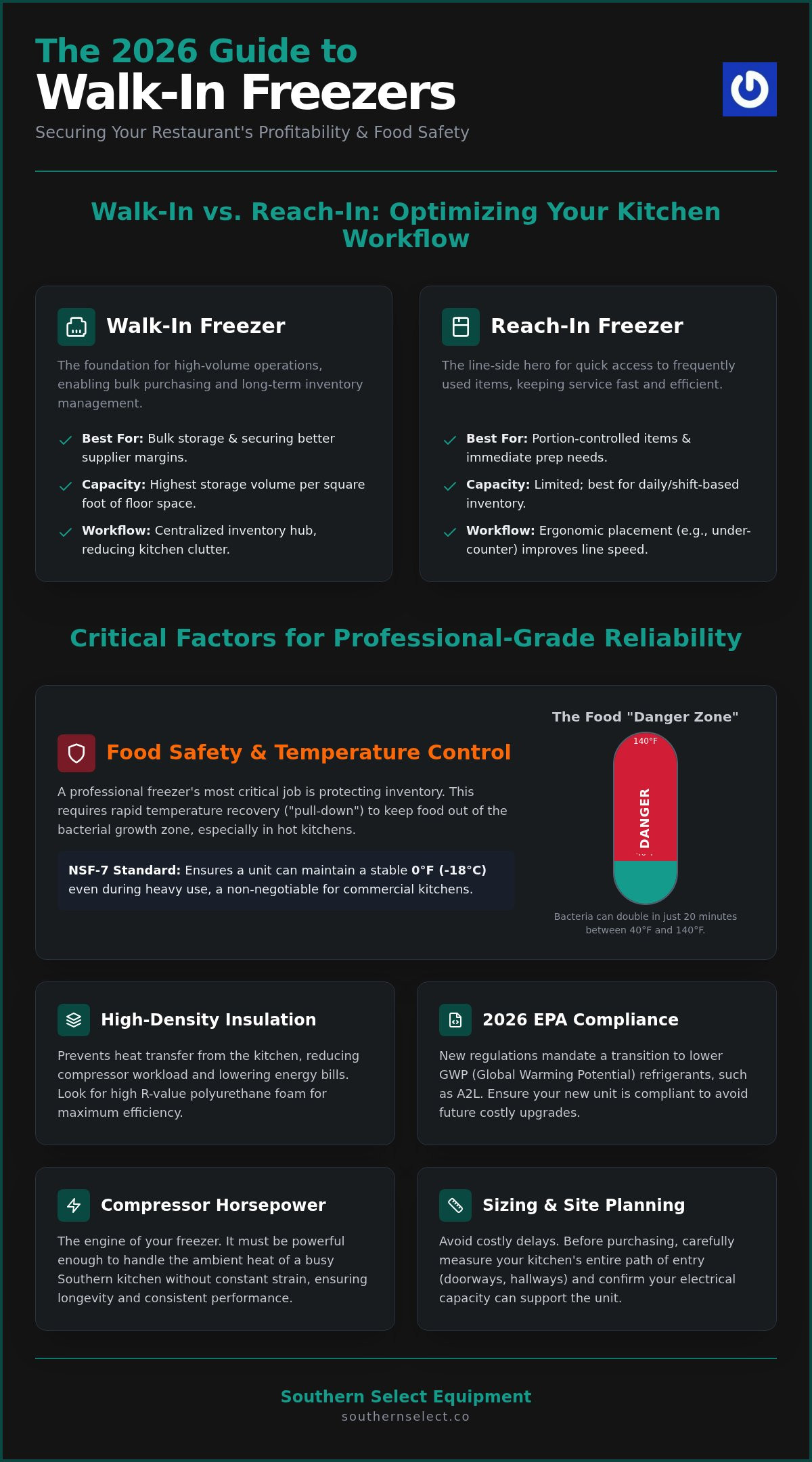
Proper cooling isn’t just about blowing cold air; it’s about how that air moves around your inventory. If a unit has poor circulation, you’ll end up with “warm spots” where bacteria can multiply even if the external thermostat looks correct. This is why we prioritize NSF-7 standards. These certifications ensure the unit can maintain safe temperatures even during the heavy usage typical of a busy lunch rush. The danger zone refers to the temperature range between 40°F and 140°F where harmful bacteria can double in number in as little as twenty minutes.
Inventory Management as a Profit Driver
Consistency is the secret to a healthy bottom line. When you can trust your equipment to hold a rock-solid temperature, you gain the freedom to buy in bulk and secure better margins from your suppliers. Reliable walk-in freezers for restaurants prevent the “shrink” that eats away at your monthly profits. We’ve seen how a single equipment failure can disrupt a family-owned business, and it’s our goal to ensure your inventory remains an asset rather than a liability—a goal you can further support when you discover Chicago POS Systems and their tailored restaurant management solutions.
For a truly resilient kitchen, we recommend integrating your bulk storage with high-performance commercial refrigerators to create a seamless cold-chain solution. This ensures that every ingredient, from the walk-in to the line-side prep table, stays at peak freshness. By choosing equipment built for professional demands, you aren’t just buying a machine; you’re securing the long-term health of your community and your business.
Evaluating Walk-In vs. Reach-In Freezers for High-Volume Workflows
Choosing the right cold storage configuration is like planning the layout of a home. It requires a deep understanding of how people move through the space. In a bustling culinary environment, walk-in freezers for restaurants serve as the foundation, while reach-in units act as the immediate tools of the trade. Finding the perfect balance between these two ensures that your chefs aren’t constantly trekking to the back of the house during a dinner rush, which keeps the kitchen rhythm steady and the service times sharp.
Reach-in freezers are the “line-side” heroes. They provide quick access to frequently used items like portioned proteins or frozen appetizers. However, relying solely on reach-ins often leads to a cluttered floor plan and higher energy costs. As your volume grows, the footprint-to-volume ratio becomes critical. A single walk-in unit typically offers significantly more storage per square foot of floor space than a row of reach-in cabinets. For those with tighter prep areas, under-counter or worktop freezers offer an ergonomic solution that doubles as a functional surface, though they should never be the primary storage for your bulk inventory.
Walk-In Solutions: Scaling for High-Volume Operations
There comes a point in every successful business where adding another reach-in just doesn’t make sense. If your team is struggling to organize deliveries or if you’re frequently running out of stock, it’s time to scale. Centralizing your storage in a restaurant kitchen improves inventory management and reduces the mechanical strain on multiple smaller compressors. When planning your installation, consider your flooring. A structural floor is necessary if you plan to use heavy rolling racks, while a floorless model is often sufficient for stationary shelving on a concrete slab.
Hybrid Storage Strategies
The most efficient kitchens utilize a hybrid approach. This strategy uses walk-in freezers for restaurants for bulk dough, seasonal ingredients, or large protein orders, while smaller reach-ins hold the “day storage” needed for immediate service. This setup minimizes the time the walk-in door stays open, which is the leading cause of temperature fluctuations and frost buildup. Maintaining these strict boundaries helps you adhere to FDA food safety standards, ensuring that all frozen goods stay at or below 0°F consistently.
By optimizing employee movement patterns, you reduce the physical toll on your staff and the mechanical toll on your equipment. If you’re unsure which combination best suits your unique space, you might find it helpful to browse our curated selection of professional equipment to see how different sizes fit into a modern workflow. Our goal is to ensure your kitchen remains a place of hospitality and efficiency, where every piece of machinery supports your culinary vision.
Key Technical Specifications: Compressors, Insulation, and 2026 Standards
When you’re looking at the technical specifications of walk-in freezers for restaurants, you’re looking at more than just a list of parts. You’re looking at the structural integrity of your business. As of January 1, 2026, the landscape of commercial refrigeration has shifted significantly due to new EPA regulations. It’s no longer just about keeping things cold; it’s about doing so with a focus on environmental responsibility and extreme energy efficiency. All new installations must now comply with strict Department of Energy standards, specifically the Annual Walk-In Energy Factor (AWEF) ratings that ensure your equipment isn’t bleeding profit through your utility bill.
One of the most critical changes in 2026 involves the refrigerants used within these systems. High-GWP (Global Warming Potential) gases like R-404A are now prohibited for new units. Instead, modern systems utilize A2L refrigerants such as R-454A or R-455A. For smaller self-contained units, R290 (propane) has become a popular, highly efficient choice. While these transitions might seem like a regulatory hurdle, they actually offer better thermodynamic properties. This means your compressor doesn’t have to work quite as hard to maintain that vital 0°F setpoint, which extends the life of your machinery.
The Heart of the System: Compressor Performance
Matching your compressor’s horsepower to your kitchen’s ambient heat is essential for long-term reliability. In a hot, high-volume environment, a forced-air cooling system must be robust enough to recover temperature within seconds of a door being closed. You’ll need to choose between a top-mount condenser, which is easier to install but adds heat to your kitchen, or a remote condenser that sits outside to keep your workspace cool and quiet. Placing the compressor in an easily accessible location ensures your service technician can perform routine cleanings and inspections without disrupting your entire line.
Cabinet Construction and Durability
The “envelope” of your freezer is what keeps the cold in and the costs down. At Southern Select, we’ve found that prioritizing these technical details early on prevents the heartbreak of inventory loss later. We always recommend 304 stainless steel for the interior and exterior because it resists the corrosive effects of salt and food acids better than cheaper alternatives. The secret to low energy consumption, however, is the insulation. High-density, 4-inch foam-in-place polyurethane is the professional minimum for walk-in freezers for restaurants, providing the R-value necessary to withstand the 2026 efficiency mandates. Don’t overlook the gaskets; a high-quality magnetic gasket creates the vacuum seal needed to prevent frost buildup and unnecessary compressor cycles.
Sizing and Site Requirements: Planning Your Walk-In Installation
The most sophisticated freezer in the world won’t help your business if it can’t make it through your back door. We’ve seen many restaurant owners focus so much on the technical specs that they overlook the physical reality of the delivery day. Measuring your ‘path of entry’ is a non-negotiable step in the planning process. You must account for every doorway, hallway corner, and tight turn between the loading dock and the final installation site. A few misplaced inches can result in costly delays or the need for professional disassembly, which adds unnecessary strain to your budget and your timeline.
Beyond the dimensions, your floor must be perfectly level to ensure the longevity of your walk-in freezers for restaurants. If the foundation is uneven, the heavy panels won’t align correctly, causing the door to sag or the magnetic gaskets to fail. This leads to air leaks that force your compressor to run constantly, eventually leading to a premature burnout. For units without a built-in floor, ensuring your concrete slab is insulated and level is the first step toward a reliable, long-term storage solution that reflects the professional standards of your kitchen.
Electrical Load and Utility Planning
Commercial power requirements are significantly more intense than what you’ll find in a standard residential setting. Most professional walk-in units require a 208-230V single-phase or three-phase connection, though some smaller models may run on a standard 115V circuit. It’s vital to use a dedicated circuit for your freezer to prevent nuisance breaker trips that could jeopardize your inventory. When you are scaling your kitchen, you must plan for the power surges common with commercial restaurant equipment. Ensure your NEMA plug types match your facility’s outlets before the unit arrives to keep the installation process smooth and neighborly.
Clearance and Airflow Ergonomics
Your freezer needs room to breathe. Crowding walk-in freezers for restaurants against walls or under low ceilings is a recipe for mechanical failure. Most manufacturers recommend a minimum of 12 inches of clearance above the unit to allow for proper airflow around the condenser. If the heat generated by the system can’t escape, the compressor will overheat, significantly shortening its lifespan. We recommend creating a dedicated ‘maintenance zone’ around the unit. This space allows your team to perform routine coil cleanings and gives service technicians the room they need to work with integrity and speed. If you are ready to find a unit that fits your specific floor plan, explore our curated selection of restaurant equipment today.
Sourcing High-Performance Freezers with Southern Select Equipment
Mastering the technical side of walk-in freezers for restaurants is an essential first step, but the final piece of the puzzle is finding a partner who values your kitchen’s success as much as you do. At Southern Select, we don’t believe in cold transactions or generic catalogs. Instead, we offer a curated experience that filters out the noise, presenting only the heavy-duty, professional-grade machinery that can handle the rigorous demands of a high-volume kitchen. Our focus is on durability, integrity, and the long-term profitability of your business. We want you to feel like you’re in capable, friendly hands from the moment you begin your search.
We understand that your freezer isn’t just a purchase; it’s a multi-decade investment. That’s why we emphasize commercial-grade equipment built to exceed the 2026 standards we’ve discussed. Our signature ‘Select’ approach means we’ve already done the heavy lifting of vetting manufacturers for you. We look for the specialized engineering that handles the unique challenges of a professional environment, ensuring your equipment doesn’t buckle under the pressure of a busy holiday weekend or a humid summer. By choosing a partner who understands the high stakes of the hospitality industry, you ensure that your equipment remains a reliable asset rather than a recurring headache.
Expert Consultation for Your Sourcing Needs
Finding the right fit goes beyond looking at a spec sheet. Your menu dictates your storage needs as much as your floor plan does. Whether you’re storing delicate coastal seafood or bulk dough for a high-volume bakery, the requirements change. As a specialized restaurant equipment supply partner, we evaluate the longevity and real-world performance of every unit before it enters our inventory. We look for the specific qualities that ensure a unit can withstand the heat of a professional line while maintaining peak efficiency. We’re here to help you move beyond the catalog to find the exact configuration that supports your culinary vision.
A Commitment to Southern Hospitality
Our business is built on the same values you bring to your dining room: integrity, reliability, and warmth. While we maintain a national reach, we operate with the personal touch of a family-owned company. We aren’t just interested in the numbers; we are interested in the people and the communities behind the properties. This “Trusted Local Guide” persona is at the heart of everything we do. We aim to provide a sense of calm and competence that is vital when making large-scale equipment decisions.
Your next step toward a high-performance kitchen starts with a conversation. We invite you to explore our offerings and discover how a partnership rooted in hospitality can help your restaurant thrive for years to come. Equipping your kitchen with the right walk-in freezers for restaurants is about securing your future, and we’re honored to be part of that journey. Let’s work together to build a kitchen that is as efficient as it is welcoming.
Securing the Future of Your Kitchen’s Cold Chain
Choosing the right refrigeration is about more than just meeting 2026 EPA standards or finding the right R-value for your insulation. It’s about creating a workspace where your team can thrive and your inventory remains protected from the first delivery to the final plate. By mastering the balance between bulk storage and line-side accessibility, you ensure that walk-in freezers for restaurants act as a foundation for your profitability rather than a drain on your energy bill. Proper site planning and a deep understanding of compressor performance will keep your operations running smoothly through even the busiest shifts; for those managing larger site preparation or agricultural projects, you can discover Root River Equipment LLC for specialized heavy machinery rentals.
Since 2010, our family-owned and operated team has provided the professional-grade equipment that high-volume pizza shops and restaurants trust to stay competitive. We offer nationwide shipping and a hand-picked selection of machinery built for the highest professional demands. You don’t have to navigate these technical waters alone; we’re here to offer the neighborly guidance and expert integrity you deserve. Explore our curated selection of high-performance commercial freezers today to find the perfect fit for your unique vision. We look forward to helping you build a kitchen that serves your community with excellence.
Frequently Asked Questions
What is the difference between a walk-in freezer and a reach-in freezer?
A walk-in freezer serves as your primary hub for centralized bulk storage, while a reach-in freezer provides quick access to portioned items directly on the kitchen line. Choosing walk-in freezers for restaurants allows you to buy ingredients in higher volumes and keep your primary stock organized in one place. Reach-ins are better suited for the fast-paced movement of active service, acting as a secondary station for immediate needs.
How often should I clean the condenser coils on my walk-in freezer?
You should clean your condenser coils at least once every 90 days, though high-volume kitchens with heavy grease or dust may need monthly maintenance. Clogged coils force the compressor to work harder, which leads to higher energy bills and eventually a total system failure. A simple vacuuming or brushing can extend the life of your equipment and ensure it remains a reliable part of your daily operations.
What is the ideal temperature setting for a commercial walk-in freezer?
The ideal temperature for a commercial walk-in freezer is 0°F or lower to ensure all food remains frozen solid. According to the California Retail Food Code and general FDA standards, health inspectors will check multiple locations within the unit to verify this consistency. Maintaining this rock-solid temperature prevents bacterial growth and protects the texture and quality of your high-value ingredients.
Do I need a floor for my walk-in freezer if it’s on a concrete slab?
You generally need an insulated floor even on a concrete slab to prevent sweating and significant energy loss through the ground. While some floorless models exist for specific applications, a built-in floor provides a thermal break that keeps the cold inside the cabinet. This structural choice is vital for meeting 2026 energy efficiency standards and preventing the foundation from cracking due to extreme temperature differences.
What happens to my inventory if the walk-in freezer loses power?
If you lose power, keep the freezer doors closed to trap the cold air inside and protect your inventory for as long as possible. A well-insulated unit can often maintain safe temperatures for several hours if the seal remains unbroken. It’s a good idea to have a battery-backed temperature monitoring system that alerts your team immediately so you can arrange for a generator or temporary storage if the outage lasts.
Is it better to have a top-mount or a remote compressor for a walk-in?
A remote compressor is often the better choice for busy kitchens because it moves the heat and noise outside, keeping your workspace comfortable for your staff. Top-mount compressors are easier and less expensive to install since they are self-contained, but they dump heat directly into your kitchen. If you have limited ventilation or a small prep area, the extra investment in a remote system pays off in daily comfort.
How long do commercial walk-in freezers typically last?
Most commercial walk-in freezers typically last between 15 and 20 years when they receive regular professional maintenance and timely repairs. The lifespan of your unit depends heavily on the quality of the initial installation and how well you care for the gaskets and coils. Investing in high-performance walk-in freezers for restaurants from the start ensures you have a durable partner that grows alongside your business.
What are the electrical requirements for a standard walk-in freezer?
Standard walk-in freezers usually require a 208-230V single-phase or three-phase electrical connection on a dedicated circuit. It’s critical to have a licensed electrician verify your building’s capacity before delivery to ensure the NEMA plug types match your outlets. Using a dedicated circuit prevents the nuisance breaker trips that often occur when multiple heavy-duty appliances share the same power line during peak kitchen hours.